







Question: Feb 3 : Lecture Review Analysis of input (from Users) direct: (int) 2 params, 1 param *no param? *keyboard *(Scanner): String methods *2/6 *2 /6
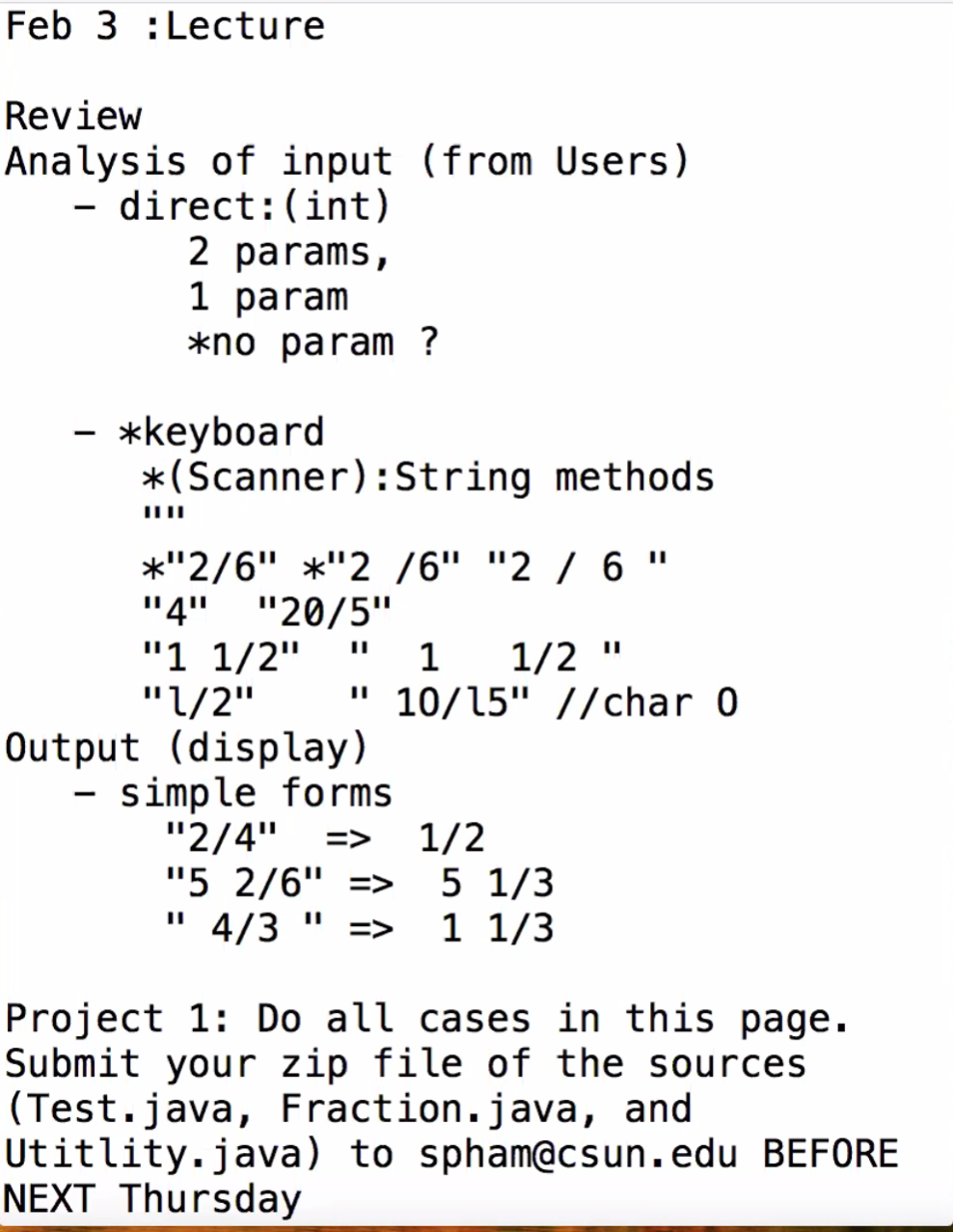
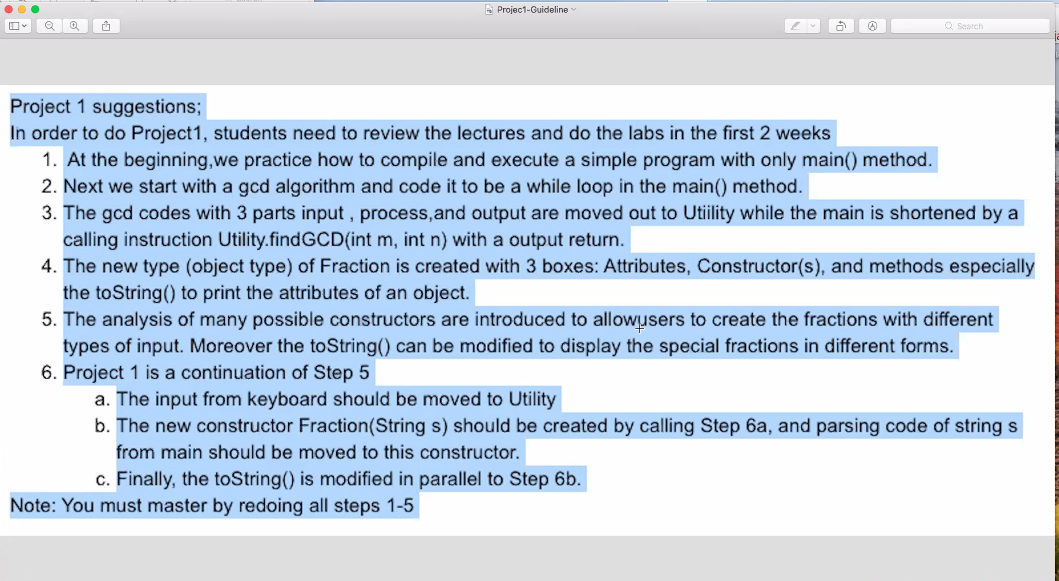
Feb 3 : Lecture Review Analysis of input (from Users) direct: (int) 2 params, 1 param *no param? *keyboard *(Scanner): String methods *"2/6" *"2 /6" "2 / 6" "4" "20/5" "1 1/2" " 1 1/2" "1/2" " 10/15" 7/char o Output (display) simple forms "2/4" 1/2 "5 2/6" => 5 1/3 " 4/3 1 1/3 => => Project 1: Do all cases in this page. Submit your zip file of the sources (Test.java, Fraction.java, and Utitlity.java) to spham@csun.edu BEFORE NEXT Thursday Project-Guideline Q Search Project 1 suggestions; In order to do Project1, students need to review the lectures and do the labs in the first 2 weeks 1. At the beginning, we practice how to compile and execute a simple program with only main() method. 2. Next we start with a gcd algorithm and code it to be a while loop in the main() method. 3. The gcd codes with 3 parts input , process, and output are moved out to Utility while the main is shortened by a calling instruction Utility.find GCD(int m, int n) with a output return. 4. The new type (object type) of Fraction is created with 3 boxes: Attributes, Constructor(s), and methods especially the toString() to print the attributes of an object. 5. The analysis of many possible constructors are introduced to allowusers to create the fractions with different types of input. Moreover the toString() can be modified to display the special fractions in different forms. 6. Project 1 is a continuation of Step 5 a. The input from keyboard should be moved to Utility b. The new constructor Fraction(String s) should be created by calling Step 6a, and parsing code of strings from main should be moved to this constructor. c. Finally, the toString() is modified in parallel to Step 6b. Note: You must master by redoing all steps 1-5 Feb 3 : Lecture Review Analysis of input (from Users) direct: (int) 2 params, 1 param *no param? *keyboard *(Scanner): String methods *"2/6" *"2 /6" "2 / 6" "4" "20/5" "1 1/2" " 1 1/2" "1/2" " 10/15" 7/char o Output (display) simple forms "2/4" 1/2 "5 2/6" => 5 1/3 " 4/3 1 1/3 => => Project 1: Do all cases in this page. Submit your zip file of the sources (Test.java, Fraction.java, and Utitlity.java) to spham@csun.edu BEFORE NEXT Thursday Project-Guideline Q Search Project 1 suggestions; In order to do Project1, students need to review the lectures and do the labs in the first 2 weeks 1. At the beginning, we practice how to compile and execute a simple program with only main() method. 2. Next we start with a gcd algorithm and code it to be a while loop in the main() method. 3. The gcd codes with 3 parts input , process, and output are moved out to Utility while the main is shortened by a calling instruction Utility.find GCD(int m, int n) with a output return. 4. The new type (object type) of Fraction is created with 3 boxes: Attributes, Constructor(s), and methods especially the toString() to print the attributes of an object. 5. The analysis of many possible constructors are introduced to allowusers to create the fractions with different types of input. Moreover the toString() can be modified to display the special fractions in different forms. 6. Project 1 is a continuation of Step 5 a. The input from keyboard should be moved to Utility b. The new constructor Fraction(String s) should be created by calling Step 6a, and parsing code of strings from main should be moved to this constructor. c. Finally, the toString() is modified in parallel to Step 6b. Note: You must master by redoing all steps 1-5
Step by Step Solution
There are 3 Steps involved in it

Get step-by-step solutions from verified subject matter experts
 Study Help