







Question: Feel free to write any WORK on a separate collection of paper. Make sure your name is visible on your paper(s) and that your work
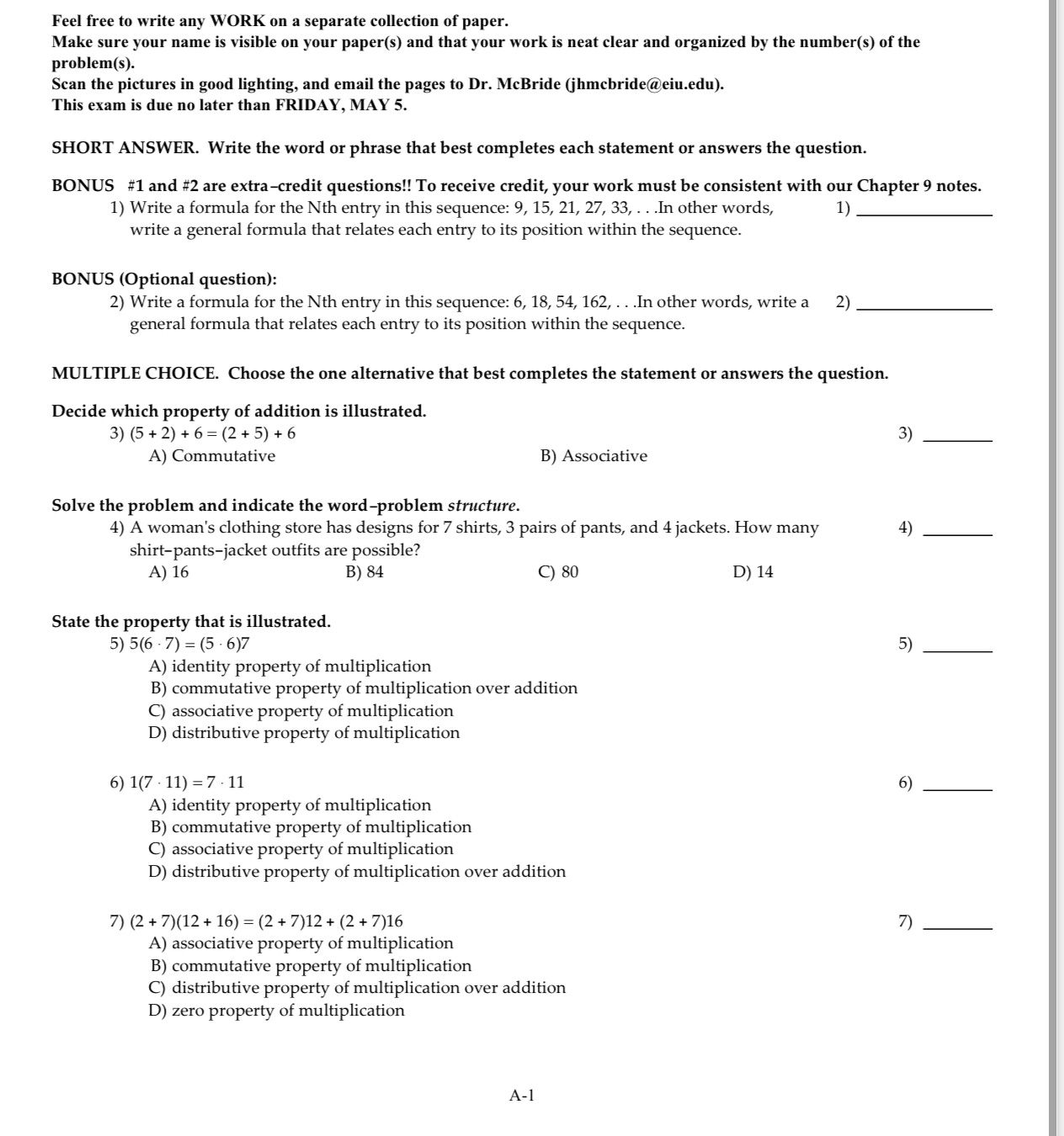
Feel free to write any WORK on a separate collection of paper. Make sure your name is visible on your paper(s) and that your work is neat clear and organized by the number(s) of the prohlem(s). Scan the pictures in good lighting, and email the pages to Dr. McBride (jhmcbride@eiu.edu). This exam is due no later than FRIDAY, MAY 5. SHORT ANSWER. Write the word or phrase that best completes each statement or answers the question. BONUS #1 and #2 are extra credit questions!! To receive credit, your work must be consistent with our Chapter 9 notes. 1) Write a formula for the Nth entry in this sequence: 9, 15, 2], 27, 33, . . .111 other words, 1) write a general formula that relates each entry to its position within the sequence. BONUS (Optional question): 2) Write a formula for the Nth entry in this sequence: 6, 18, 54, 162, . . .In other words, write a 2) general formula that relates each entry to its position within the sequence. MULTIPLE CHOICE. Choose the one alternative that best completes the statement or answers the question. Decide which property of addition is illustrated. 3)(5+2)+6:(2+5)+6 3) A) Commutative B) Associative Solve the problem and indicate the word-problem structure. 4) A woman's clothing store has designs for 7 shirts, 3 pairs of pants, and 4 jackets. How many 4) shirtpants-jacket outfits are possible? A) 16 B) 84 C) 80 D) 14 State the property that is illustrated. 5) 5(6 , 7) = (5 , m7 5) A) identity property of multiplication B) commutative property of multiplication over addition C) associative property of multiplication D) distributive property of multiplication 6) 1(7711)=7711 6) A) identity property of multiplication B) commutative property of multiplication C) associative property of multiplication D) distributive property of multiplication over addition 7) (2 + 7)(]2 + 16) = (2 + 7)12 + (2 + 7)16 7) A) associative property of multiplication B) commutative property of multiplication C) distributive property of multiplication over addition D) zero property of multiplication
Step by Step Solution
There are 3 Steps involved in it

Get step-by-step solutions from verified subject matter experts
 Study Help