



Question: 178 PART A Understanding were also affected later in 2015, increasing the total number affected to !1 million diesel cars across a number of the
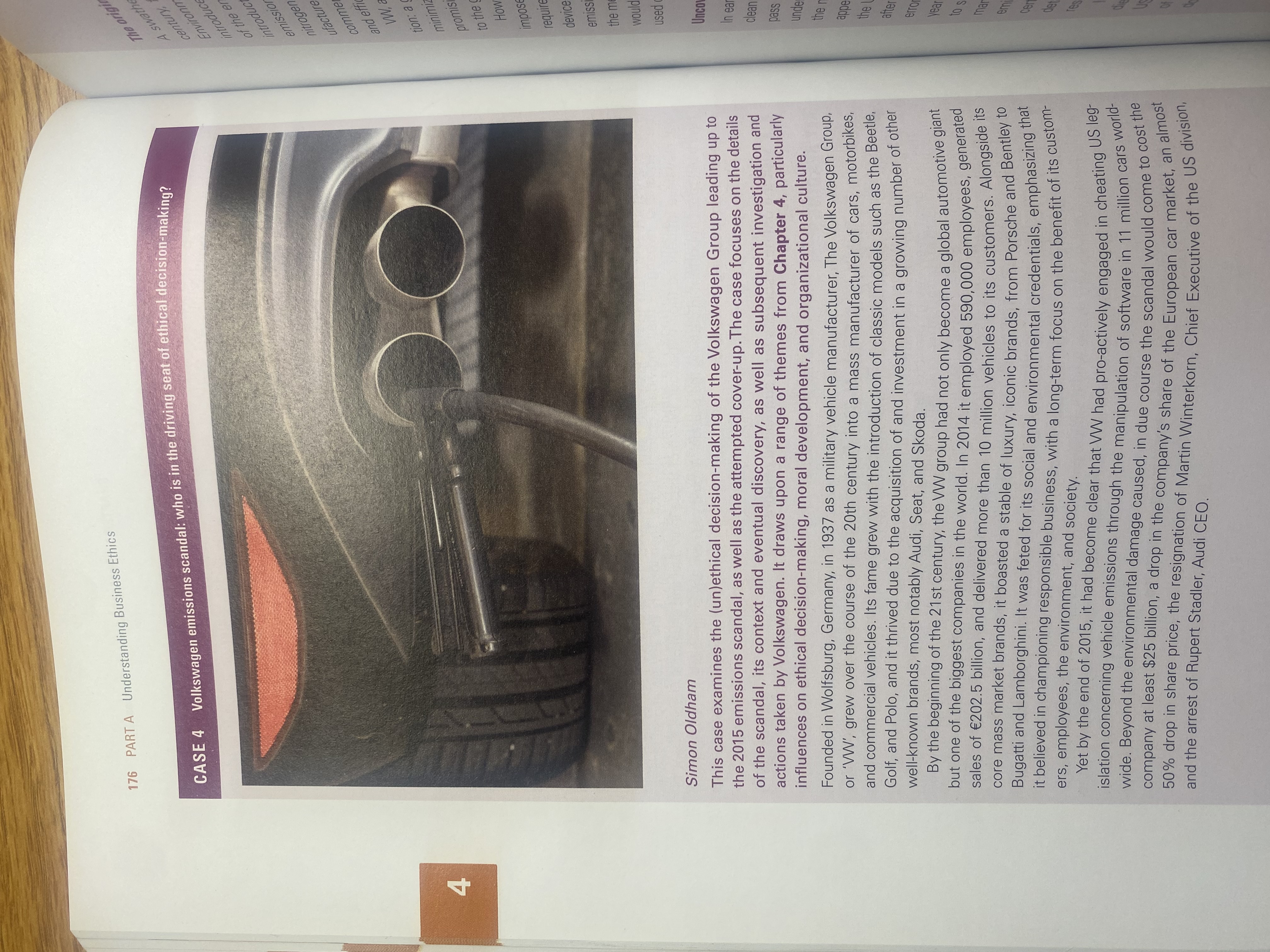
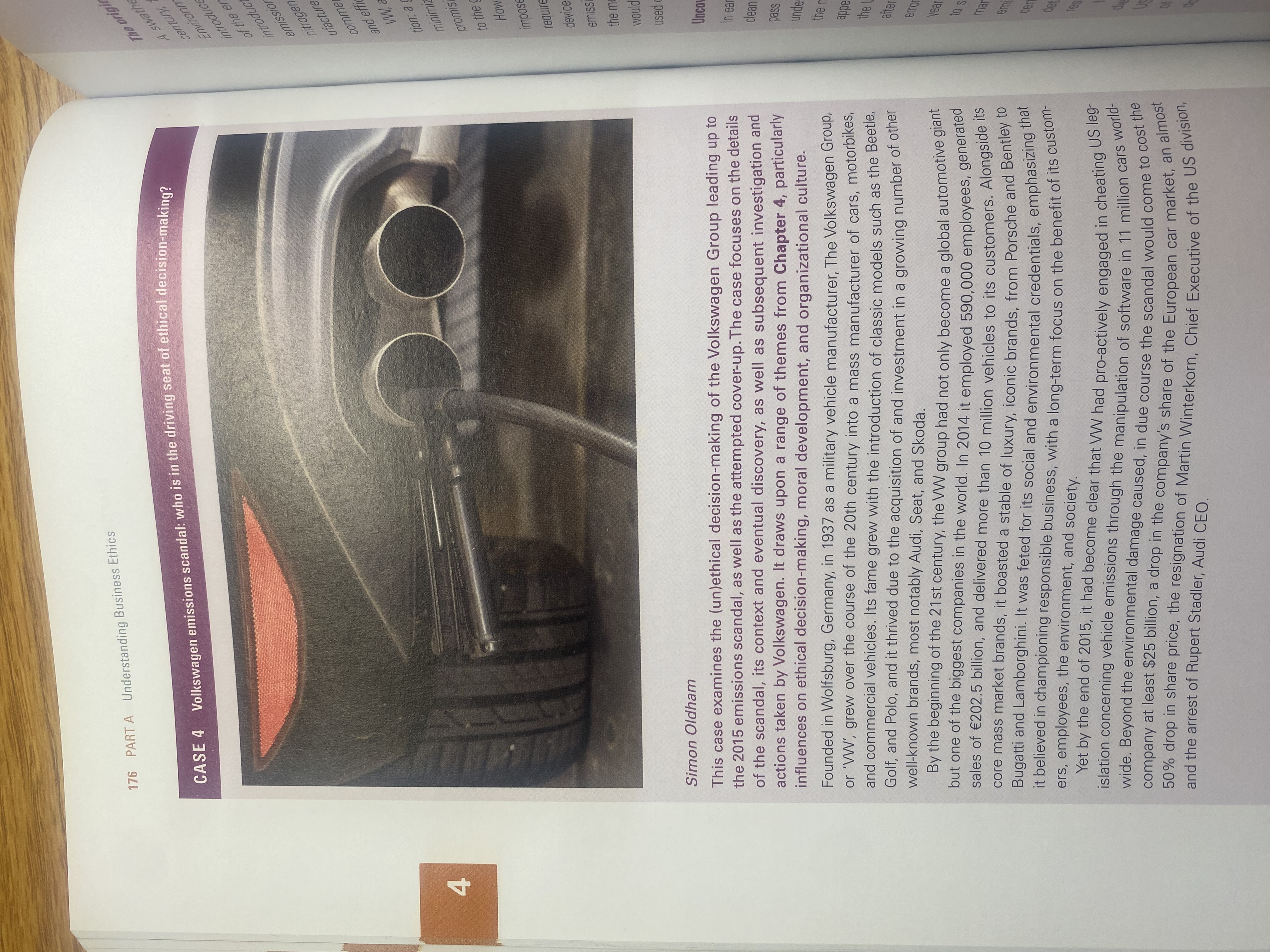
178 PART A Understanding were also affected later in 2015, increasing the total number affected to !1 million diesel cars across a number of the firm's brands: VW, Audi, Seat, and Skoda, as well as 800,000 petrol cars being affected. Eventually, after investigation by US regulators, it became apparent that the fault did not ile with a small number of rogue software engineers but was in fact a far larger conspiracy involving senior figures within the company and extensive attempts to cover up the wrongdoing. The roll call of unethical decision-makers As part of a plea bargain with the US Government, an agreed statement of facts between the US Department of Justice and VW in 2017, and investigations by German authorities, it became clear that the conspiracy had most likely started as early as 2006, when company executives met in Wolfsburg to discuss the intentional inclusion of software that would defeat emissions testing in its vehicles. Accordingly, on top of managers sanctioning the use of these defeat devices in millions of cars that were delivered to customers over a six-year period, from 2009 to 2015, engineers at the company when were encouraged to hide their usage, despite objections. 4 The scandal appears to have become even murkier when a cover-up operation began in response to US investigators commencing their 2014 investigation. Specifically, VW set up a taskforce to handle official enquiries, designed to give the appearance of co-operation while in fact obfuscating the existence of the defeat device from regulatory bodies. The cover-up, between 2014 and 2015, involved VW executives and engineers feeding regulators false and misleading data, the company he ran points issuing a bogus recall of cars which allowed them to inform the regulators that the issue had been urgedin the O rectified as a result of software updates, and thousands of incriminating documents being destroyed just a month before the scandal was made public. a sing Rest's After the scandal broke, German police searched the houses and offices of dozens of VW execu- the model in its tives and, in mid-2018, another senior figure within the company, Audi CEO Rupert Stadler, was arrested in Germany due to fears that he might prevent, obstruct, or hinder the investigation. Mean- atrelated while, in the US, authorities indicted six former VW executives, and Oliver Schmidt, VW's former but the fraud US environmental and engineering manager, was prosecuted in 2017 for being a key conspirator, atrk that W accused by the US government of misleading investigators and deliberately destroying documents, Robert activity and sentenced to seven years in prison on top of a $400,000 fine. The conspiracy took a more serious turn in 2018, when an indictment by US authorities against TakWW seek Michael Winterkorn, former VW CEO, was released, claiming that he not only had full awareness of re fim has so what engineers were doing but also authorized a continued cover-up. The indictment asserted that engineers at the company had become aware of a study by the International Council on Clean Transport in 2014, which had concluded that VW diesels were producing higher emissions on the road than they were in laboratory tests, and that senior managers were informed, including a memo written concern- ing the tests which was sent to Dr Winterkorn. Additionally, in July 2015 it is alleged that Dr Winterkorn was given a presentation about the situation, which supposedly included details of the cover-up and the consequences of the regulators finding out, a month before any admissions were made to authorities. Moreover, in 2017, Robert Bosch, auto components maker, although not conceding any wrongdo- ing, agreed to pay $327.5 million in compensation for its role in supplying the cheating software, suggesting awareness of the conspiracy was not just confined to individuals within VW. VW turns over a new leaf Despite the eruption of the emissions scandal in late 2015, the ensuing public outrage at the dishon- esty and disingenuous actions of VW, the enormous financial cost to the company, and the detriment tal environmental consequences of its actions, after an initial dip, VW's latest financial results sug gest that the company has managed to shrug off any wrongdoing. In fact, if an individual had invested in VW a day before the emissions scandal broke in 2015, as of the beginning of 2018 the stock would be up 10%, having outperformed both BMW and Daimler. Sales at VW exceed those prior to the scandal breaking in 2015, costs have declined, employee numbers have gone up, and plans to release a large range of all electric cars by 2025 have impressed investors and the public alike.CHAPTER 4 Making Decisions in Business Ethics 177 The origins of 'Emissionsgate' A swathe of environmental legislation was formulated and implemented at the turn of the 21st century, for example the Environmental Protection Act was passed in Denmark in 1992, while the Environment Act was passed in the UK in 1995, and the Canadian Environmental Protection Act was introduced in 1999. This new legislation included, in many cases, heightened scrutiny and control of the environmental impact of automobiles. This was perhaps most apparent in the US, where the introduction of the 1990 Clean Air Act Amendments precipitated a tightening of light-duty vehicle emissions standards designed to reduce environmentally damaging emissions, such as carbon and nitrogen. When introduced in the noughties, this legislative shift led to pressure on automotive man- ufacturers for a new generation of vehicles which adhered to new emissions standards. However, commercial pressures necessitated that such alterations would not compromise on performance and efficiency, which would heighten the running costs and potentially impact sales. VW, at a presentation to US regulators in September 2008, promoted their response to the legisla- tion: a generation of re-designed diesel automobiles, which met the country's pollution laws, thus minimizing the smog, soot, and harmful emissions long attributed to diesel engines, while not com- promising on performance. Regulators satisfied, this new generation of diesel cars were put on sale to the general public by VW, who were hoping to finally crack the US car market. However, unbeknownst to US regulators, this new generation of vehicles did not meet the newly imposed emissions legislation as it had proved too difficult to design vehicles which would allow the required balance between emissions and performance. Instead, VW engineers had designed 'defeat devices', which ensured that, when fitted to VW's cars, the vehicles passed the regulatory, lab-based emissions tests. These defeat devices could detect when such a test was being performed through the measurement of factors such as steering patterns, atmospheric pressures, and engine use, and would accordingly alter emissions controls to switch on fume cleaning technology. However, when used on public roads, some models would pump out nitrogen at up to 40 times the legal limit. Uncovering the problem In early 2014, transport campaigners Peter Mock and John German set out to prove to Europe that clean diesel cars could exist; the US had appeared to achieve a fantastic result: diesel cars that could pass its strict emissions tests without compromising performance. A 1,300-mile test journey was undertaken from San Diego to Seattle using a number of car models to prove their point. Despite all the models having passed lab-based emissions tests, the VWs tested gave some unusual results, appearing to emit dangerous levels of toxins, some at 35 times the legal limit. As a result of this, the US Environmental Protection Agency (EPA) launched an investigation in May 2014. Volkswagen, after repeating the tests themselves, asserted that the results were caused by a minor software error, which was easily fixable through the issue of a product recall. This denial continued for over a year after the EPA had first launched its investigation until August 2015 when VW finally came clean to senior officials, the EPA, and the California Air Resources Board, admitting that the automotive manufacturer had deliberately misled US regulators through the alteration of vehicle software to cheat emissions tests. VW's confession was allegedly only precipitated by both bodies threatening not to certify the company's 2016 diesel models. Over the following month, the company revealed further details regarding exactly how the software worked to the US regulators and the regulator devised its response to news before, finally, in late September, news of VW's wrongdoings broke to the public. Initially, when news of the unethical decision-making relating to emissions fixing of 600,000 VW diesel cars in the United States broke, public dismay was evident. However, Michael Horn, head of US operations, assured a congressional committee that the wrongdoing was the result of 'a couple of software engineers' and Dr Winterkorn, VW CEO, publicly stated that he was aware of no wrong- doing on his part. However, the case spiralled, with VW being forced to admit that cars in Europe
Step by Step Solution
There are 3 Steps involved in it

Get step-by-step solutions from verified subject matter experts