







Question: ffTrue or False: 11. The derivative of a sinusoidal function is another sinusoidal function. ___12. The rate of change of a sinusoidal function is periodic
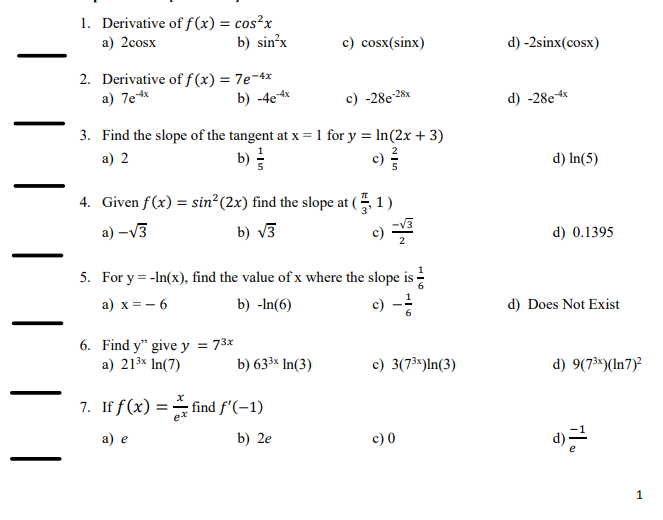
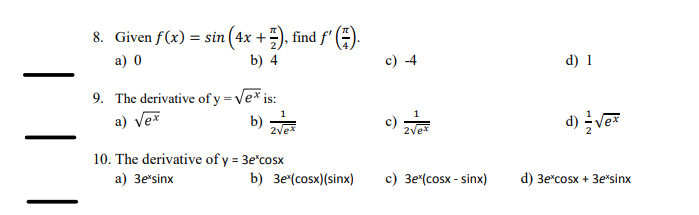
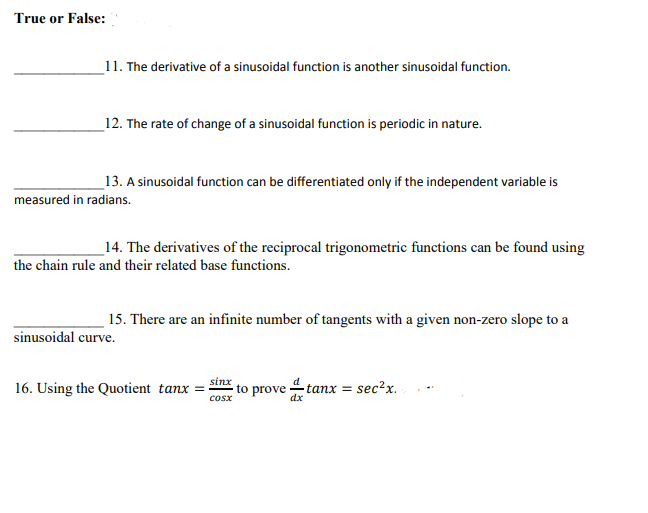
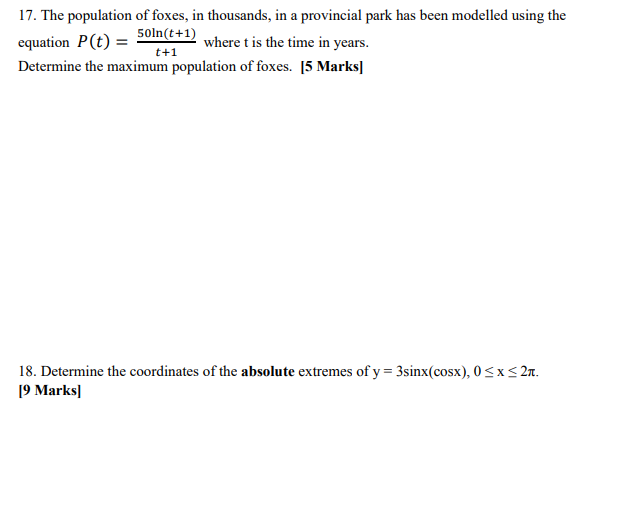
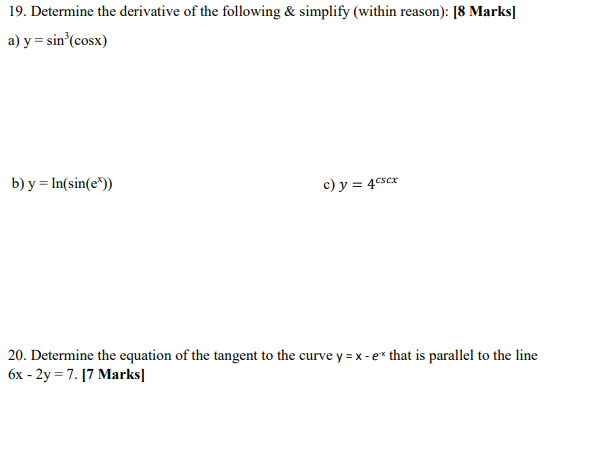
\f\fTrue or False: 11. The derivative of a sinusoidal function is another sinusoidal function. ___12. The rate of change of a sinusoidal function is periodic in nature. 13, Asinusoidal function can be differentiated only if the independent variable is measured in radians. _14. The derivatives of the reciprocal trigonometric functions can be found using the chain rule and their related base functions. s e 15. There are an infinite number of tangents with a given non-zero slope to a sinusoidal curve. 16. Using the Quotient tanx = oY prove 2 tanx = sec?x. = COsx dx 17. The population of foxes, in thousands, in a provincial park has been modelled using the 50In(t+1) t+1 Determine the maximum population of foxes. |5 Marks| equation P(t) = where t is the time in years. 18. Determine the coordinates of the absolute extremes of v = 3sinx(cosx), 0
Step by Step Solution
There are 3 Steps involved in it

Get step-by-step solutions from verified subject matter experts
 Study Help