







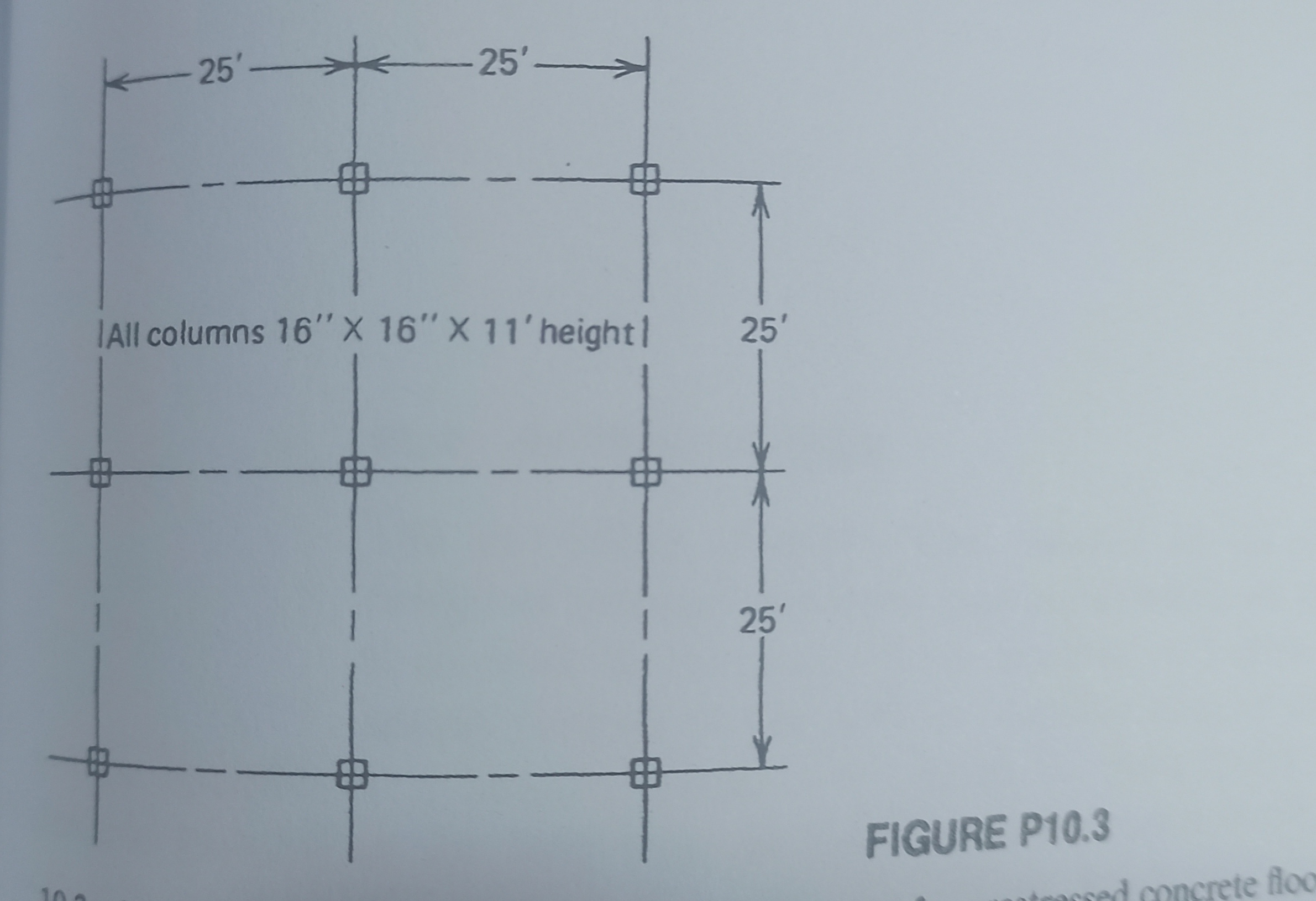
Question: Fig P 1 0 . 3 shows a typical interior region of a prestressed concrete floor that a to be designed as a flat plate,
Fig P shows a typical interior region of a prestressed concrete floor that a to be designed as a flat plate, using unbonded posttensioned tendons. There will be column capitals or dropped panels. Service live load is psf dead load consists of selfweight plus psf superimposed. a Find the required slab thickness, tendon profile, required prestress force per ft and spacing of tendons in the colume sad middle strips. A twoway banded tendon arrangement is specified Prestress should be based on a balanced load consisting of self weight plus superimposed dead load b Find the concrete stresses at all critical sections resulting from applicanom of dead plus service live load. c Determine the size, spacing, and length of all required nonprestressed bonded flexural steel d Check the flexural strength of the slab, and modify the design, if necessary Note that, according to ACI Code, if the
line load does not exceed threefourths of the dead load, m moments may be anned to occur at all with des entire slab system. e Check for shear transfer at a typical panel reinforcement a required, use degree bent bus se Ref. deffection at the center of a typical panel when the full service live load is in place?
Tendons will be in diameter Grade unbonded strands and fc psi and f'ci psi Assume percent time dependent loss.FIGURE P
Step by Step Solution
There are 3 Steps involved in it
1 Expert Approved Answer
Step: 1 Unlock

Question Has Been Solved by an Expert!
Get step-by-step solutions from verified subject matter experts
Step: 2 Unlock
Step: 3 Unlock
 Study Help