







Question: Figure 1 - 6 a: Additional resource constraints ( steel 4 . mod ) . set PROD : = bands coils plate; set STAGE :
Figure a: Additional resource constraints steelmodset PROD : bands coils plate;
set STAGE : reheat roll;
param rate: reheat roll :
bands
coils
plate ;
param: profit commit market :
bands
coils
plate ;
param avail : reheat roll ;
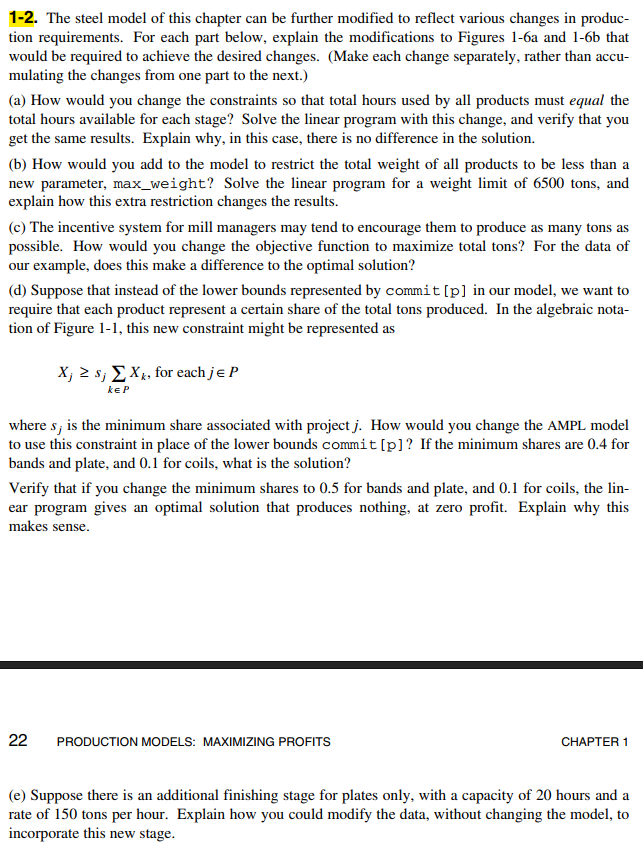
Figure b: Data for additional resource constraints steel dat The steel model of this chapter can be further modified to reflect various changes in produc
tion requirements. For each part below, explain the modifications to Figures a and b that
would be required to achieve the desired changes. Make each change separately, rather than accu
mulating the changes from one part to the next.
a How would you change the constraints so that total hours used by all products must equal the
total hours available for each stage? Solve the linear program with this change, and verify that you
get the same results. Explain why, in this case, there is no difference in the solution.
b How would you add to the model to restrict the total weight of all products to be less than a
new parameter, maxweight? Solve the linear program for a weight limit of tons, and
explain how this extra restriction changes the results.
c The incentive system for mill managers may tend to encourage them to produce as many tons as
possible. How would you change the objective function to maximize total tons? For the data of
our example, does this make a difference to the optimal solution?
d Suppose that instead of the lower bounds represented by commit p in our model, we want to
require that each product represent a certain share of the total tons produced. In the algebraic nota
tion of Figure this new constraint might be represented as
for each jinP
where is the minimum share associated with project How would you change the AMPL model
to use this constraint in place of the lower bounds commit p If the minimum shares are for
bands and plate, and for coils, what is the solution?
Verify that if you change the minimum shares to for bands and plate, and for coils, the lin
ear program gives an optimal solution that produces nothing, at zero profit. Explain why this
makes sense.
e Suppose there is an additional finishing stage for plates only, with a capacity of hours and a
rate of tons per hour. Explain how you could modify the data, without changing the model, to
incorporate this new stage.
Step by Step Solution
There are 3 Steps involved in it
1 Expert Approved Answer
Step: 1 Unlock

Question Has Been Solved by an Expert!
Get step-by-step solutions from verified subject matter experts
Step: 2 Unlock
Step: 3 Unlock
 Study Help