







Question: Figure 1 C(A),p(A) Find the least congested paths from C to all other network nodes assuming link state routing, i.e., choosing the path with the
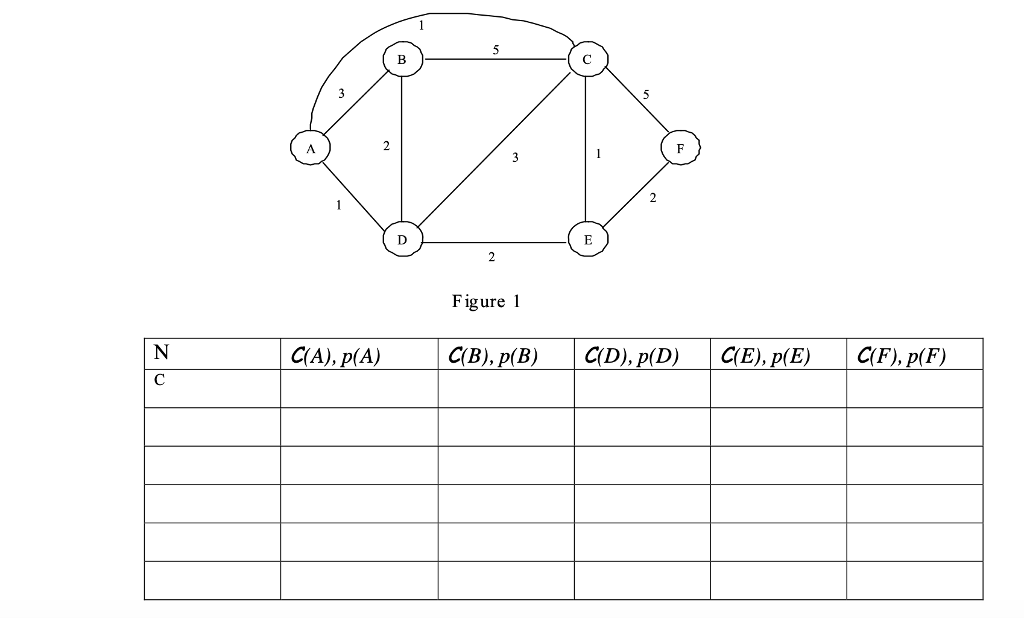
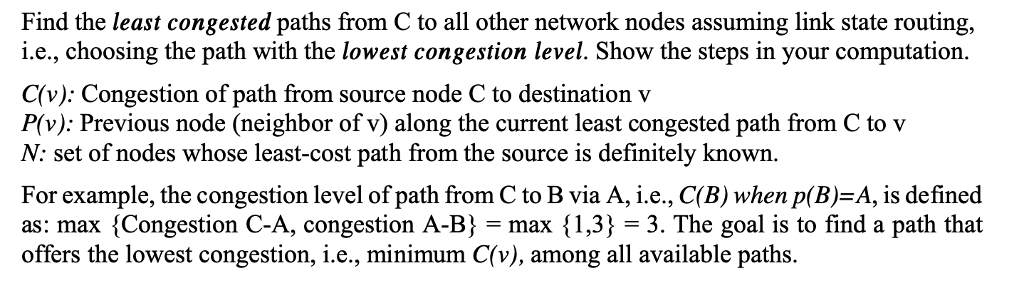
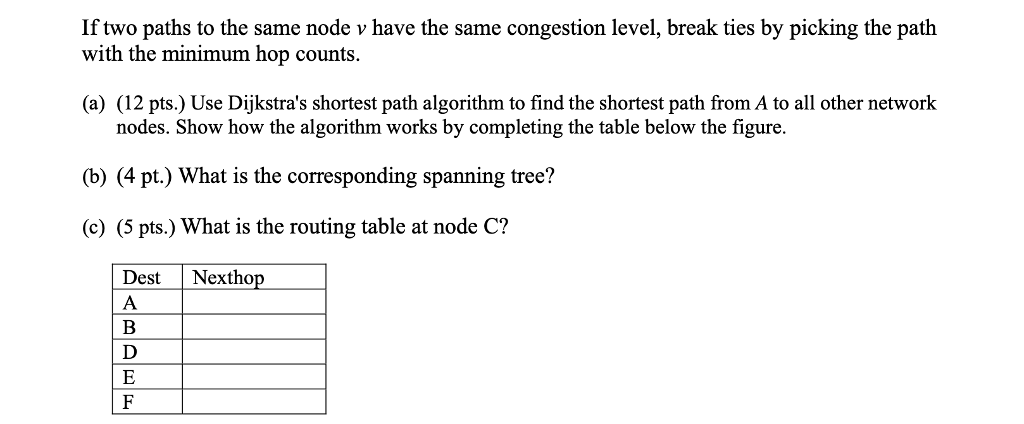
Figure 1 C(A),p(A) Find the least congested paths from C to all other network nodes assuming link state routing, i.e., choosing the path with the lowest congestion level. Show the steps in your computation. C(v): Congestion of path from source node C to destination v P(v): Previous node (neighbor of v) along the current least congested path from C to v N: set of nodes whose least-cost path from the source is definitely known. For example, the congestion level of path from C to B via A, i.e., C(B) when p(B)=A, is defined as: max {Congestion C-A, congestion A-B) - max {1,33 - 3. The goal is to find a path that offers the lowest congestion, i.e., minimum C(v), among all available paths. Figure 1 C(A),p(A) Find the least congested paths from C to all other network nodes assuming link state routing, i.e., choosing the path with the lowest congestion level. Show the steps in your computation. C(v): Congestion of path from source node C to destination v P(v): Previous node (neighbor of v) along the current least congested path from C to v N: set of nodes whose least-cost path from the source is definitely known. For example, the congestion level of path from C to B via A, i.e., C(B) when p(B)=A, is defined as: max {Congestion C-A, congestion A-B) - max {1,33 - 3. The goal is to find a path that offers the lowest congestion, i.e., minimum C(v), among all available paths
Step by Step Solution
There are 3 Steps involved in it

Get step-by-step solutions from verified subject matter experts
 Study Help