







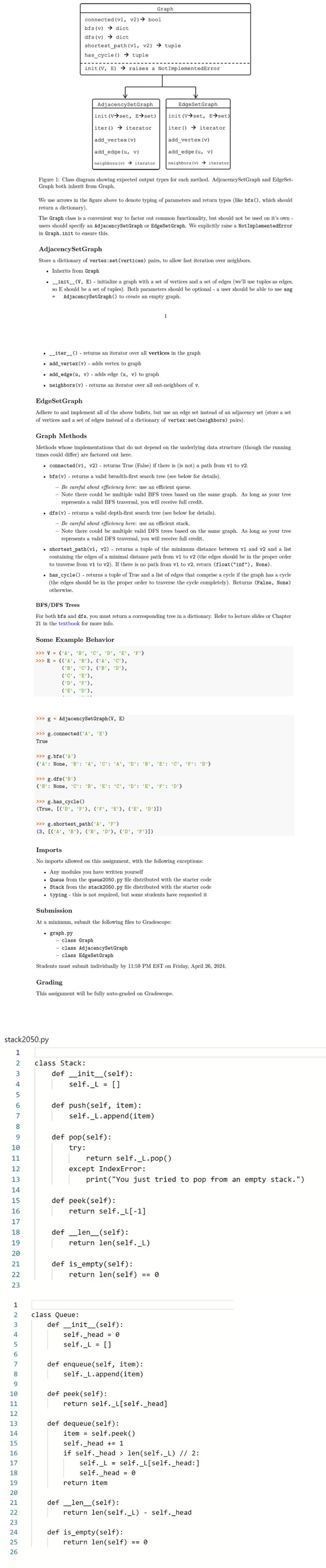
Question: Figure 1 : Class diagram showing expected output types for each method. AdjcacencySetGraph and EdgeSetGraph both inherit from Graph. We use arrows in the figure
Figure : Class diagram showing expected output types for each method. AdjcacencySetGraph and EdgeSetGraph both inherit from Graph. We use arrows in the figure above to denote typing of parameters and return types like bfs which should return a dictionary The Graph class is a convenient way to factor out common functionality, but should not be used on its ownusers should specify an AdjacencySetGraph or EdgeSetGraph. We explicitly raise a NotImplementedError in Graph.init to ensure this. AdjacencySetGraph Store a dictionary of vertex:setvertices pairs, to allow fast iteration over neighbors. Inherits from Graph initV E initialize a graph with a set of vertices and a set of edges well use tuples as edges, so E should be a set of tuples Both parameters should be optional a user should be able to use asg AdjacencySetGraph to create an empty graph. iter returns an iterator over all vertices in the graph addvertexv adds vertex to graph addedgeu v adds edge u v to graph neighborsv returns an iterator over all outneighbors of v EdgeSetGraph Adhere to and implement all of the above bullets, but use an edge set instead of an adjacency set store a set of vertices and a set of edges instead of a dictionary of vertex:setneighbors pairs Graph Methods Methods whose implementations that do not depend on the underlying data structure though the running times could differ are factored out here. connectedv v returns True False if there is is not a path from v to v bfsv returns a valid breadthfirst search tree see below for details Be careful about efficiency here: use an efficient queue. Note there could be multiple valid BFS trees based on the same graph. As long as your tree represents a valid BFS traversal, you will receive full credit. dfsv returns a valid depthfirst search tree see below for details Be careful about efficiency here: use an efficient stack. Note there could be multiple valid DFS trees based on the same graph. As long as your tree represents a valid DFS traversal, you will receive full credit. shortestpathv v returns a tuple of the minimum distance between v and v and a list containing the edges of a minimal distance path from v to vthe edges should be in the proper order to traverse from v to v If there is no path from v to v return floatinf None hascycle returns a tuple of True and a list of edges that comprise a cycle if the graph has a cycle the edges should be in the proper order to traverse the cycle completely Returns False None otherwise. BFSDFS Trees For both bfs and dfs you must return a corresponding tree in a dictionary. Refer to lecture slides or Chapter in the textbook for more info. Some Example Behavior V ABCDEF E ABACBCBDCEDFEDFE g AdjacencySetGraphV E gconnectedAE True gbfsAA: None, B: AC: AD: BE: CF: D gdfsBB: None, C: BE: CD: EF: D ghascycleTrueDFFEED gshortestpathAFABBDDF Imports No imports allowed on this assignment, with the following exceptions: Any modules you have written yourself Queue from the queuepy file distributed with the starter code Stack from the stackpy file distributed with the starter code typing this is not required, but some students have requested it Submission At a minimum, submit the following files to Gradescope: graph.py class Graph class AdjacencySetGraph class EdgeSetGraph Students must submit individually by : PM EST on Friday, April Grading This assignment will be fully autograded on Gradescope. Module Homework Graphs
Overview Implement data structure dependent methods for a directed, nonweighted graph in AdjacencySetGraph and EdgesetGraph classes. Then implement a parent class Graph with methods that are independent of the underlying data structures:
Figure : Class diagram showing expected output types for each method. AdjcacencySetGraph and EdgeSet Graph both inherit from Graph.
return a dictionary The Graph class is a convenient way to factor out common functionality, but should not be used on it's own users should specify an AdjacencySetGraph or EdgeSetGraph. We explicitly raise a NotImplementedError in Graph. nnt to ensure this.
in Graphnt to ensure this
AdjacencySetGraph Store a dictionary of vertex: setvertices pairs, to allow fast iteration ov
Step by Step Solution
There are 3 Steps involved in it
1 Expert Approved Answer
Step: 1 Unlock

Question Has Been Solved by an Expert!
Get step-by-step solutions from verified subject matter experts
Step: 2 Unlock
Step: 3 Unlock
 Study Help