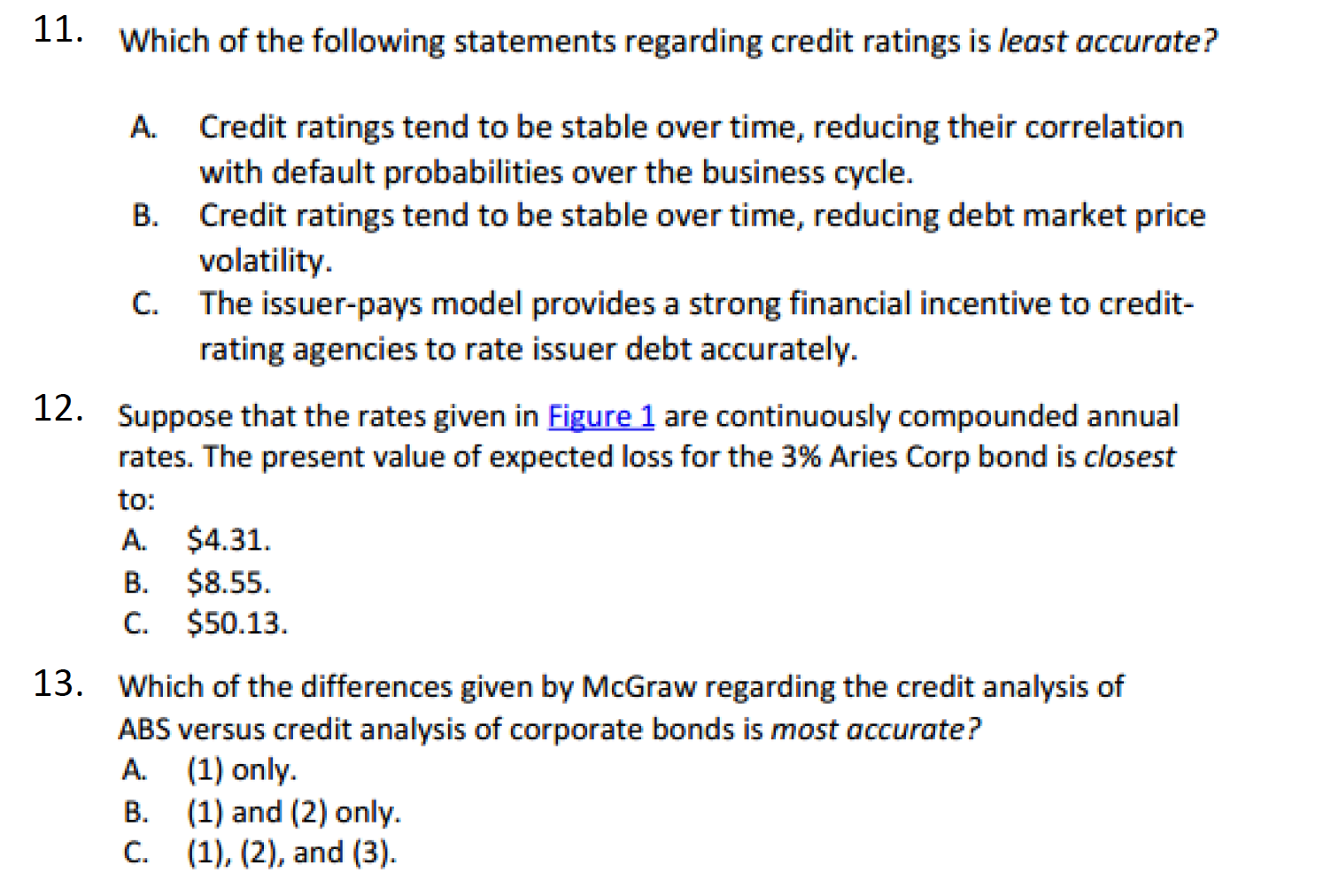
Question: Figure 1: Exhibit 1: Data on 3% 5-year Ari. Corp bonds Payment Date Risk-Free Rate Credit Spread 30-Sep 2011 0.15% 0.1396 31-Mar 20KB 0.22% 0.1796
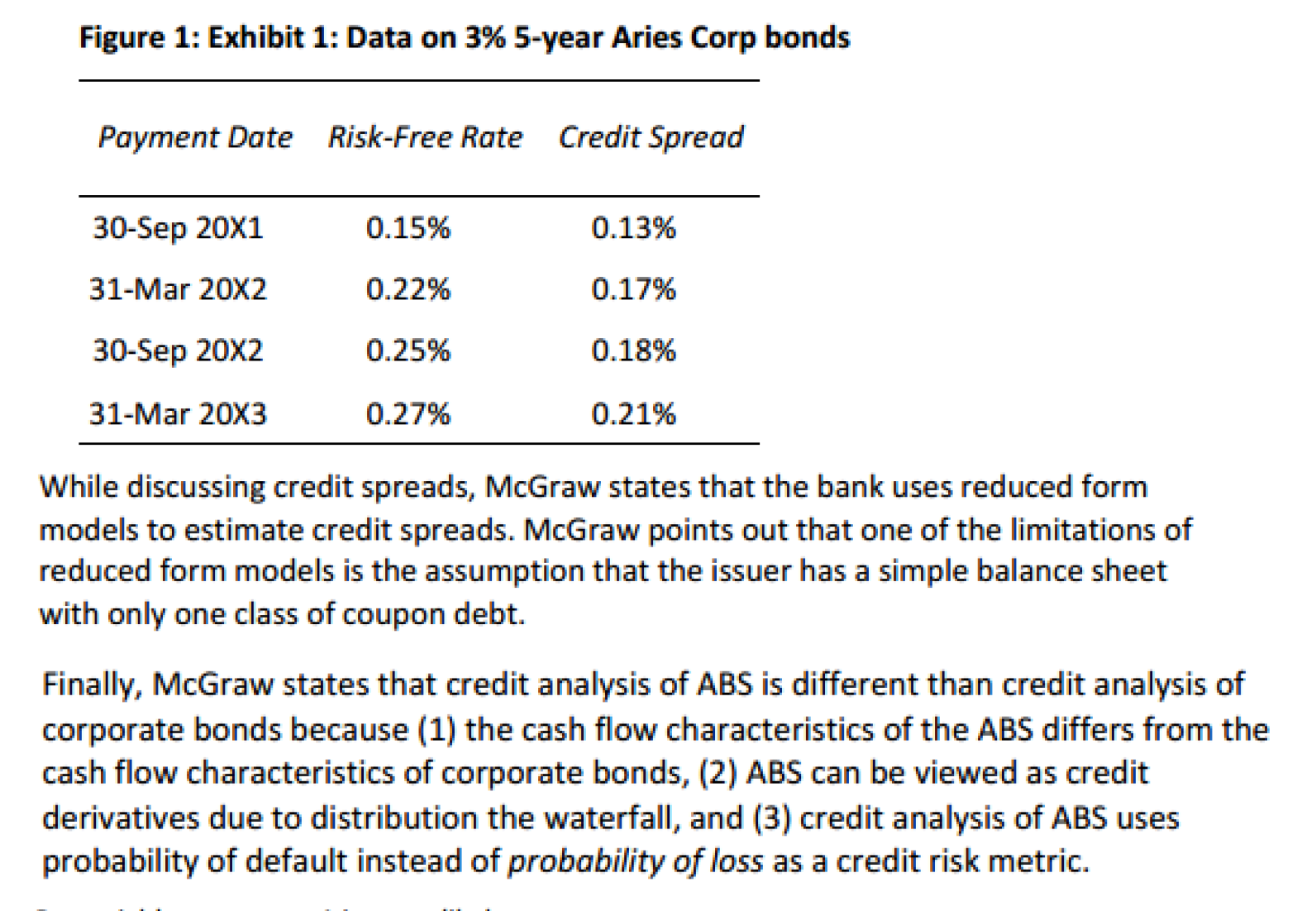
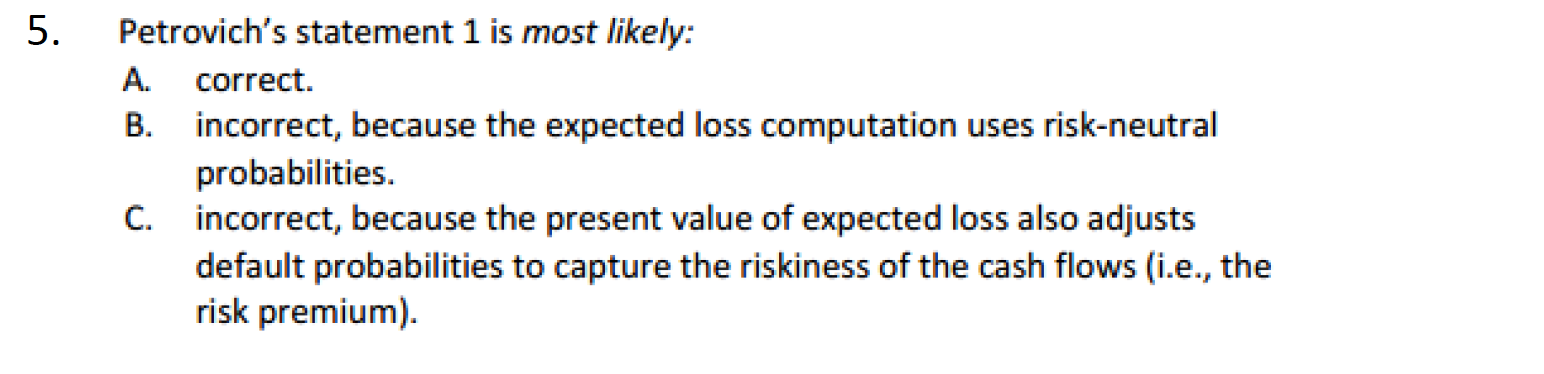
Figure 1: Exhibit 1: Data on 3% 5-year Ari. CorpFigure 1: Exhibit 1: Data on 3% 5-year Ari. CorpFigure 1: Exhibit 1: Data on 3% 5-year Ari. CorpFigure 1: Exhibit 1: Data on 3% 5-year Ari. Corp
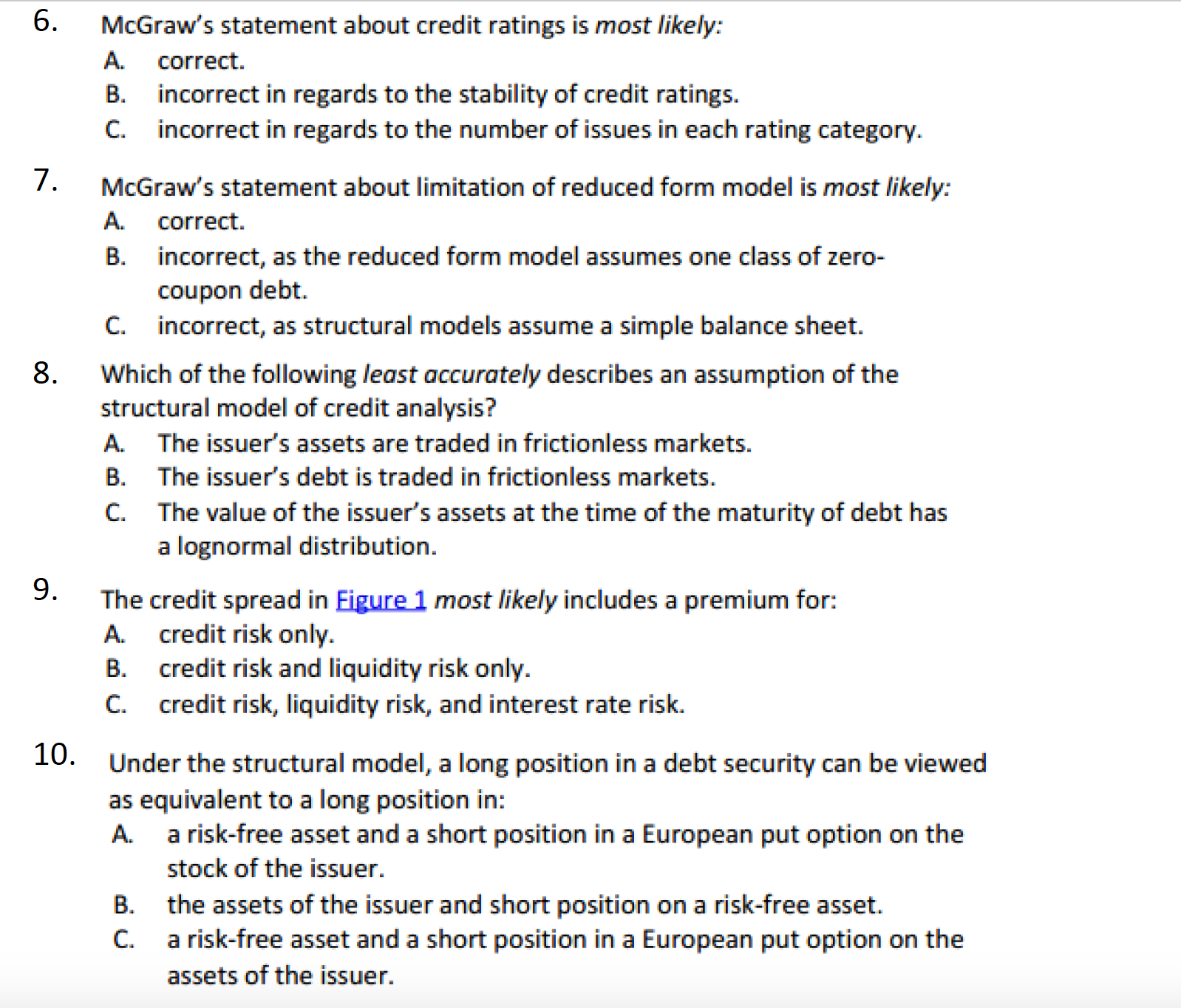
Figure 1: Exhibit 1: Data on 3% 5-year Ari. Corp bonds Payment Date Risk-Free Rate Credit Spread 30-Sep 2011 0.15% 0.1396 31-Mar 20KB 0.22% 0.1796 30-Sep ZONE 0.25% 0.1896 31-Mar 2038 0.27% 0.2196 While discussing credit spreads. McGraw states that the bank uses reduced form models to estimate credit spreads. McGraw points out that one of the limitations of reduced form models is the assumption that the issuer has a simple balance sheet with only one class of coupon debt. Finally, McGraw states that credit analysis of ABS is different than credit analysis of corporate bonds because (1] the cash ow characteristics of the ABS differs from the cash ow characteristics of corporate bonds, [2] ABS can be viewed as credit derivatives due to distribution the waterfall, and {3} credit analysis of ABS uses proba bility of default instead of probability of ioss as a credit risk metric. 5. Petrovich's statement 1 is most likely: A. correct. B. incorrect, because the expected loss computation uses risk-neutral probabilities. C. incorrect, because the present value of expected loss also adjusts default probabilities to capture the riskiness of the cash flows (i.e., the risk premium).6- McGraw's statement about credit ratings is most likely: A. correct. B. incorrect in regards to the stability of credit ratings. C. incorrect in regards to the number of issues in each rating category. 7- McGraw's statement about limitation of reduced form model is most likely: A. correct. B. incorrect. as the reduced form model assumes one class of zero- coupon debt. C. incorrect. as structural models assume a simple balance sheet. 8. Which of the following least occumteiy describes an assumption of the structural model of credit analysis? A. The issue r's assets are traded in frictionless markets. B. The issue r's debt is traded in frictionless markets. (I. The value of the issuer's assets at the time of the maturity of debt has a lognormal d istri bution. 9- The credit spread in nal most likely includes a premium for: A. credit risk only. B. credit risk and liquidity risk only. C. credit risk, liquidity risk, and interest rate risk. 10- Under the structural model, a long position in a debt secu rityir can be 1viewed as equivalent to a long position in: A. a risk-free asset and a short position in a European put option on the stock of the issuer. B. the assets of the issuer and short position on a risk-free asset. C. a risk-free asset and a short position in a European put option on the assets of the issue r. 11- Which of the following statements regarding credit ratings is least accurate? A. Credit ratings tend to be stable over time, reducing their correlation witj'l default probabilities over the business cycle. B. Credit ratings tend to be stable over time, reducing debt market price volatility. C. The issuer-pays model provides a strong nancial incentive to credit- rating agencies to rate issuer debt accurately. 12- Suppose that the rates given in Em are continuously compounded annual rates. The present value of expected loss for the 35!: Aries Corp bond is closest to: A. 54.31. B. 33.55. C. $50.13. 13. Which of the differences given by McGraw regarding the credit analysis of ABS versus credit anaiysis of corporate bonds is most accurate? A. {1} only. B. {1) and {2] only. C. {1}, (1], and {3]
Step by Step Solution

There are 3 Steps involved in it

1 Expert Approved Answer
Step: 1 Unlock blur-text-image

Question Has Been Solved by an Expert!

Get step-by-step solutions from verified subject matter experts

Step: 2 Unlock
Step: 3 Unlock

Students Have Also Explored These Related Accounting Questions!