Question: Figure 2 below depicts a typical (steady-state) boundary value problem where a confined aquifer transmits water laterally through soil deposits between two rivers of known

Figure 2 below depicts a typical (steady-state) boundary value problem where a confined aquifer transmits water laterally through soil deposits between two rivers of known stage.

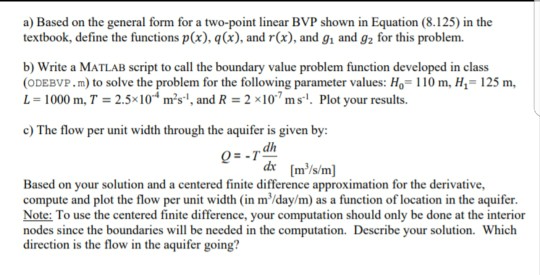
(Please solve all parts and include Matlab code, thank you)
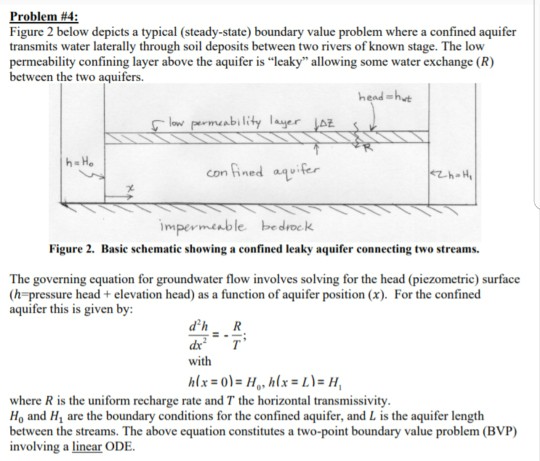
Figure 2 below depicts a typical (steady-state) boundary value problem where a

confined aquifer transmits water laterally through soil deposits between two rivers of

ODEBVP.m funtion provided here:

function z = ODEBVP(p,q,r,a,b,ga,gb,N)

% A program to solve the two point boundary value problem

% y''=p(x)y'+q(x)y+r(x), a

% y(a)=g1, y(b)=g2

% Input

% p, q, r: coefficient functions

% a, b: the end-points of the interval

% ga, gb: the prescribed function values at the end-points

% N: number of sub-intervals

% Output

% z = [ xx yy ]: xx is an (N+1) column vector of the node points

% yy is an (N+1) column vecotr of the solution values

% A sample call would be

% z=ODEBVP('p','q','r',a,b,ga,gb,100)

% The user must provide m-files to define the functions p, q and r.

%

% Other MATLAB program called: tridiag.m

%

% Initialization

N1 = N+1;

h = (b-a)/N;

h2 = h*h;

xx = linspace(a,b,N1)';

yy = zeros(N1,1);

yy(1) = ga;

yy(N1) = gb;

% Define the sub-diagonal avec, main diagonal bvec, superdiagonal cvec

pp(2:N) = feval(p,xx(2:N));

avec(2:N-1) = -1-(h/2)*pp(3:N);

bvec(1:N-1) = 2+h2*feval(q,xx(2:N));

cvec(1:N-2) = -1+(h/2)*pp(2:N-1);

% Define the right hand side vector fvec

fvec(1:N-1) = -h2*feval(r,xx(2:N));

fvec(1) = fvec(1)+(1+h*pp(2)/2)*ga;

fvec(N-1) = fvec(N-1)+(1-h*pp(N)/2)*gb;

% Solve the tridiagonal system

yy(2:N) = tridiag(avec,bvec,cvec,fvec,N-1,0);

z = [xx'; yy']';

Problem #4: Figure 2 below depicts a typical (steady-state) boundary value problem where a confined aquifer transmits water laterally through soil deposits between two rivers of known stage. The low permeability confining layer above the aquifer is "leaky" allowing some water exchange (R) between the two aquifers. head hu low permeabi lity layer LAZ con ined aquifer impermcable be drock Figure 2. Basic schematic showing a confined leaky aquifer connecting two streams. The governing equation for groundwater flow involves solving for the head (piezometric) surface (h pressure head +elevation head) as a function of aquifer position (x). For the confined aquifer this is given by: dh R dx T with where R is the uniform recharge rate and T the horizontal transmissivity Ho and H1 are the boundary conditions for the confined aquifer, and L is the aquifer length between the streams. The above equation constitutes a two-point boundary value problem (BVP) involving a linear ODE Problem #4: Figure 2 below depicts a typical (steady-state) boundary value problem where a confined aquifer transmits water laterally through soil deposits between two rivers of known stage. The low permeability confining layer above the aquifer is "leaky" allowing some water exchange (R) between the two aquifers. head hu low permeabi lity layer LAZ con ined aquifer impermcable be drock Figure 2. Basic schematic showing a confined leaky aquifer connecting two streams. The governing equation for groundwater flow involves solving for the head (piezometric) surface (h pressure head +elevation head) as a function of aquifer position (x). For the confined aquifer this is given by: dh R dx T with where R is the uniform recharge rate and T the horizontal transmissivity Ho and H1 are the boundary conditions for the confined aquifer, and L is the aquifer length between the streams. The above equation constitutes a two-point boundary value problem (BVP) involving a linear ODE

Step by Step Solution

There are 3 Steps involved in it

1 Expert Approved Answer
Step: 1 Unlock blur-text-image
Question Has Been Solved by an Expert!

Get step-by-step solutions from verified subject matter experts

Step: 2 Unlock
Step: 3 Unlock

Students Have Also Explored These Related Databases Questions!