







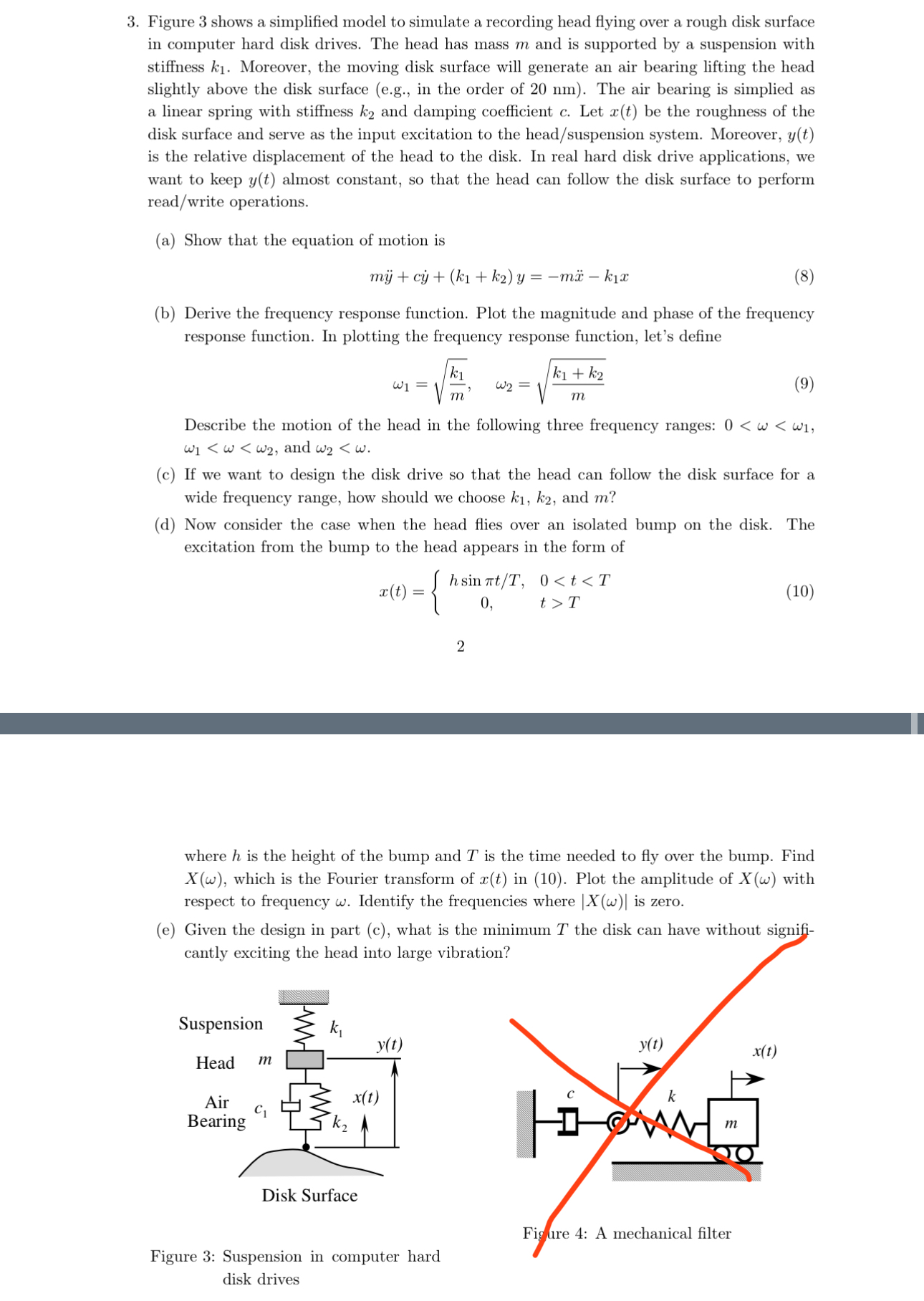
Question: Figure 3 shows a simplified model to simulate a recording head flying over a rough disk surface in computer hard disk drives. The head has
Figure shows a simplified model to simulate a recording head flying over a rough disk surface in computer hard disk drives. The head has mass and is supported by a suspension with stiffness Moreover, the moving disk surface will generate an air bearing lifting the head slightly above the disk surface eg in the order of nm The air bearing is simplied as a linear spring with stiffness and damping coefficient Let be the roughness of the disk surface and serve as the input excitation to the headsuspension system. Moreover, is the relative displacement of the head to the disk. In real hard disk drive applications, we want to keep almost constant, so that the head can follow the disk surface to perform readwrite operations.
a Show that the equation of motion is
b Derive the frequency response function. Plot the magnitude and phase of the frequency response function. In plotting the frequency response function, let's define
Describe the motion of the head in the following three frequency ranges: and
c If we want to design the disk drive so that the head can follow the disk surface for a wide frequency range, how should we choose and
d Now consider the case when the head flies over an isolated bump on the disk. The excitation from the bump to the head appears in the form of
where is the height of the bump and is the time needed to fly over the bump. Find which is the Fourier transform of in Plot the amplitude of with respect to frequency Identify the frequencies where is zero.
e Given the design in part c what is the minimum the disk can have without significantly exciting the head into large vibrati
Figure : Suspension in computer hard disk drives
Step by Step Solution
There are 3 Steps involved in it
1 Expert Approved Answer
Step: 1 Unlock

Question Has Been Solved by an Expert!
Get step-by-step solutions from verified subject matter experts
Step: 2 Unlock
Step: 3 Unlock
 Study Help