







Question: Figure 6 # int A, B void test( int*, int, int ); int main () test &A, 25, 4*B 17. Consider the C language statements
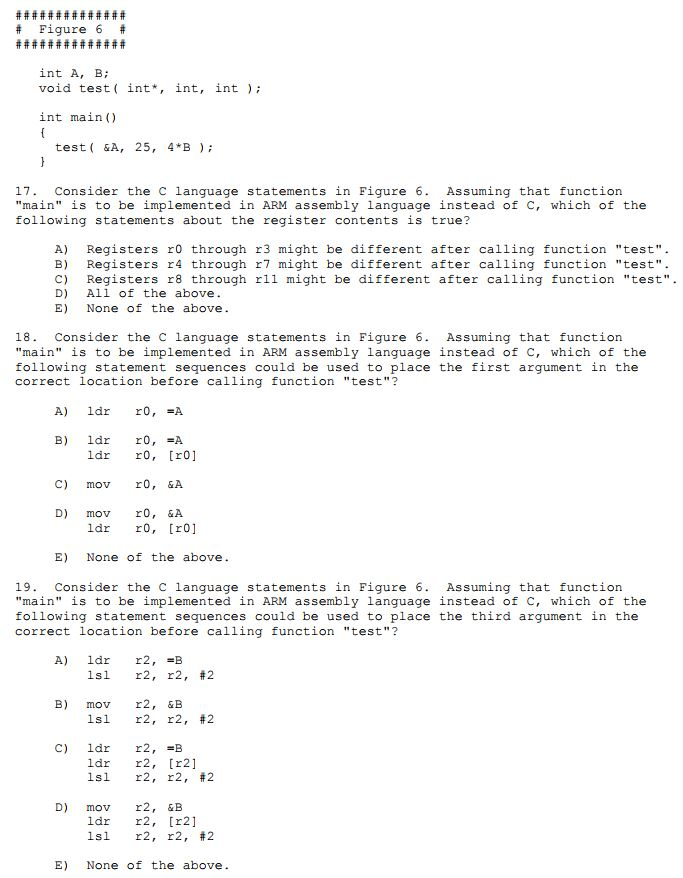
Figure 6 # int A, B void test( int*, int, int ); int main () test &A, 25, 4*B 17. Consider the C language statements in Figure 6 Assuming that function "main" is to be implemented in ARM assembly language instead of C, which of the following statements about the register contents is true? A) Registers r0 through r3 might be different after calling function "test" B) Registers r4 through r7 might be different after calling function "test". C) Registers r8 through rl1 might be different after calling function "test". D) All of the above E) None of the above 18. Consider the C language statements in Figure 6. Assuming that function "main" is to be implemented in ARM assembly language instead of C, which of the following statement sequences could be used to place the first argument in the correct location before calling function "test"? A) ldr r0,=A B) ldr r0,=A ldr r0, r0 C) mov r, &A D) mov r0, &A ldr r0, [r0] E) None of the above 19. Consider the C language statements in Figure 6. Assuming that function "main" is to be implemented in ARM assembly language instead of C, which of the following statement sequences could be used to place the third argument in the correct location before calling function "test"? A) ldr r2,=B 1s1 r2, r2, #2 B) mov r2, &B 1s1 r2, r2, #2 C) ldr r2,#8 ldr r2, [r2] 1s1 r2, r2, #2 D) mov r2, &B ldr r2, [r2] 1s1 r2, r2,#2 E) None of the above
Step by Step Solution
There are 3 Steps involved in it

Get step-by-step solutions from verified subject matter experts
 Study Help