



Question: Figure. shows a typical 90-degree elbow joint. Its purpose is to change the direction of water flow. This elbow alters the water flow by
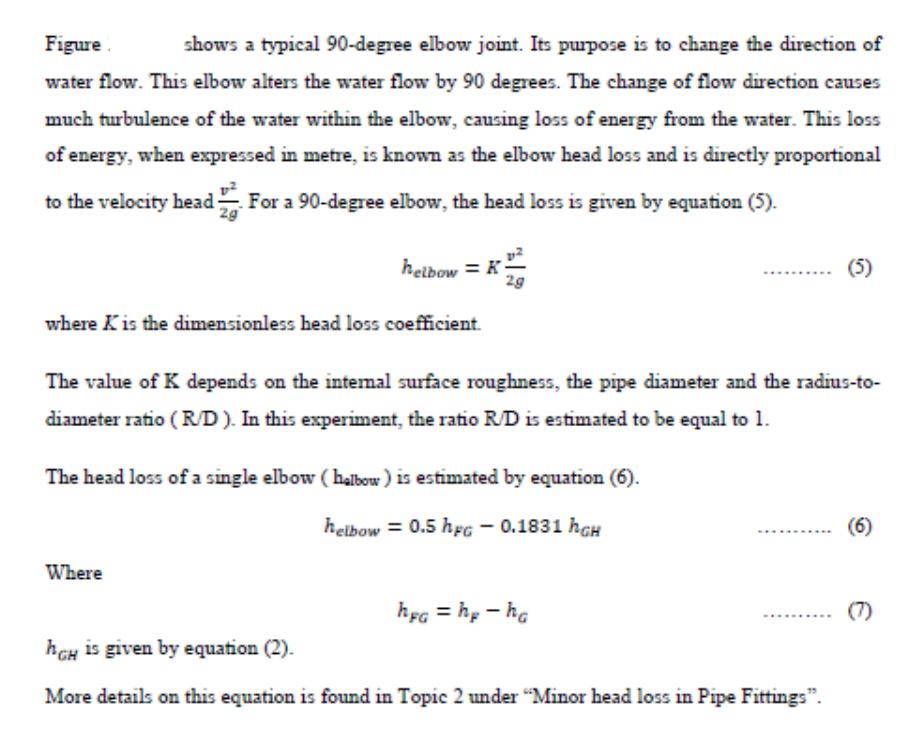
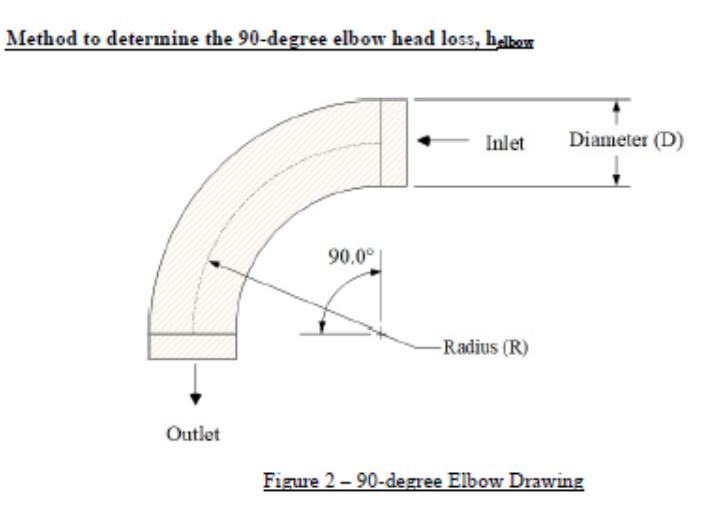
Figure. shows a typical 90-degree elbow joint. Its purpose is to change the direction of water flow. This elbow alters the water flow by 90 degrees. The change of flow direction causes much turbulence of the water within the elbow, causing loss of energy from the water. This loss of energy, when expressed in metre, is known as the elbow head loss and is directly proportional to the velocity head For a 90-degree elbow, the head loss is given by equation (5). 2g helbow K where K is the dimensionless head loss coefficient. 2g Where The value of K depends on the internal surface roughness, the pipe diameter and the radius-to- diameter ratio (R/D). In this experiment, the ratio R/D is estimated to be equal to 1. The head loss of a single elbow (halbow) is estimated by equation (6). helbow = 0.5 hFG - 0.1831 hGH hFG = hy - ha (5) hGH is given by equation (2). More details on this equation is found in Topic 2 under "Minor head loss in Pipe Fittings". (6) Method to determine the 90-degree elbow head loss, helbow Outlet 90.0 Inlet Radius (R) Diameter (D) Figure 2-90-degree Elbow Drawing
Step by Step Solution
There are 3 Steps involved in it

Get step-by-step solutions from verified subject matter experts