Question: File Tools View Document1 - Word O CASE STUDY IV-3 IT Infrastructure Outsourcing at Schaeffer (A) :The Outsourcing Decision Schaeffer Corporation, headquartered in the small
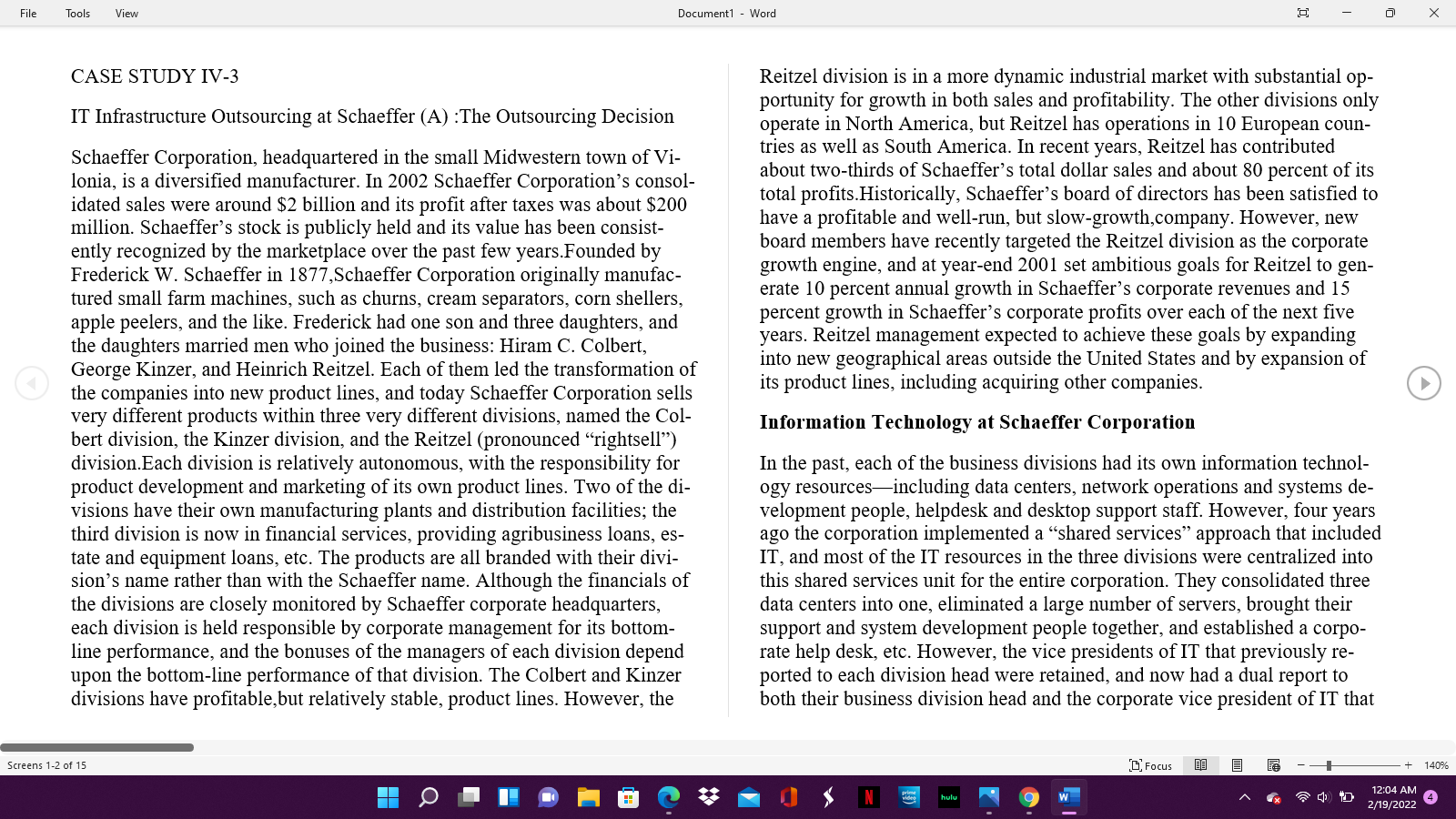
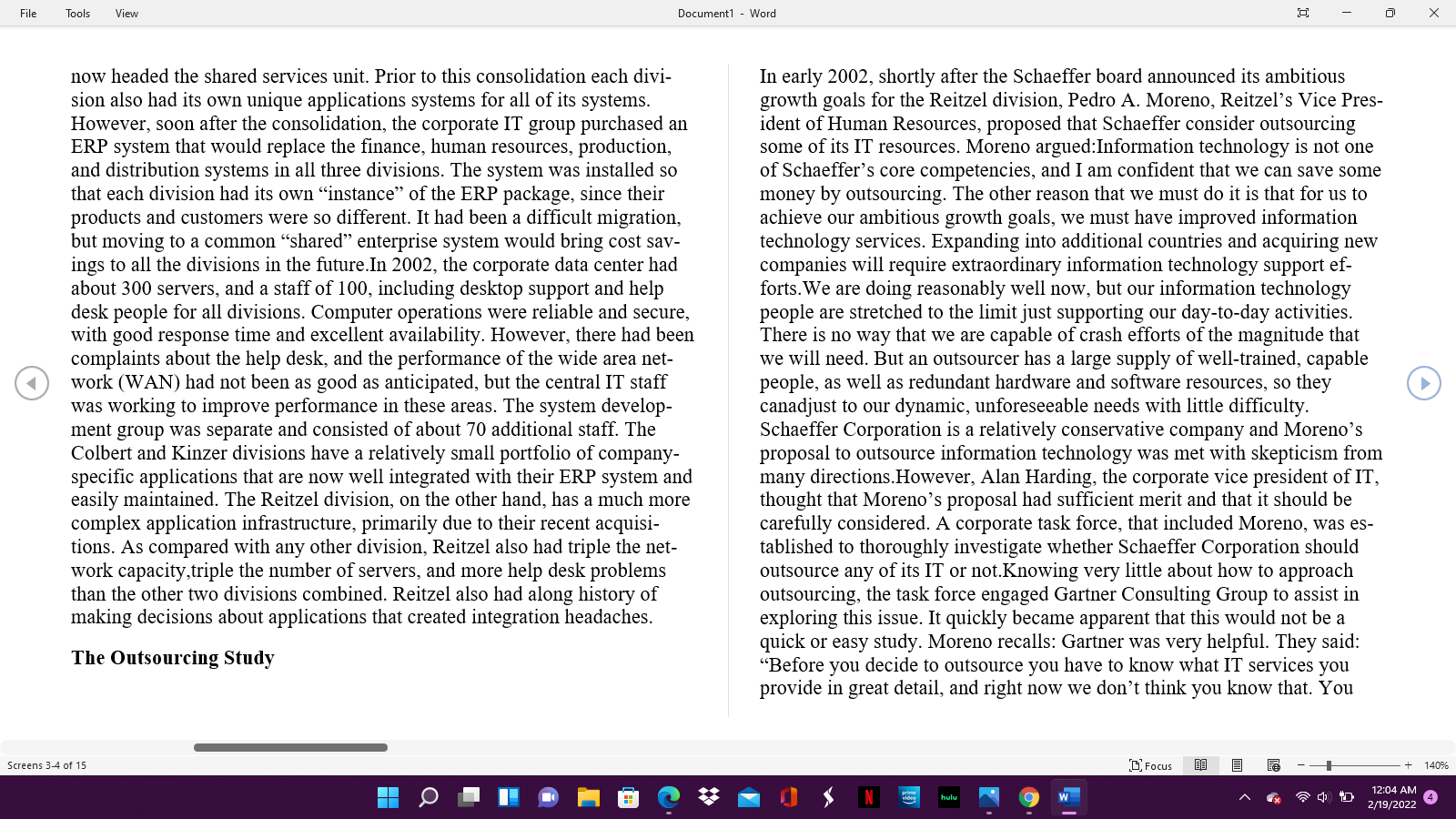
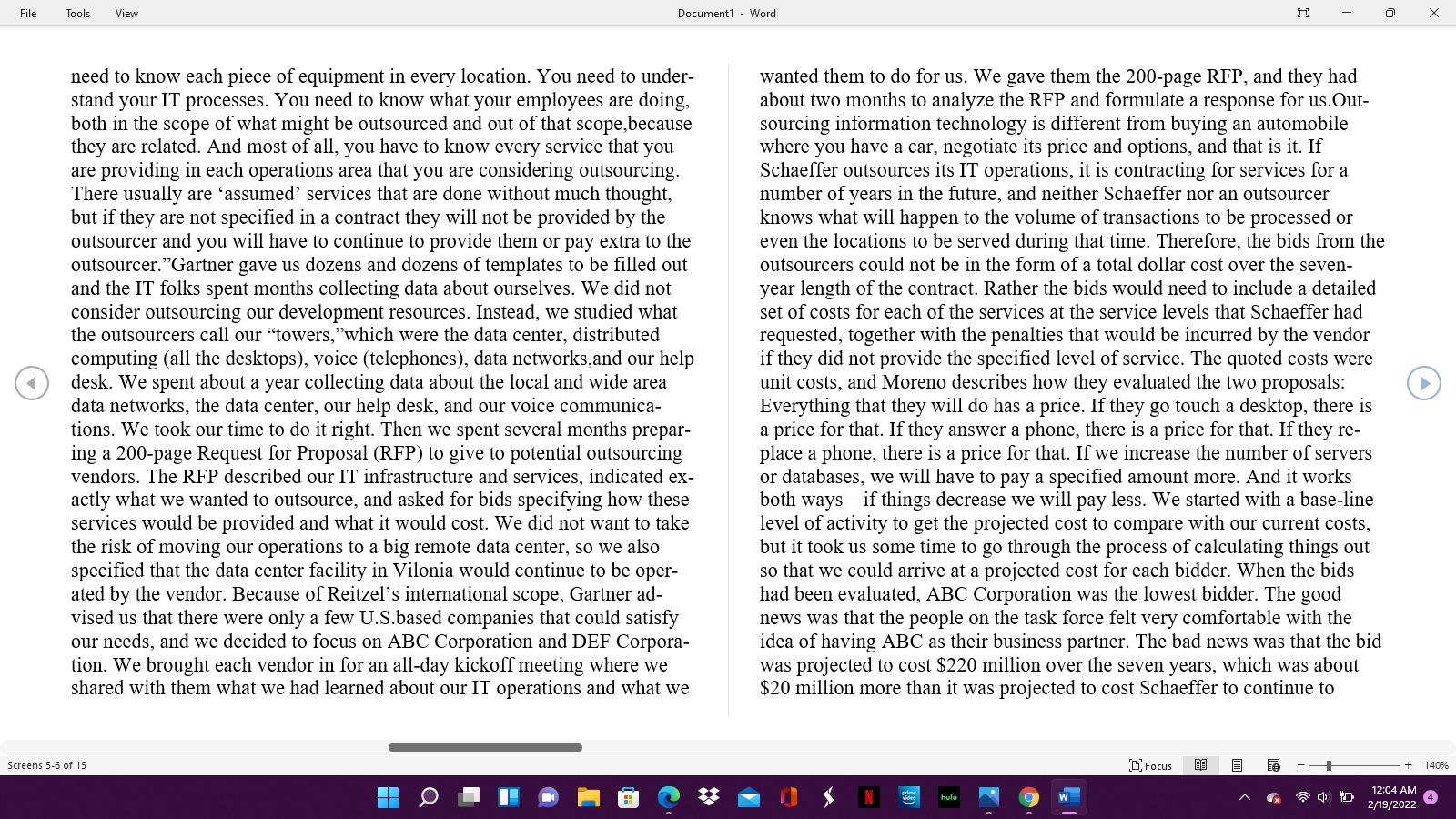
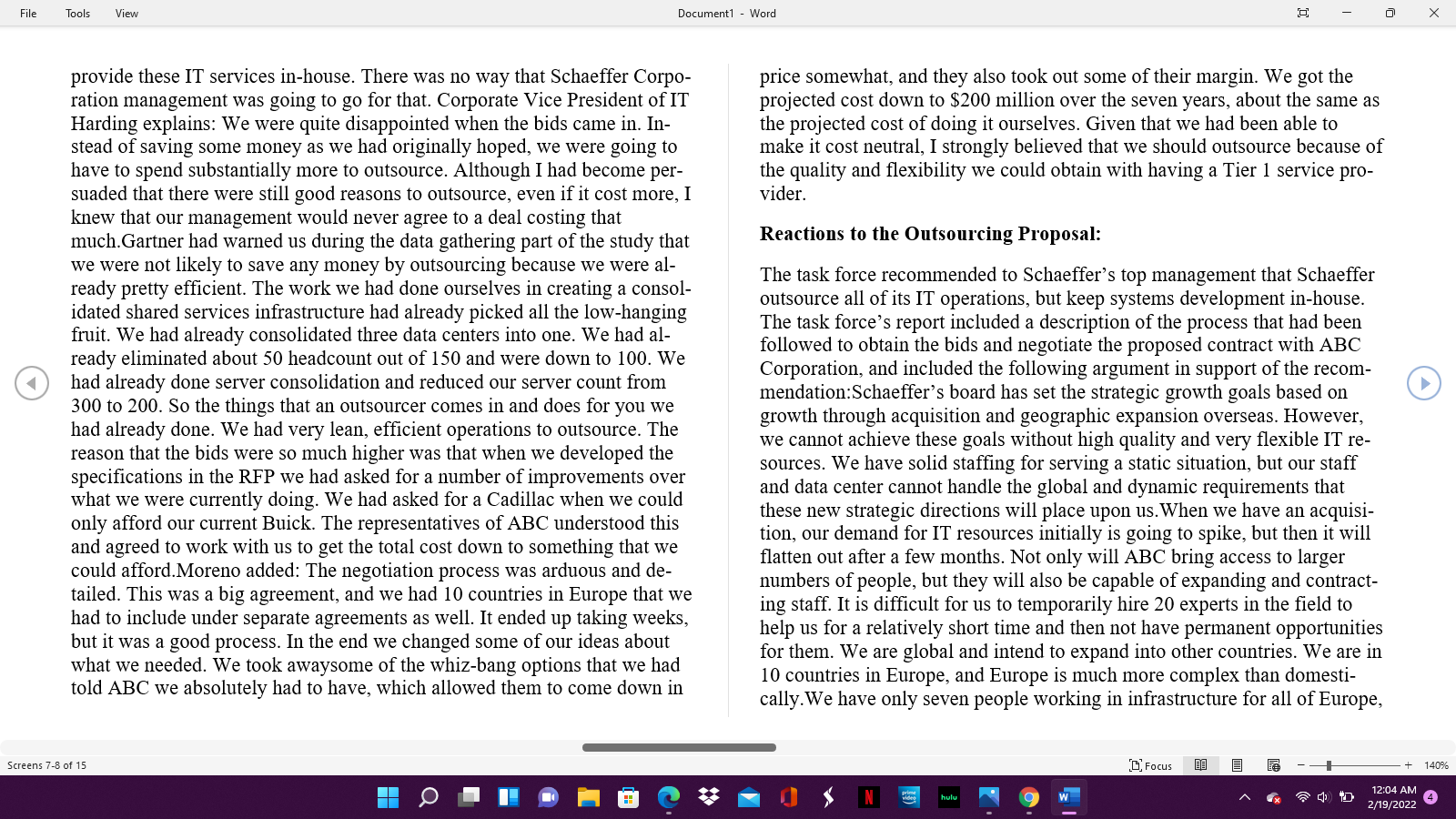
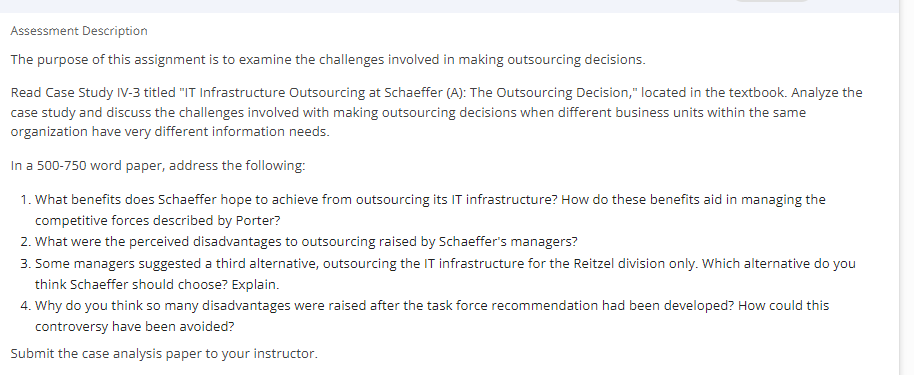
File Tools View Document1 - Word O CASE STUDY IV-3 IT Infrastructure Outsourcing at Schaeffer (A) :The Outsourcing Decision Schaeffer Corporation, headquartered in the small Midwestern town of Vi- lonia, is a diversified manufacturer. In 2002 Schaeffer Corporation's consol- idated sales were around $2 billion and its profit after taxes was about $200 million. Schaeffer's stock is publicly held and its value has been consist- ently recognized by the marketplace over the past few years.Founded by Frederick W. Schaeffer in 1877,Schaeffer Corporation originally manufac- tured small farm machines, such as churns, cream separators, corn shellers, apple peelers, and the like. Frederick had one son and three daughters, and the daughters married men who joined the business: Hiram C. Colbert, George Kinzer, and Heinrich Reitzel. Each of them led the transformation of the companies into new product lines, and today Schaeffer Corporation sells very different products within three very different divisions, named the Col- bert division, the Kinzer division, and the Reitzel (pronounced "rightsell) division. Each division is relatively autonomous, with the responsibility for product development and marketing of its own product lines. Two of the di- visions have their own manufacturing plants and distribution facilities; the third division is now in financial services, providing agribusiness loans, es- tate and equipment loans, etc. The products are all branded with their divi- sion's name rather than with the Schaeffer name. Although the financials of the divisions are closely monitored by Schaeffer corporate headquarters, each division is held responsible by corporate management for its bottom- line performance, and the bonuses of the managers of each division depend upon the bottom-line performance of that division. The Colbert and Kinzer divisions have profitable, but relatively stable, product lines. However, the Reitzel division is in a more dynamic industrial market with substantial op- portunity for growth in both sales and profitability. The other divisions only operate in North America, but Reitzel has operations in 10 European coun- tries as well as South America. In recent years, Reitzel has contributed about two-thirds of Schaeffer's total dollar sales and about 80 percent of its total profits.Historically, Schaeffer's board of directors has been satisfied to have a profitable and well-run, but slow-growth,company. However, new board members have recently targeted the Reitzel division as the corporate growth engine, and at year-end 2001 set ambitious goals for Reitzel to gen- erate 10 percent annual growth in Schaeffer's corporate revenues and 15 percent growth in Schaeffer's corporate profits over each of the next five years. Reitzel management expected to achieve these goals by expanding into new geographical areas outside the United States and by expansion of its product lines, including acquiring other companies. Information Technology at Schaeffer Corporation In the past, each of the business divisions had its own information technol- ogy resourcesincluding data centers, network operations and systems de- velopment people, helpdesk and desktop support staff. However, four years ago the corporation implemented a shared services approach that included IT, and most of the IT resources in the three divisions were centralized into this shared services unit for the entire corporation. They consolidated three data centers into one, eliminated a large number of servers, brought their support and system development people together, and established a corpo- rate help desk, etc. However, the vice presidents of IT that previously re- ported to each division head were retained, and now had a dual report to both their business division head and the corporate vice president of IT that Screens 1-2 of 15 C Focus 140% 12:04 AM 2/19/2022 File Tools View Document1 - Word O now headed the shared services unit. Prior to this consolidation each divi- sion also had its own unique applications systems for all of its systems. However, soon after the consolidation, the corporate IT group purchased an ERP system that would replace the finance, human resources, production, and distribution systems in all three divisions. The system was installed so that each division had its own instance of the ERP package, since their products and customers were so different. It had been a difficult migration, a but moving to a common shared enterprise system would bring cost sav- ings to all the divisions in the future.In 2002, the corporate data center had about 300 servers, and a staff of 100, including desktop support and help desk people for all divisions. Computer operations were reliable and secure, with good response time and excellent availability. However, there had been complaints about the help desk, and the performance of the wide area net- work (WAN) had not been as good as anticipated, but the central IT staff was working to improve performance in these areas. The system develop- ment group was separate and consisted of about 70 additional staff. The Colbert and Kinzer divisions have a relatively small portfolio of company- specific applications that are now well integrated with their ERP system and easily maintained. The Reitzel division, on the other hand, has a much more complex application infrastructure, primarily due to their recent acquisi- tions. As compared with any other division, Reitzel also had triple the net- work capacity,triple the number of servers, and more help desk problems than the other two divisions combined. Reitzel also had along history of making decisions about applications that created integration headaches. In early 2002, shortly after the Schaeffer board announced its ambitious growth goals for the Reitzel division, Pedro A. Moreno, Reitzel's Vice Pres- ident of Human Resources, proposed that Schaeffer consider outsourcing some of its IT resources. Moreno argued: Information technology is not one of Schaeffer's core competencies, and I am confident that we can save some money by outsourcing. The other reason that we must do it is that for us to achieve our ambitious growth goals, we must have improved information technology services. Expanding into additional countries and acquiring new companies will require extraordinary information technology support ef- forts. We are doing reasonably well now, but our information technology people are stretched to the limit just supporting our day-to-day activities. There is no way that we are capable of crash efforts of the magnitude that we will need. But an outsourcer has a large supply of well-trained, capable people, as well as redundant hardware and software resources, so they canadjust to our dynamic, unforeseeable needs with little difficulty. Schaeffer Corporation is a relatively conservative company and Moreno's proposal to outsource information technology was met with skepticism from many directions. However, Alan Harding, the corporate vice president of IT, thought that Moreno's proposal had sufficient merit and that it should be carefully considered. A corporate task force, that included Moreno, was es- tablished to thoroughly investigate whether Schaeffer Corporation should outsource any of its IT or not.Knowing very little about how to approach outsourcing, the task force engaged Gartner Consulting Group to assist in exploring this issue. It quickly became apparent that this would not be a quick or easy study. Moreno recalls: Gartner was very helpful. They said: "Before you decide to outsource you have to know what IT services you provide in great detail, and right now we don't think you know that. You The Outsourcing Study Screens 3-4 of 15 C Focus 140% 1 a O 12:04 AM 2/19/2022 File Tools View Document1 - Word O need to know each piece of equipment in every location. You need to under- stand your IT processes. You need to know what your employees are doing, both in the scope of what might be outsourced and out of that scope,because they are related. And most of all, you have to know every service that you are providing in each operations area that you are considering outsourcing. There usually are assumed services that are done without much thought, but if they are not specified in a contract they will not be provided by the outsourcer and you will have to continue to provide them or pay extra to the outsourcer.Gartner gave us dozens and dozens of templates to be filled out and the IT folks spent months collecting data about ourselves. We did not consider outsourcing our development resources. Instead, we studied what the outsourcers call our "towers,"which were the data center, distributed computing (all the desktops), voice (telephones), data networks,and our help desk. We spent about a year collecting data about the local and wide area data networks, the data center, our help desk, and our voice communica- tions. We took our time to do it right. Then we spent several months prepar- ing a 200-page Request for Proposal (RFP) to give to potential outsourcing vendors. The RFP described our IT infrastructure and services, indicated ex- actly what we wanted to outsource, and asked for bids specifying how these services would be provided and what it would cost. We did not want to take the risk of moving our operations to a big remote data center, so we also specified that the data center facility in Vilonia would continue to be oper- ated by the vendor. Because of Reitzel's international scope, Gartner ad- vised us that there were only a few U.S.based companies that could satisfy our needs, and we decided to focus on ABC Corporation and DEF Corpora- tion. We brought each vendor in for an all-day kickoff meeting where we shared with them what we had learned about our IT operations and what we wanted them to do for us. We gave them the 200-page RFP, and they had about two months to analyze the RFP and formulate a response for us. Out- sourcing information technology is different from buying an automobile where you have a car, negotiate its price and options, and that is it. If Schaeffer outsources its IT operations, it is contracting for services for a number of years in the future, and neither Schaeffer nor an outsourcer knows what will happen to the volume of transactions to be processed or even the locations to be served during that time. Therefore, the bids from the outsourcers could not be in the form of a total dollar cost over the seven- year length of the contract. Rather the bids would need to include a detailed set of costs for each of the services at the service levels that Schaeffer had requested, together with the penalties that would be incurred by the vendor if they did not provide the specified level of service. The quoted costs were unit costs, and Moreno describes how they evaluated the two proposals: Everything that they will do has a price. If they go touch a desktop, there is a price for that. If they answer a phone, there is a price for that. If they re- place a phone, there is a price for that. If we increase the number of servers or databases, we will have to pay a specified amount more. And it works both waysif things decrease we will pay less. We started with a base-line level of activity to get the projected cost to compare with our current costs, but it took us some time to go through the process of calculating things out so that we could arrive at a projected cost for each bidder. When the bids had been evaluated, ABC Corporation was the lowest bidder. The good news was that the people on the task force felt very comfortable with the idea of having ABC as their business partner. The bad news was that the bid was projected to cost $220 million over the seven years, which was about $20 million more than it was projected to cost Schaeffer to continue to Screens 5-6 of 15 C Focus 140% 12:04 AM 2/19/2022 File Tools View Document1 - Word O price somewhat, and they also took out some of their margin. We got the projected cost down to $200 million over the seven years, about the same as the projected cost of doing it ourselves. Given that we had been able to make it cost neutral, I strongly believed that we should outsource because of the quality and flexibility we could obtain with having a Tier 1 service pro- vider. Reactions to the Outsourcing Proposal: provide these IT services in-house. There was no way that Schaeffer Corpo- ration management was going to go for that. Corporate Vice President of IT Harding explains: We were quite disappointed when the bids came in. In- stead of saving some money as we had originally hoped, we were going to have to spend substantially more to outsource. Although I had become per- suaded that there were still good reasons to outsource, even if it cost more, I knew that our management would never agree to a deal costing that much.Gartner had warned us during the data gathering part of the study that we were not likely to save any money by outsourcing because we were al- ready pretty efficient. The work we had done ourselves in creating a consol- idated shared services infrastructure had already picked all the low-hanging fruit. We had already consolidated three data centers into one. We had al- ready eliminated about 50 headcount out of 150 and were down to 100. We had already done server consolidation and reduced our server count from 300 to 200. So the things that an outsourcer comes in and does for you we had already done. We had very lean, efficient operations to outsource. The reason that the bids were so much higher was that when we developed the specifications in the RFP we had asked for a number of improvements over what we were currently doing. We had asked for a Cadillac when we could only afford our current Buick. The representatives of ABC understood this and agreed to work with us to get the total cost down to something that we could afford. Moreno added: The negotiation process was arduous and de- tailed. This was a big agreement, and we had 10 countries in Europe that we had to include under separate agreements as well. It ended up taking weeks, but it was a good process. In the end we changed some of our ideas about what we needed. We took awaysome of the whiz-bang options that we had told ABC we absolutely had to have, which allowed them to come down in The task force recommended to Schaeffer's top management that Schaeffer outsource all of its IT operations, but keep systems development in-house. The task force's report included a description of the process that had been followed to obtain the bids and negotiate the proposed contract with ABC Corporation, and included the following argument in support of the recom- mendation:Schaeffer's board has set the strategic growth goals based on growth through acquisition and geographic expansion overseas. However, we cannot achieve these goals without high quality and very flexible IT re- sources. We have solid staffing for serving a static situation, but our staff and data center cannot handle the global and dynamic requirements that these new strategic directions will place upon us. When we have an acquisi- tion, our demand for IT resources initially is going to spike, but then it will flatten out after a few months. Not only will ABC bring access to larger numbers of people, but they will also be capable of expanding and contract- ing staff. It is difficult for us to temporarily hire 20 experts in the field to help us for a relatively short time and then not have permanent opportunities for them. We are global and intend to expand into other countries. We are in 10 countries in Europe, and Europe is much more complex than domesti- cally. We have only seven people working in infrastructure for all of Europe, Screens 7-8 of 15 C Focus 140% 12:04 AM 2/19/2022 File Tools View Document1 - Word O so we are going to have to double or triple our staff over there. So it makes sense to give the responsibility to ABC who already has resources in all these countries, both where we are now and where we will be going in the future.ABC has a very deep benchhundreds of thousands of employees for them to pick from to serve our needs as opposed to our one hundred. If someone leaves, it generally takes us three to six months to find a suitable replacement because it is hard to get people to move to Vilonia. ABC pro- vides an attractive career path for its employees and can attract and keep people with outstanding talent that would never come to Vilonia to work for Schaeffer. ABC can afford to invest in extensive training and can offer a va- riety of challenging technical opportunities to its people, so we will have ac- cess to substantially higher quality technical knowledge. In short, Schaeffer is anticipating exciting opportunities that will be impossible to achieve with our existing IT staff. With ABC as our business partner, we will be much better positioned to exploit the dynamic opportunities for growth that we are seeking. When the task force report was circulated, there was quite a reaction throughout Schaeffer Corporation, with some managers voicing enthusiastic support and others equally strongly opposed. Vivian D. Johnson, vice presi- dent of IT for the Kinzer division, expressed the following concerns:Perhaps IT is not one of Schaeffer's core competencies, but it is a critical factor in our long-term success. Do we want to turn over such critical resources to an outside organization? It will be like getting married to ABC Corporation. Although it has a good reputation and we feel comfortable with its people, what happens three years down the road when these people have gone on to greener pastures within ABC? Today Schaeffer may be a high priority with ABC, but before long other opportunities will appear and the good people that we will start out with will be replaced with others who do not know us as well. What will happen when a new situation arises that is not covered in our contract and we have to renegotiate, and we have lost our bargaining po- sition? Quite a number of outsourcing relationships have not worked out well. If we become unhappy with ABC's performance, we will have elimi- nated these internal IT capabilities and the cost of bringing it back will be tremendousthere is no way our management would go for that. What will that mean for our dreams of growth that depend so heavily on good infor- mation technology support?There is a lot of unrecognized risk inherent in this proposal. What will happen to our current information technology peo- ple, many of whom have served Schaeffer faithfully for years? I don't know the exact numbers, but I am sure that many of them will no longer be em- ployed by Schaeffer. Is that fair? This is a small-town company and our greatest asset has always been our loyal, dedicated, and hard-working labor force. We are mostly nonunion, and we have never had a strike. We have never done anything likethis, and I am concerned about the effect this may have on the morale of all of our workers and on their future commitment to the company. I understand that our company is changing and that we face new and different challenges that require expanding our IT resources. But have we considered the available alternatives? Traditionally when we needed special skills or additional people we have employed contractors, and that approach has worked out well in the past. Under the proposed con- tract we will be paying ABC for every bit of help we get just as we would any contractor, but we would be married to themif the relationship sours you can't just employ another vendor. Also, it is clear that we have under- funded our information technology area, so it should be no surprise that we do not have all the resources that we will need in the future. Under the con- tract with ABC, we will be paying extra for any additional resources that it Screens 9-10 of 15 C Focus 140% 12:04 AM 2/19/2022 File Tools View Document1 - Word O provides. Would we not be better off investing some of that money in ac- quiring and developing our own people? Then we would have our own re- sources for the long run instead of having to depend on an outside organiza- tion over which we have little control when push comes to shove. Carol J. Hanna, vice president for finance of the Colbert division, expressed the fol- lowing concerns: The proposal to outsource is very expensive and risky. Although it appears to be no more expensive than our in-house Information Technology organization, there is no question in my mind that we will be paying substantially more. With such complex services I am sure that we have not been able to define them all to include in the contract and there will be things that are not included that will still have to be done at additional cost. Furthermore, it is common knowledge that outsourcers "lowball the first-year costs of a contract because they know that they can make it up in the later years, and because their clients will have no bargaining position when inevitable changes have to be negotiated. We will be writing a blank check since there is no way of knowing what our costs in the future will be as conditions change. Also, there will be substantial unanticipated costs in- volved in administering the contract and managing the relationships with ABC people. As the financial officer of Colbert, I am particularly concerned because I am convinced that whatever benefits this proposal will bring will go to our Reitzel division, while the other divisions will bear additional costs without additional benefits. Both ABC and Gartner have said that our present IT organization is very efficient. We are getting along fine with our current IT services, and can continue to do so in the future. This is not a fair deal for Colbert. If it is so important that IT support for Reitzel be out- sourced, why not outsource Reitzel's part of the data center, the network, and the phone system, and leave the rest of our support as it is? That would have the added benefit of maintaining a nucleus of IT professionals within Schaeffer so that if the outsourcing deal does not work out there would be something to build on if we wanted to bring it back in house for Reitzel. While the data center will remain in Vilonia, we have heard that most of ABC's people, including the help desk staff, will be located faraway. Only a handful (less than 20) of information technology people will be located here. What happens if we have a problem? How are we going to get some- one to help us? Today we know where our IT support people sit. We can go to their office, beg them for help, and stay there until things get fixed. We know and trust these people. Not only are they long-time colleagues, but they are our neighbors as well. With a big outsourcing company, how are we going to work with them? All of the processes are going to change, be- cause the people can be all over the world. We are afraid of that and we do not like it at all! Charles T. Gibbs, vice president of IT for the Reitzel divi- sion, enthusiastically supported the recommendation to outsource: Schaeffer's world changed when our top management set such aggressive growth goals for the corporation. To get a corporatewide sales growth of 10 percent a year, Reitzel's sales are going to have to grow over 14 percent, and for corporate profits to grow 15 percent a year, Reitzel's profits will have to increase about 18 percent each year. Those are daunting goals, and they can't be achieved by business as usual. We can't continue to be the conservative, risk-averse company that we have always been. We are going to have to be nimble and daring in expanding into new markets and in ac- quiring outside companies. And it is amply clear that our in-house infor- mation technology organization does not have the skills or the flexibility to support the rate of change that we must undertake. With its vast reservoir of talented and skilled people, and experience managing change, ABC Screens 11-12 of 15 C Focus 140% 12:04 AM 2/19/2022 File Tools View Document1 - Word O to manage a long term relationship with ABC, and at the same time to estab- lish closer relationships with users in the divisions so that information tech- nology can more effectively support the essential needs and strategic direc- tions of the business. Corporation is the ideal business partner to enable our new strategy. There is no question that ABC can manage technology well. The data center will perform at least as well as it does today, and our telephone services will continue to be excellent. ABC can manage our data networks far better than we have been able to do, so we will be able to substantially reduce the out- ages that have been disrupting critical business activities. There has been a great deal of FUD [fear, uncertainty, and doubt] about the performance of the help desk and desktop support services that are more people-intensive. But there have been lots of complaints about the performance of our present help desk, so people's concern in this area may be a case of preferring our familiar mediocre service to the unknown. However, the task force under- stood people's fears and put a lot of effort into defining performance crite- ria, both for response to help desk calls and time to resolve problems. We have involved large numbers of our users in defining these service criteria, and ABC has agreed that they are attainable, and they will pay significant penalties if they are not met. In Europe, each country has its local help desk support. With all the divided responsibility, this is hard to manage with a hodgepodge of processes and no global view of our support issues. ABC will provide a global help desk with a single process and an integrated data- base that all countries will work off of. Furthermore, ABC's help desk will be globally redundant as it can be supported from any site where ABC pro- vides help desk services. We believe that help desk support will be a shining example of the value outsourcing brings to the table. In the final analysis we have to recognize that Schaeffer's world has changed. We have to move our mindset into the twenty first century where information technology organi- zations will also become managers of IT service providers rather than providing all the services themselves. The challenge of our IT people will be Harding responded to some of the concerns that had been expressed: We have been very concerned about what may happen to our IT people who may be displaced. Many people who worked in this organization were wor- ried about what outsourcing would mean for them. We tried to engage them with ABC so that they could learn about what it would mean to work for ABC. We brought in ABC people who joined them from a client firm who talked with our people about how wonderful it had been for their career. We tried to convince our people that if you are a technical person, working for ABC is a good thing because you have so many more opportunities for tech- nical career development and advancement. Instead of working in Vilonia in an IT organization with only 100 positions, you are going to work with a company that is global and has 100,000 employees. Unfortunately, that ar- gument worked with a few people, but the bulk of the people had the atti- tudeLook, I care about my career advancement, but I want to stay in Vi- lonia. We had about 100 headcount when we started studying outsourcing. However, during the outsourcing decision process, 10 people decided to leave for other jobs; and we did not fill these vacancies with Schaeffer em- ployeeswe filled these positions with tempsso now we have 90 Schaeffer IT employees who will be affected. ABC will likely offer jobs to about 40 of our current employees, but some of them may not take them be- cause in the long run they might have to leave Vilonia. So at least 50 people will be terminated if they can't find other jobs somewhere within Schaeffer. They will be given six months' pay and help in finding other employment. Screens 13-14 of 15 D Focus 140% 12:04 AM 2/19/2022 File Tools View Document1 - Word o - 0 X Fifty is a very small number when compared to the thousands of Schaeffer's people in Vilonia. It has been suggested that we could use the resources that we will devote to outsourcing to build up our internal IT resources and em- ploy more contractors and thereby satisfy our future needs. This suggestion simply reflects a lack of understanding of how different our future must be. Although we have good information technology resources today, good will not be good enough. We are going to have to change our corporate as- piration level from being satisfied with our insular way of doing things, to a situation where in critical areas we aspire be the very best.To accomplish our goals, our IT support must be the very best, and ABC is clearly out- standing in providing that support. ABC brings IT resources that we simply cannot match given our size and location. It has been suggested that we out- source IT for Reitzel only, and leave all IT in-house for the other divisions. That would be very expensive because we would lose economies of scale. We would have to restart negotiations with our current vendors as well as ABC, and would not be able to get the same deals because of the smaller scale. Furthermore, today our IT operations for all three divisions are con- solidated into a shared infrastructure. To break this infrastructure apart to take out Reitzel would be very expensive and take many months. That would be a logistical nightmare for Reitzel, especially when they are at- tempting to concentrate management attention on leveraging their core com- petencies.Our management is going to have all it can handle just striving to meet its ambitious growth goals. It was now up to Schaeffer's corporate management to make a decision on the task force recommendation. End of document I Screen 15 of 15 C Focus 140% HH O a 12:04 AM 2/19/2022 Assessment Description The purpose of this assignment is to examine the challenges involved in making outsourcing decisions. Read Case Study IV-3 titled "IT Infrastructure Outsourcing at Schaeffer (A): The Outsourcing Decision," located in the textbook. Analyze the case study and discuss the challenges involved with making outsourcing decisions when different business units within the same organization have very different information needs. In a 500-750 word paper, address the following: 1. What benefits does Schaeffer hope to achieve from outsourcing its IT infrastructure? How do these benefits aid in managing the competitive forces described by Porter? 2. What were the perceived disadvantages to outsourcing raised by Schaeffer's managers? 3. Some managers suggested a third alternative, outsourcing the IT infrastructure for the Reitzel division only. Which alternative do you think Schaeffer should choose? Explain. 4. Why do you think so many disadvantages were raised after the task force recommendation had been developed? How could this controversy have been avoided? Submit the case analysis paper to your instructor









 Study Help