







Question: Fill in the blanks 1. 2. /*function le2be converts a little endian int and return it as a big endian int. The code does this
Fill in the blanks
1.
2.
/*function le2be converts a little endian int and return it as a big endian int. The code does this using shift and logical operations only. No built-in or library conversion functions are used.*/ int le2be(int x){
int d;
/* ((x >>24) & 0x000000FF) =0x ______________________
((x >> 8) & 0x0000FF00) = 0x_______________________
((x
((x
*/ d= ( ((x >>24) & 0x000000FF) | ((x >> 8) & 0x0000FF00) | \
((x
//d = 0x_____________________________________
return d;
}
3.
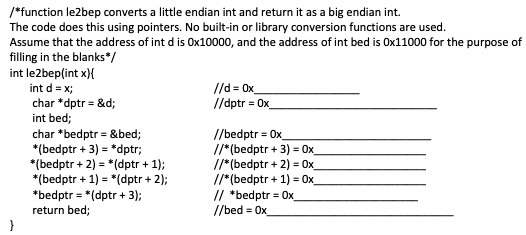
/*function le2bep converts a little endian int and return it as a big endian int. The code does this using pointers. No built-in or library conversion functions are used. Assume that the address of int d is 0x10000, and the address of int bed is 0x11000 for the purpose of filling in the blanks*/ int le2bep(int x){
int d = x;
char *dptr = &d;
int bed;
char *bedptr = &bed;
*(bedptr + 3) = *dptr;
*(bedptr + 2) = *(dptr + 1);
*(bedptr + 1) = *(dptr + 2);
*bedptr = *(dptr + 3);
return bed;
}
PLEASE SHOW ALL STEPS AND WORK
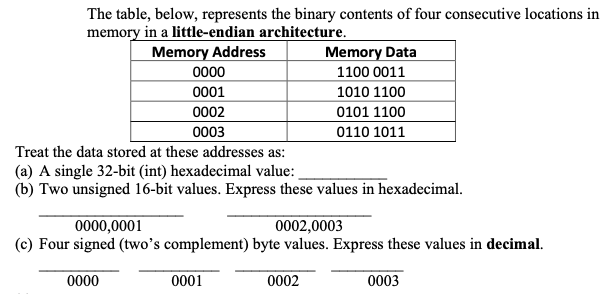
The table, below, represents the binary contents of four consecutive locations in memory in a little-endian architecture. Memory Address Memory Data 0000 1100 0011 0001 1010 1100 0002 0101 1100 0003 0110 1011 Treat the data stored at these addresses as: (a) A single 32-bit (int) hexadecimal value: (b) Two unsigned 16-bit values. Express these values in hexadecimal. 0000,0001 0002,0003 (c) Four signed (two's complement) byte values. Express these values in decimal. 0000 0001 0002 0003 /*function le2bep converts a little endian int and return it as a big endian int. The code does this using pointers. No built-in or library conversion functions are used. Assume that the address of int d is 0x10000, and the address of int bed is 0x11000 for the purpose of filling in the blanks*/ int le bep(int x) int d = x; //d = Ox char *dptr=&d; //dptr = Ox int bed; char *bedptr = &bed; //bedptr = 0x *(bedptr + 3) = *dptr; 1/*(bedptr + 3) = 0x *(bedptr + 2) = *(dptr + 1); 1/*(bedptr + 2) = 0x *(bedptr + 1) = *(dptr + 2); //*(bedptr + 1) = 0x *bedptr = *(dptr + 3); // *bedptr = Ox_ return bed; 1/bed = 0x }
Step by Step Solution
There are 3 Steps involved in it

Get step-by-step solutions from verified subject matter experts
 Study Help