







Question: Fill in the mini - case and Teaching Note templates provided below to write a mini - case based upon a topic covered in the
Fill in the minicase and Teaching Note templates provided below to write a minicase based upon a topic covered in the course. The minicase situation you choose can be based in the context of either an organization or your choice that you have contact with, or secondary sources via library databases, online, etc. All sources must be properly sited. Each case must be based upon a real situation.
Aim to incorporate relationship to Sustainability Development Goals SDG into the minicase theme and Teaching Note questions answers where possible. See supporting SDG material for further reference.
Minicase: page guideline, singlespaced, following template provided.
Teaching Note: page guideline, singlespaced, following template provided.
MiniCase and Teaching Note Template
Mini Case Template Sections AG
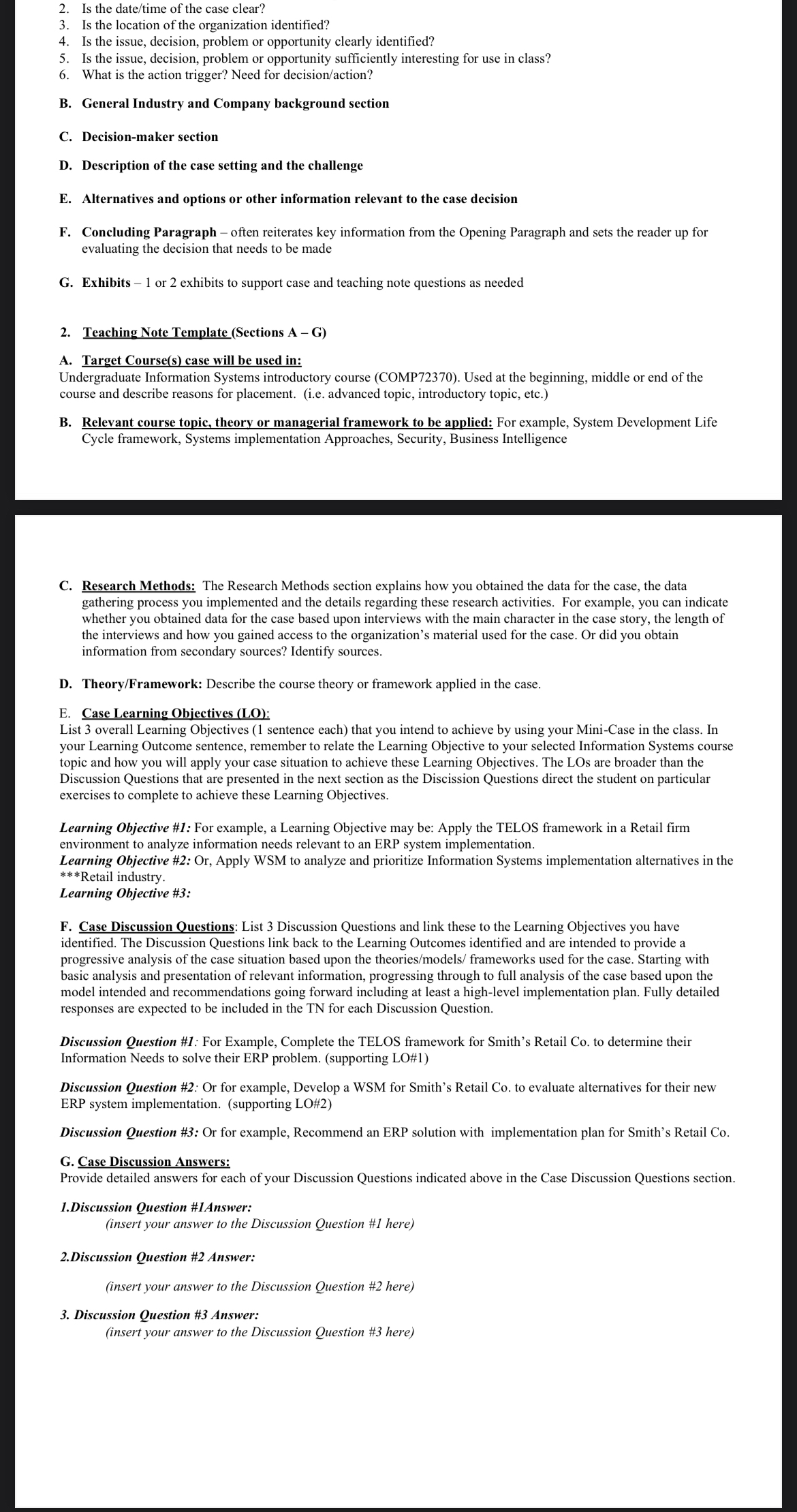
The Opening paragraph is a key component of every case that presents the case issue. In developing your Opening Paragraph, review the checklist below. Review the Opening paragraphs and content of our Weekly cases for reference.
A Opening Paragraph
NOTE: Opening paragraph checklist:
Is the decision maker identified by name and position?
Is the datetime of the case clear?
Is the location of the organization identified?
Is the issue, decision, problem or opportunity clearly identified?
Is the issue, decision, problem or opportunity sufficiently interesting for use in class?
What is the action trigger? Need for decisionaction
B General Industry and Company background section
C Decisionmaker section
D Description of the case setting and the challenge
E Alternatives and options or other information relevant to the case decision
F Concluding Paragraph often reiterates key information from the Opening Paragraph and sets the reader up for evaluating the decision that needs to be made
G Exhibits or exhibits to support case and teaching note questions as needed
Teaching Note Template Sections AG
A Target Courses case will be used in:
Undergraduate Information Systems introductory course COMP Used at the beginning, middle or end of the course and describe reasons for placement. ie advanced topic, introductory topic, etc.
B Relevant course topic, theorv or managerial framework to be applied: For example, System Development Life Cycle framework, Systems implementation Approaches, Security, Business Intelligence
C Research Methods: The Research Methods section explains how you obtained the data for the case, the data gathering process you implemented and the details regarding these research activities. For example, you can indicate whether you obtained data for the case based upon interviews with the main character in the case story, the length of the interviews and how you gained access to the organization's material used for the case. Or did you obtain information from secondary sources? Identify sources.
D TheoryFramework: Describe the course theory or framework applied in the case.
E Case Learning Objectives LO:
List overall Learning Objectives sentence each that you intend to achieve by using your MiniCase in the class. In your Learning Outcome sentence, remember to relate the Learning Objective to your selected Information Systems course topic and how you will apply your case situation to achieve these Learning Objectives. The LOs are broader than the Discussion Questions that are presented in the next section as the Discission Questions direct the student on particular exercises to complete to achieve these Learning Objectives.
Learning Objective #: For example, a Learning Objective may be: Apply the TELOS framework in a Retail firm environment to analyze information needs relevant to an ERP system implementation.
Learning Objective #: Or Apply WSM to analyze and prioritize Information Systems implementation alternatives in the Retail industry.
Learning Objective #:
F Case Discussion Questions: List Discussion Questions and link these to the Learning Objectives you have identified. The Discussion Questions link back to the Learning Outcomes identified and are intended to provide a progressive analysis of the case situation based upon the theoriesmodels frameworks used for the case. Starting with basic analysis and presentation of relevant information, progressing through to full analysis of the case based upon the model intended and recommendations going forward including at least a highlevel implementation plan. Fully detailed responses are expected to be included in the TN for each Discussion Question.
Discussion Question #: For Example, Complete the TELOS framework for Smith's Retail Co to determine their Information Needs to solve their ERP problem. supporting LO#
Is the datetime of the case clear?
Is the location of the organization identified?
Is the issue, decision, problem or opportunity clearly identified?
Is the issu
Step by Step Solution
There are 3 Steps involved in it
1 Expert Approved Answer
Step: 1 Unlock

Question Has Been Solved by an Expert!
Get step-by-step solutions from verified subject matter experts
Step: 2 Unlock
Step: 3 Unlock
 Study Help