







Question: fill in the missing tables and answer this and I will give thumbs up if correct Income is to be evaluated under four different sltuations
fill in the missing tables and answer this and I will give thumbs up if correct
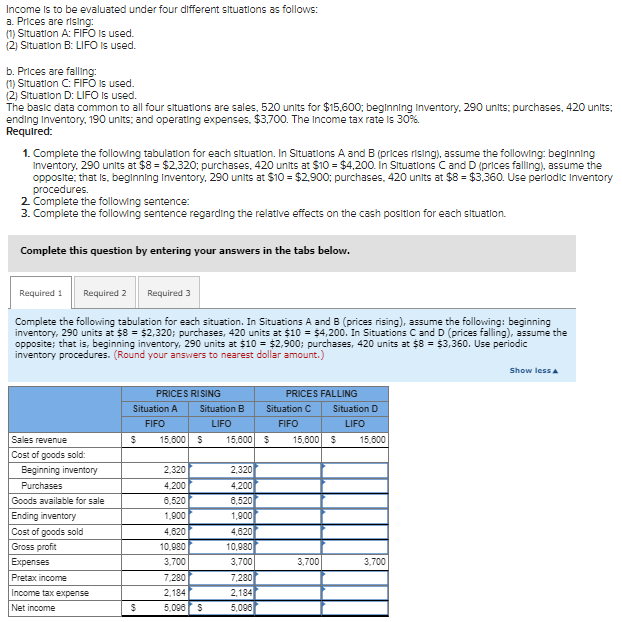
Income is to be evaluated under four different sltuations as follows: a. Prices are rising: (1) Sltuation A: FIFO is used. (2) SItuation B: LIFO Is used. b. Prices are falling: (1) Situation C: FIFO is used. (2) Situation D: LIFO Is used. The basic data common to all four sltuations are sales, 520 unlts for $15,600; beginning Inventory, 290 unlts; purchases, 420 unlts; ending inventory, 190 unlts; and operating expenses, $3,700. The income tax rate is 30%. Required: 1. Complete the following tabulation for each situation. In Situations A and B (prices rising), assume the following: beginning Inventory, 290 units at $8=$2,320; purchases, 420 units at $10=$4,200. In Sltuations C and D (prices falling), assume the opposite; that Is, beginning Inventory, 290 units at $10=$2,900; purchases, 420 unlts at $8=$3,360. Use periodic inventory procedures. 2. Complete the following sentence: 3. Complete the following sentence regarding the relative effects on the cash position for each situation. Complete this question by entering your answers in the tabs below. Complete the following tabulation for each situation. In Situations A and B (prices rising), assume the following: beginning inventory, 290 units at $8=$2,320; purchases, 420 units at $10=$4,200. In Situations C and D (prices falling), assume the opposite; that is, beginning inventory, 290 units at $10=$2,900; purchases, 420 units at $8=$3,360. Use periodic inventory procedures. (Round your answers to nearest dollar amount.) Income is to be evaluated under four different sltuations as follows: a. Prices are rising: (1) Sltuation A: FIFO is used. (2) SItuation B: LIFO Is used. b. Prices are falling: (1) Situation C: FIFO is used. (2) Situation D: LIFO Is used. The basic data common to all four sltuations are sales, 520 unlts for $15,600; beginning Inventory, 290 unlts; purchases, 420 unlts; ending inventory, 190 unlts; and operating expenses, $3,700. The income tax rate is 30%. Required: 1. Complete the following tabulation for each situation. In Situations A and B (prices rising), assume the following: beginning Inventory, 290 units at $8=$2,320; purchases, 420 units at $10=$4,200. In Sltuations C and D (prices falling), assume the opposite; that Is, beginning Inventory, 290 units at $10=$2,900; purchases, 420 unlts at $8=$3,360. Use periodic inventory procedures. 2. Complete the following sentence: 3. Complete the following sentence regarding the relative effects on the cash position for each situation. Complete this question by entering your answers in the tabs below. Complete the following tabulation for each situation. In Situations A and B (prices rising), assume the following: beginning inventory, 290 units at $8=$2,320; purchases, 420 units at $10=$4,200. In Situations C and D (prices falling), assume the opposite; that is, beginning inventory, 290 units at $10=$2,900; purchases, 420 units at $8=$3,360. Use periodic inventory procedures. (Round your answers to nearest dollar amount.)
Step by Step Solution
There are 3 Steps involved in it

Get step-by-step solutions from verified subject matter experts
 Study Help