







Question: filling in the empty spots in chart Developmental Trends Table The table below describes language-related behaviors of children and adolescents in five different age ranges.
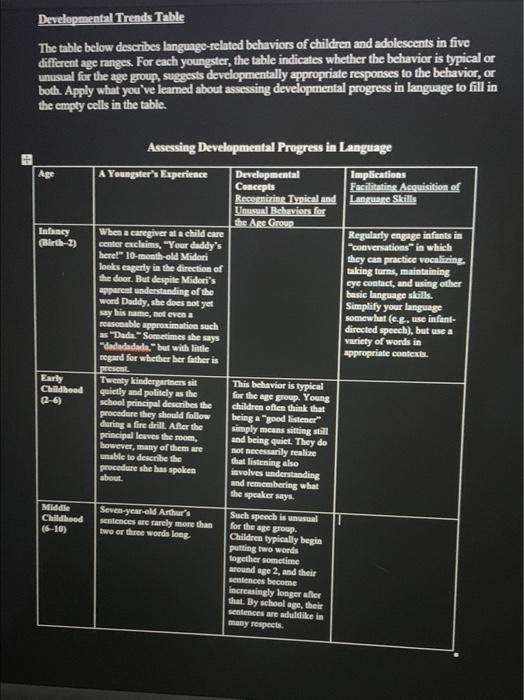
Developmental Trends Table The table below describes language-related behaviors of children and adolescents in five different age ranges. For each youngster, the table indicates whether the behavior is typical or unusual for the age group, suggests developmentally appropriate responses to the behavior, or both. Apply what you've learned about assessing developmental progress in language to fill in the empty cells in the table. Assessing Developmental Progress in Language Age A Youngster's Experience Developmental Concepts Recognizing Typical and Unusual Behaviors for the Age Group Implications Facilitating Acquisition of Languare Skills Infancy (Birth-2) When a caregiver at a child care center exclaims, "Your daddy's here! 10-month old Midori looks eagerly in the direction of the door. But despite Midori's apparent understanding of the wond Daddy, she does not yet way his name, not even a reasonable approximation such as "Dada Sometimes she says dadadadada.hut with little regard for whether her father is pesent Twenty kindergartners sit quietly and politely as the school principal describes the procedure they should follow during a fire drill. After the principal leaves the room, however, many of them are able to describe the procedure she has spoken about. Regularly engage infants in "Conversations in which they can practice vocalizing. taking turns, maintaining cye contact, and using other basic language skills. Simplify your language somewhat (c.g. use infant- directed speech), but use a variety of words in appropriate contexts. Early Childhood Q-6) Middle Childhood (6-10) Seven-year-old Arthur's sentences are rarely more than two or three words long This behavior is typical for the age group. Young children often think that being a "good listener simply means sitting still and being quiet. They do not necessarily realize that listening also involves understanding and remembering what the speaker says Such speech is unusual for the age group Children typically begin putting two words together sometime around age 2 and their sentences become increasingly longer after that. By school age, the sentences are adultlike in many respects
Step by Step Solution
There are 3 Steps involved in it

Get step-by-step solutions from verified subject matter experts
 Study Help