







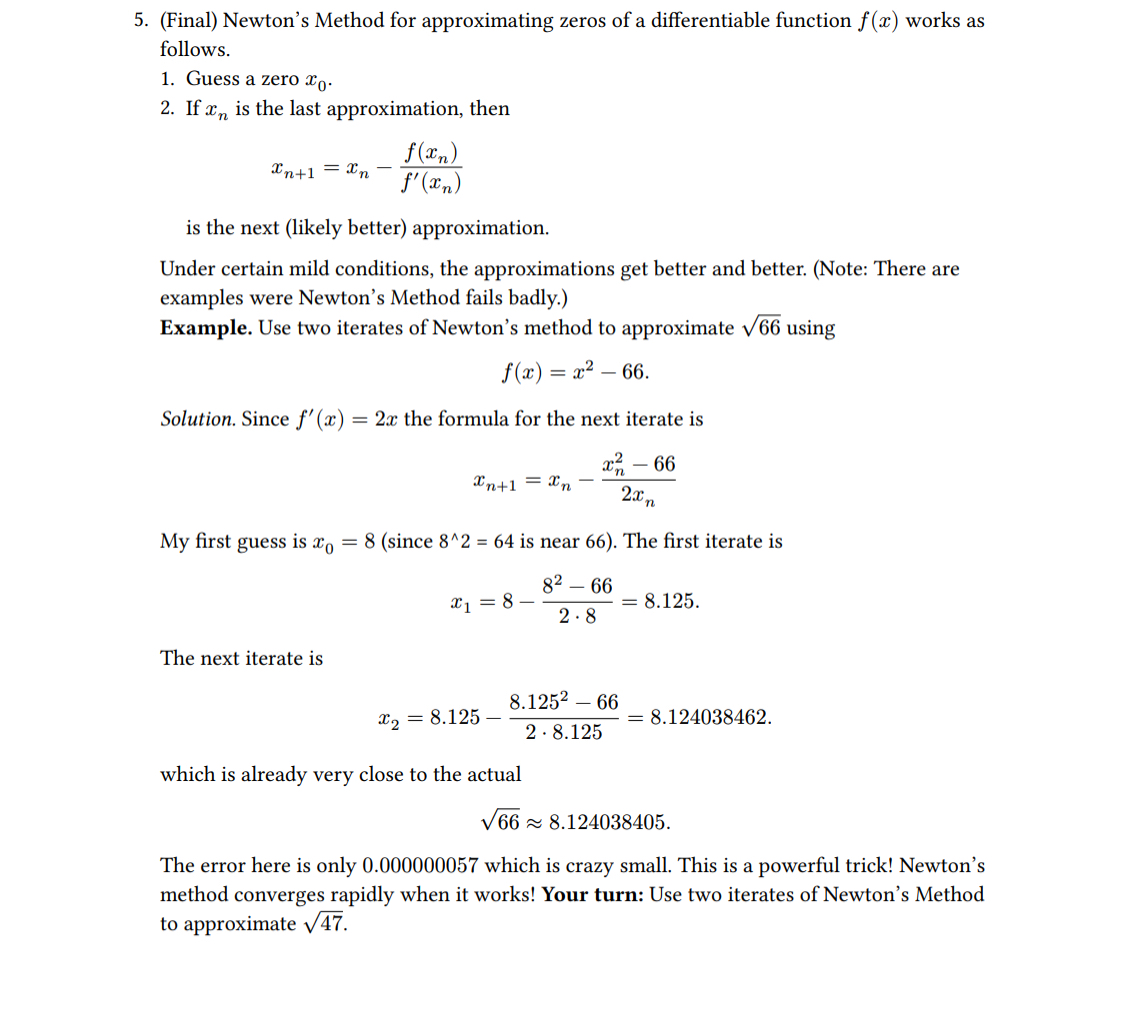
Question: ( Final ) Newton's Method for approximating zeros of a differentiable function f ( x ) works as follows. Guess a zero x 0 .
Final Newton's Method for approximating zeros of a differentiable function works as follows.
Guess a zero
If is the last approximation, then
is the next likely better approximation.
Under certain mild conditions, the approximations get better and better. Note: There are examples were Newton's Method fails badly.
Example. Use two iterates of Newton's method to approximate using
Solution. Since the formula for the next iterate is
My first guess is since is near The first iterate is
The next iterate is
which is already very close to the actual
~~
The error here is only which is crazy small. This is a powerful trick! Newton's method converges rapidly when it works! Your turn: Use two iterates of Newton's Method to approximate
Step by Step Solution
There are 3 Steps involved in it
1 Expert Approved Answer
Step: 1 Unlock

Question Has Been Solved by an Expert!
Get step-by-step solutions from verified subject matter experts
Step: 2 Unlock
Step: 3 Unlock
 Study Help