







Question: Final Practice T1 Q8 - Looking for a detailed worked solution with theoretical explanation This question has several parts. Please scroll down and try to
Final Practice T1 Q8 - Looking for a detailed worked solution with theoretical explanation
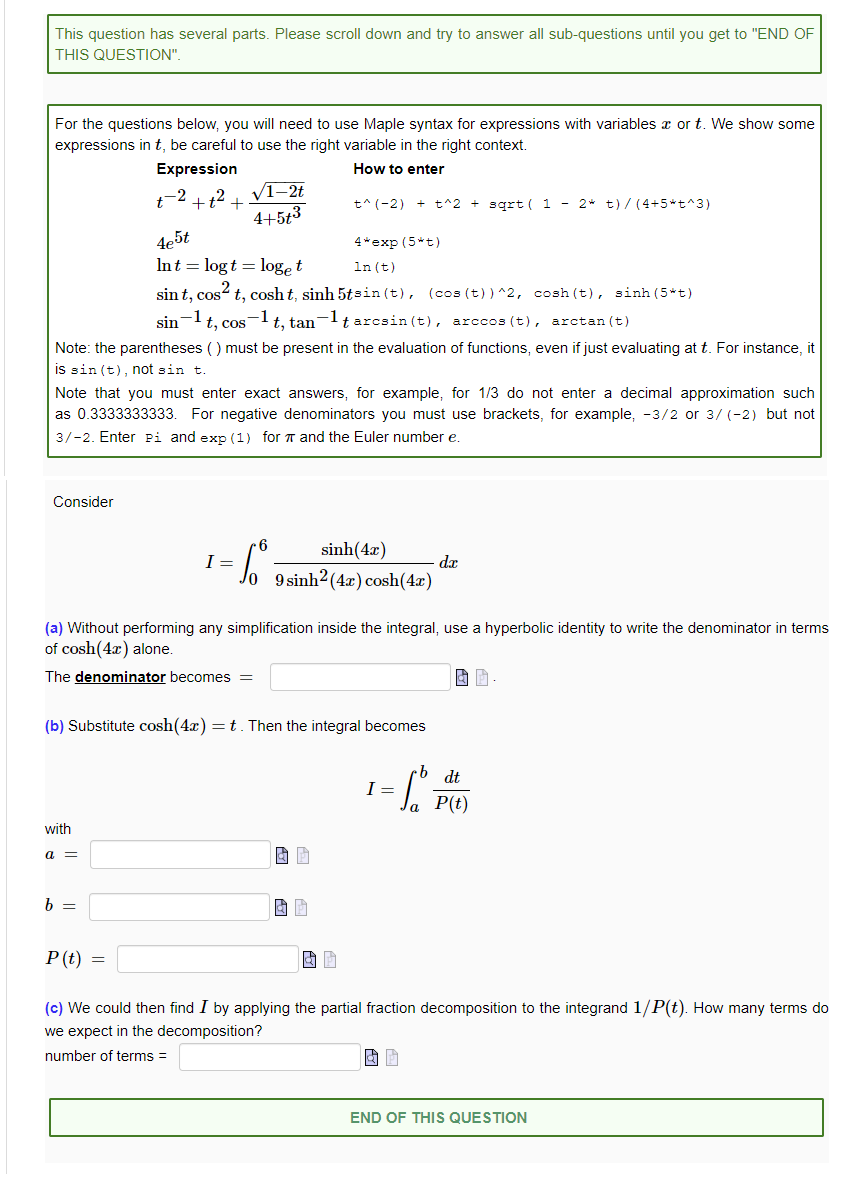
This question has several parts. Please scroll down and try to answer all sub-questions until you get to "END OF THIS QUESTION" For the questions below, you will need to use Maple syntax for expressions with variables a or t. We show some expressions in t, be careful to use the right variable in the right context. Expression How to enter t-2 + +2 - V1-2t to (-2) + t^2 + sqrt ( 1 - 2* t) / (4+5*t^3) 4+5+3 4e5t 4* exp (5*t) Int = logt = loget In (t) sint, cost, cosht, sinh 5tsin (t) , (cos (t) )^2, cosh (t), sinh (5*t) sin 1 t, cost, tan It arcsin (t) , arccos (t) , arctan (t) Note: the parentheses ( ) must be present in the evaluation of functions, even if just evaluating at t. For instance, it IS sin (t) , not sin t. Note that you must enter exact answers, for example, for 1/3 do not enter a decimal approximation such as 0.3333333333. For negative denominators you must use brackets, for example, -3/2 or 3/ (-2) but not 3/-2. Enter pi and exp (1) for 7 and the Euler number e. Consider I = sinh(4x) dx 9 sinh2 (4x) cosh(4x) (a) Without performing any simplification inside the integral, use a hyperbolic identity to write the denominator in terms of cosh (4x ) alone The denominator becomes = (b) Substitute cosh (4x) = t . Then the integral becomes I = .b dt Ja P(t) with a b = P(t) = (c) We could then find I by applying the partial fraction decomposition to the integrand 1/P(t). How many terms do we expect in the decomposition? number of terms = END OF THIS
Step by Step Solution
There are 3 Steps involved in it

Get step-by-step solutions from verified subject matter experts
 Study Help