



Question: find p What is the conclusion for this hypothesis test?A . Reject Ho. There is insufficient evidence to warrantrejection of the claim that the actual
find p What is the conclusion for this hypothesis test?A . Reject Ho. There is insufficient evidence to warrantrejection of the claim that the actual numbers of games fitthe distribution indicate by the expected proportions.B. Reject Ho. There is sufficient evidence to warrant rejectionof the claim that the actual numbers of games fit thedistribution indicated by the expected proportions.*c. Fail to reject Ho. There is sufficient evidence to warrantrejection of the claim that the actual numbers of games fitthe distribution indicated by the expected proportions.2 D. Fail to reject Ho. There is insufficient evidence to warrantrejection of the claim that the actual numbers of games fitthe distribution indicated by the expected proportions.
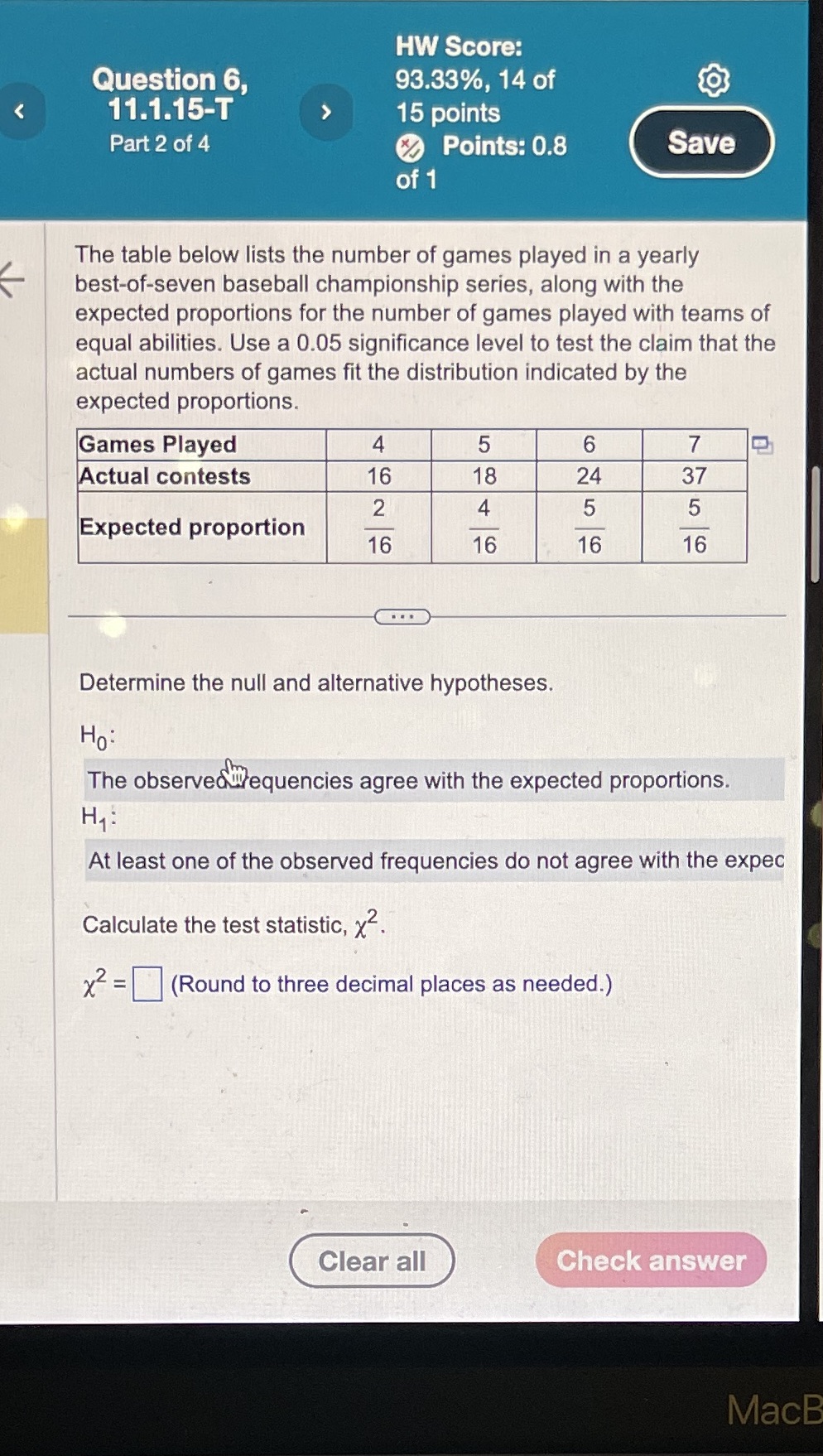
HW Score: Question 6, 93.33%, 14 of 11.1.15-T 15 points Part 2 of 4 Points: 0.8 Save of 1 The table below lists the number of games played in a yearly best-of-seven baseball championship series, along with the expected proportions for the number of games played with teams of equal abilities. Use a 0.05 significance level to test the claim that the actual numbers of games fit the distribution indicated by the expected proportions. Games Played 4 5 6 7 Actual contests 16 18 24 37 2 4 5 5 Expected proportion 16 16 16 16 Determine the null and alternative hypotheses. Ho: The observed#equencies agree with the expected proportions. Hy : At least one of the observed frequencies do not agree with the expec Calculate the test statistic, x2. x2 = (Round to three decimal places as needed.) Clear all Check answer MacB
Step by Step Solution
There are 3 Steps involved in it

Get step-by-step solutions from verified subject matter experts