







Question: Find the intervals on which f(x) is increasing, the intervals on which f(x) is decreasing, and the local extrema. f (x) =x+9x+8 . . .
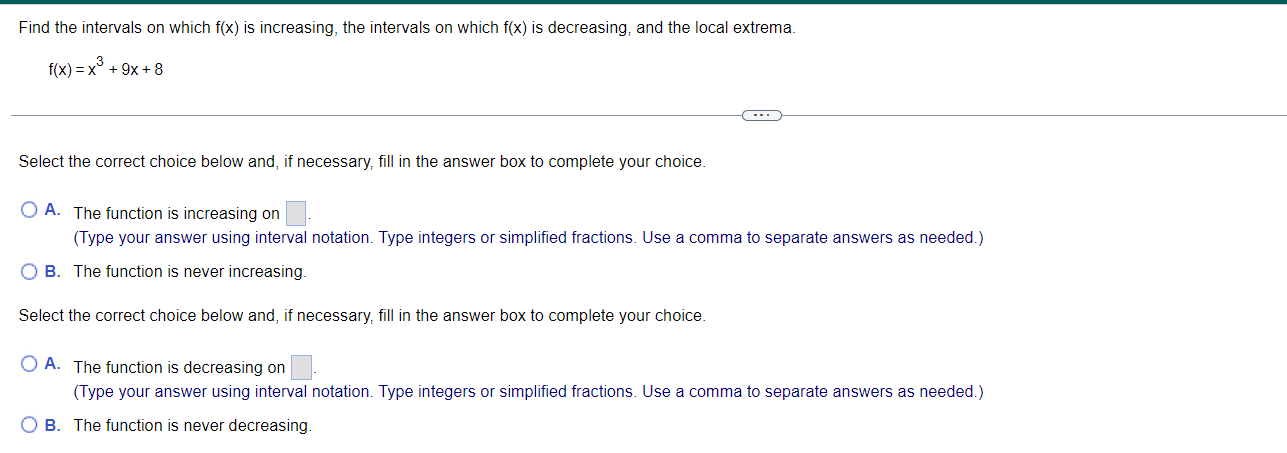
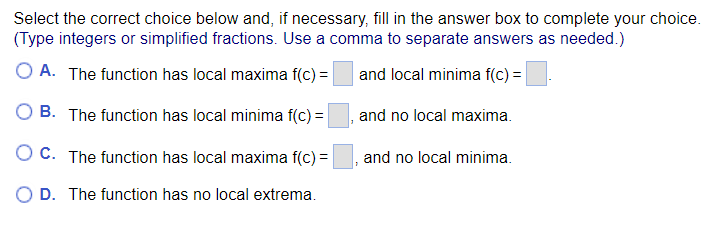
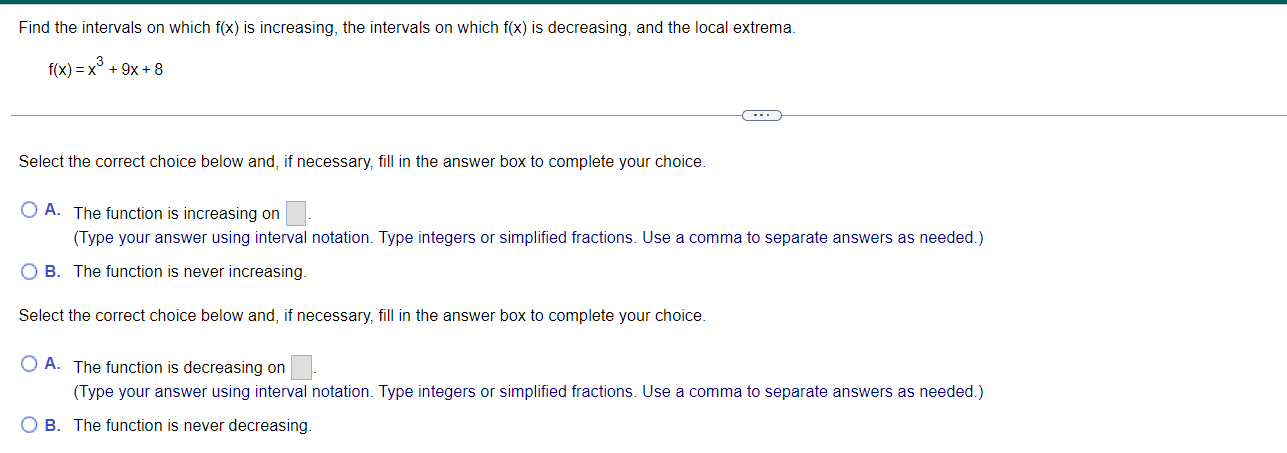
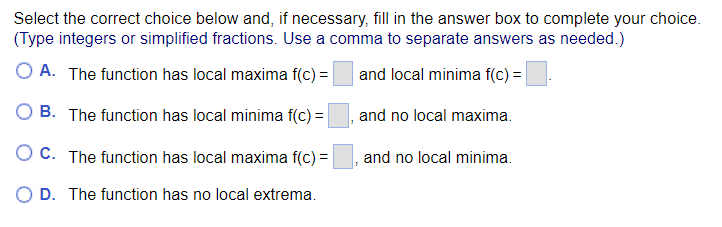
Find the intervals on which f(x) is increasing, the intervals on which f(x) is decreasing, and the local extrema. f (x) =x+9x+8 . . . Select the correct choice below and, if necessary, fill in the answer box to complete your choice. O A. The function is increasing on (Type your answer using interval notation. Type integers or simplified fractions. Use a comma to separate answers as needed.) O B. The function is never increasing. Select the correct choice below and, if necessary, fill in the answer box to complete your choice. O A. The function is decreasing on (Type your answer using interval notation. Type integers or simplified fractions. Use a comma to separate answers as needed.) O B. The function is never decreasing.Select the correct choice below and, if necessary, fill in the answer box to complete your choice. (Type integers or simplified fractions. Use a comma to separate answers as needed.) O A. The function has local maxima f(c) = and local minima f(c) = O B. The function has local minima f(c) = and no local maxima. O C. The function has local maxima f(c) = and no local minima. O D. The function has no local extrema
Step by Step Solution
There are 3 Steps involved in it

Get step-by-step solutions from verified subject matter experts
 Study Help