







Question: , find the limits. lim_(n->infty )2^(-n) lim_(n->infty )3^(n) lim_(n->infty )40(1-4^(-n)) lim_(n->infty )(2)/(1+2^(-n)) lim_(n->infty )a^(n) when a>1 lim_(n->infty )a^(n) when lim_(n->infty
, find the limits.\
\\\\lim_(n->\\\\infty )2^(-n)\
\\\\lim_(n->\\\\infty )3^(n)\
\\\\lim_(n->\\\\infty )40(1-4^(-n))\
\\\\lim_(n->\\\\infty )(2)/(1+2^(-n))\
\\\\lim_(n->\\\\infty )a^(n)when
a>1\
\\\\lim_(n->\\\\infty )a^(n)when
\\\\lim_(n->\\\\infty )(n(n+1))/(n^(2)-1)\\\\lim_(n->\\\\infty )(n^(2)+n-6)/(n-2)\\\\lim_(n->\\\\infty )(\\\\sqrt(n))/(n+1)\\\\lim_(n->\\\\infty )(n+1)/(\\\\sqrt(n))a_(n)na_(n),n=0,1,2,dots(1)/(2),(3)/(4),(5)/(6),(7)/(8),(9)/(10)(2)/(2),(6)/(4),(12)/(8),(20)/(16),(30)/(32)(1)/(2),(2)/(5),(3)/(10),(4)/(17),(5)/(26)0,(1)/(3),(2)/(4),(3)/(5),(4)/(6)tN_(1)N_(i+1)N_(i)N_(t+1)=N_(t)+{(:[ number of pups ]),( born in one year ):}-{(:[ number of wolves ]),( that die ):}N_(t)=0.28N22%N_(l)N_(0)=130N_(1)N_(1),N_(2),dots,N_(10)0\ \\\\lim_(n->\\\\infty )(n(n+1))/(n^(2)-1)\ \\\\lim_(n->\\\\infty )(n^(2)+n-6)/(n-2)\ \\\\lim_(n->\\\\infty )(\\\\sqrt(n))/(n+1)\ \\\\lim_(n->\\\\infty )(n+1)/(\\\\sqrt(n))\ In Problems 11-14, write a_(n) explicitly as a function of n on the\ basis of the first five terms of the sequence a_(n),n=0,1,2,dots.\ (1)/(2),(3)/(4),(5)/(6),(7)/(8),(9)/(10)\ (2)/(2),(6)/(4),(12)/(8),(20)/(16),(30)/(32)\ (1)/(2),(2)/(5),(3)/(10),(4)/(17),(5)/(26)\ 0,(1)/(3),(2)/(4),(3)/(5),(4)/(6)\ Saving the Red Wolf You are trying to build a mathemat-\ ical model for the size of the red wolf population in North\ Carolina. Red wolves are a critically endangered species, once\ found throughout the southeastern United States but now found\ mainly in a single North Carolina wildlife reserve. The data in\ this question come from U.S. Fish and Willife Service (2007).\ (a) If the population size t years after the start of a study on red\ wolf numbers is N_(1), start by writing a word equation so that N_(i+1)\ can be predicted from N_(i) :\ N_(t+1)=N_(t)+{(:[ number of pups ]),( born in one year ):}-{(:[ number of wolves ]),( that die ):}\ We will derive the formula of each of the terms in the word\ equation.\ (i) It is possible to count the number of pups born in given year.\ A subset of these data is given in the following table:\ Plot the number of pups against the population size N_(t). Show\ that the data are consistent with the following formula for the\ number of pups born in one year:\ Number of pups born in one year =0.28N,\ [Hint: Draw the line given by this equation on your data plot.]\ (ii) Independently conservationists are measuring the number\ of red wolf deaths in each year. Red wolves are killed by hunters\ and ranchers, or by being struck by vehicles. The conservation-\ ists estimate that in one year 22% of red wolves are killed. Write\ recurrence relation for the population size N_(l).\ (iii) Assuming that the current population size is N_(0)=130\ wolves, use your formula from (ii) to predict the population size\ N_(1) for the next 10 years (i.e., calculate N_(1),N_(2),dots,N_(10) ).\ (iv) The current conservation goal for the wild red wolf popula-\ tion is to reach 220 individuals. When, according to your model,\ will that population size be reached? 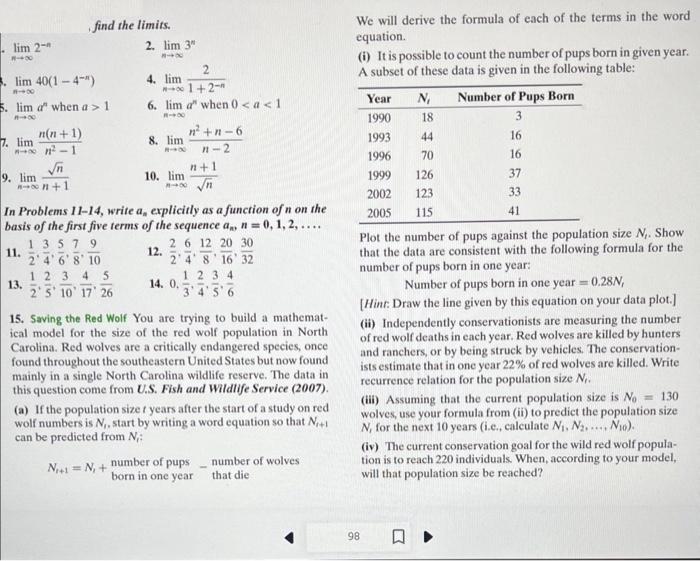
, find the limits. limn2n 2. limn3n limn40(14n) 4. limn1+2n2 5. limnn when a>1 6. limnan when 0
Step by Step Solution
There are 3 Steps involved in it
1 Expert Approved Answer
Step: 1 Unlock

Question Has Been Solved by an Expert!
Get step-by-step solutions from verified subject matter experts
Step: 2 Unlock
Step: 3 Unlock
 Study Help