







Question: Find the M values using the bisection method . DUE DATE: See Canvas (No late submission will be accepted) OBJECTIVES Formulate and solve the roots
Find the M values using the bisection method
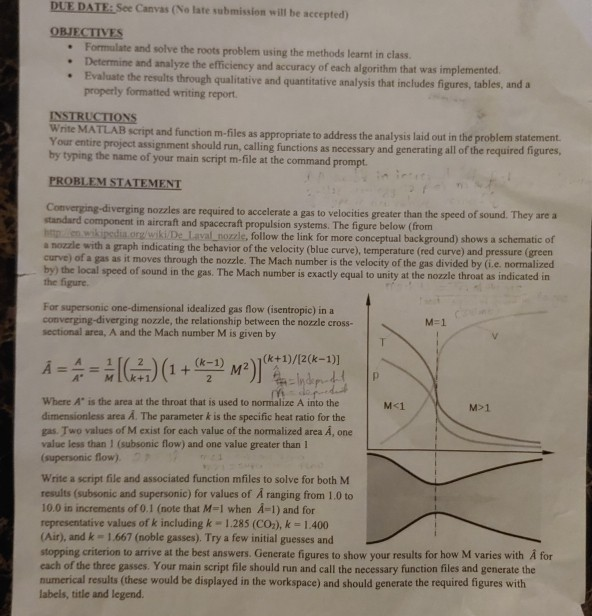
. DUE DATE: See Canvas (No late submission will be accepted) OBJECTIVES Formulate and solve the roots problem using the methods learnt in class. Determine and analyze the efficiency and accuracy of each algorithm that was implemented Evaluate the results through qualitative and quantitative analysis that includes figures, tables, and a properly formatted writing report. INSTRUCTIONS Write MATLAB script and function m-files as appropriate to address the analysis laid out in the problem statement Your entire project assignment should run, calling functions as necessary and generating all of the required figures, by typing the name of your main script m-file at the command prompt. PROBLEM STATEMENT Converging-diverging nozzles are required to accelerate a gas to velocities greater than the speed of sound. They are a standard component in aircraft and spacecraft propulsion systems. The figure below (from hon wikipedia.org/wiki/DeLaval_norrle, follow the link for more conceptual background) shows a schematic of a nozzle with a graph indicating the behavior of the velocity (blue curve), temperature (red curve) and pressure (green curve) of a gas as it moves through the nozzle. The Mach number is the velocity of the gas divided by (.e. normalized by) the local speed of sound in the gas. The Mach number is exactly equal to unity at the nozzle throat as indicated in the figure For supersonic one-dimensional idealized gas flow (isentropic) in a converging-diverging nozzle, the relationship between the nozzle cross- M=1 sectional area, A and the Mach number M is given by (k+1)/(2(k-1)] + P = Independt more Where A" is the area at the throat that is used to normalize A into the M1 dimensionless area A. The parameterk is the specific heat ratio for the gas. Two values of Mexist for each value of the normalized area A, one value less than 1 (subsonic flow) and one value greater than 1 (supersonic flow) Write a script file and associated function mfiles to solve for both M results (subsonic and supersonic) for values of A ranging from 1.0 to 10.0 in increments of 0.1 (note that M=1 when A-1) and for representative values of k including k-1.285 (CO2), k = 1.400 (Air), and k = 1.667 (noble gasses). Try a few initial guesses and stopping criterion to arrive at the best answers. Generate figures to show your results for how M varies with for cach of the three gasses. Your main script file should run and call the necessary function files and generate the numerical results (these would be displayed in the workspace) and should generate the required figures with labels, title and legend
Step by Step Solution
There are 3 Steps involved in it

Get step-by-step solutions from verified subject matter experts
 Study Help