







Question: Find the same solution please Figure 1 0 . 3 1 shows a 1 2 in . - 1 3 UNC grade 5 steel bolt
Find the same solution please
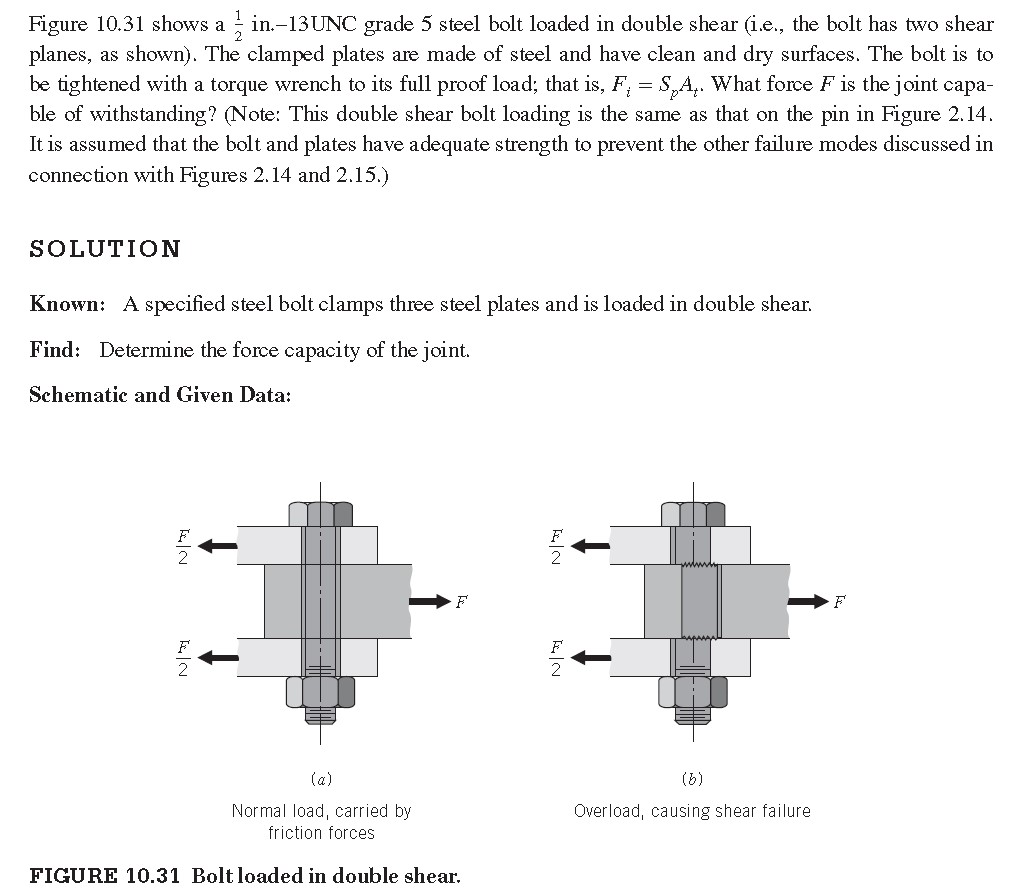
Figure shows a in UNC grade steel bolt loaded in double shear ie the bolt has two shear
planes, as shown The clamped plates are made of steel and have clean and dry surfaces. The bolt is to
be tightened with a torque wrench to its full proof load; that is What force is the joint capa
ble of withstanding? Note: This double shear bolt loading is the same as that on the pin in Figure
It is assumed that the bolt and plates have adequate strength to prevent the other failure modes discussed in
connection with Figures and
SOLUTION
Known: A specified steel bolt clamps three steel plates and is loaded in double shear.
Find: Determine the force capacity of the joint.
Schematic and Given Data: Assumptions:
The bolt is tightened to its full proof load; that is
The bolt fails in double shear.
The bolt and plates have adequate strength to prevent other failure modes.
The wrenchtorque variation is roughly
There is a initial loss in tension during the first few weeks of service see Section
Analysis:
For the inUNC grade steel bolt, Table gives and Table shows
that ksi. Specified initial tension is But
with a roughly estimated torquewrench variation and initialtension loss during the
first few weeks of service see Section a conservative assumption of working value of is
about lb
Reference gives a summary p of friction coefficients obtained with bolted plates. The coefficient
for semipolished steel is approximately and for sand or gritblasted steel approximately Various
paints, platings, and other surface treatments can alter the coefficient markedly, usually downward. Here
a friction coefficient of is assumed. This gives a force required to slip each of the two interfaces of
Thus, the value of required to overcome friction is estimated to be in the
region of lb
Although it is often desirable to limit applied load to the value that can be transmitted by friction, we
should know the larger value of force that can be transmitted through the bolt itself. For the two shear
planes involved, this force is equal to where is the area of the bolt at the shear planesin
this case, in Taking advantage of the fact that the distortion energy theory gives a
good estimate of shear yield strength for ductile metals, we have ksiksi.
Thus, for yielding of the two shear planes,
The estimated load would bring the shear stress to the yield strength over the entire cross
section of the shear planes, and the very small amount of yielding would probably result in losing most
or all of the clamping and friction forces. A further increase in load would cause total shear failure, as
indicated in Figure This total failure load is calculated as in step except for replacing with
From Eq~~ksi, the corresponding estimated load is
Comment: Note that in Figure the threaded portion of the bolt does not extend to the shear plane. This
is important for a bolt loaded in shear. Extending the thread to the shear plane is conservatively considered to
reduce the she ar area to a circle equal to the thread root diameter; in this case,
which is a reduction of
Step by Step Solution
There are 3 Steps involved in it
1 Expert Approved Answer
Step: 1 Unlock

Question Has Been Solved by an Expert!
Get step-by-step solutions from verified subject matter experts
Step: 2 Unlock
Step: 3 Unlock
 Study Help