







Question: Finding a Balance. / Where do you draw the line? / How does ethics play in your decision making? You are a new field engineer
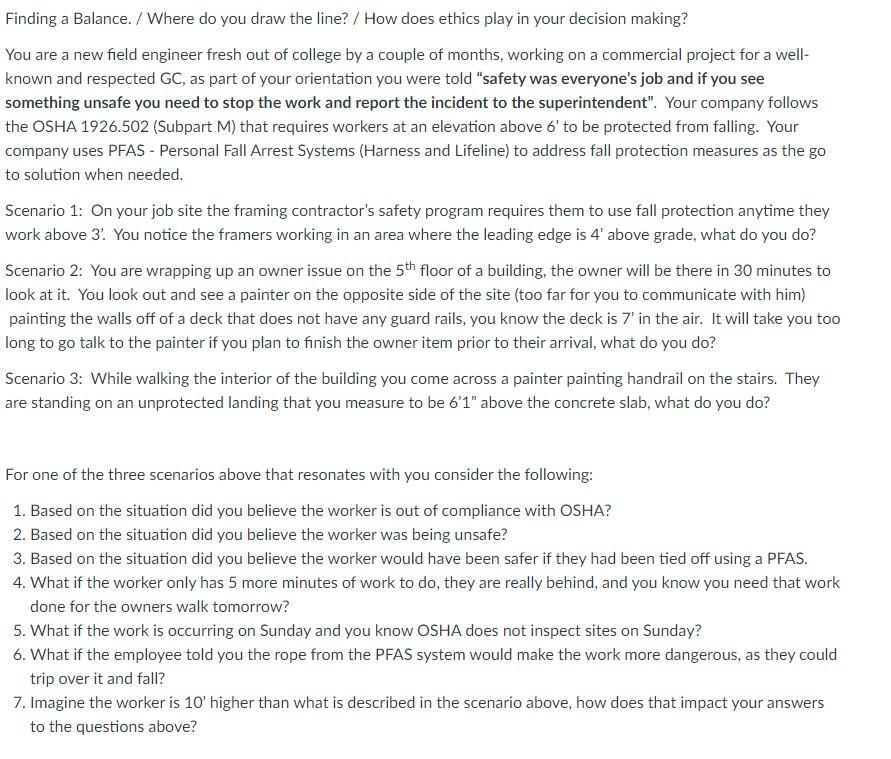
Finding a Balance. / Where do you draw the line? / How does ethics play in your decision making? You are a new field engineer fresh out of college by a couple of months, working on a commercial project for a wellknown and respected GC, as part of your orientation you were told "safety was everyone's job and if you see something unsafe you need to stop the work and report the incident to the superintendent". Your company follows the OSHA 1926.502 (Subpart M) that requires workers at an elevation above 6 ' to be protected from falling. Your company uses PFAS - Personal Fall Arrest Systems (Harness and Lifeline) to address fall protection measures as the go to solution when needed. Scenario 1: On your job site the framing contractor's safety program requires them to use fall protection anytime they work above 3'. You notice the framers working in an area where the leading edge is 4' above grade, what do you do? Scenario 2: You are wrapping up an owner issue on the 5th floor of a building, the owner will be there in 30 minutes to look at it. You look out and see a painter on the opposite side of the site (too far for you to communicate with him) painting the walls off of a deck that does not have any guard rails, you know the deck is 7 ' in the air. It will take you too long to go talk to the painter if you plan to finish the owner item prior to their arrival, what do you do? Scenario 3: While walking the interior of the building you come across a painter painting handrail on the stairs. They are standing on an unprotected landing that you measure to be 61 above the concrete slab, what do you do? For one of the three scenarios above that resonates with you consider the following: 1. Based on the situation did you believe the worker is out of compliance with OSHA? 2. Based on the situation did you believe the worker was being unsafe? 3. Based on the situation did you believe the worker would have been safer if they had been tied off using a PFAS. 4. What if the worker only has 5 more minutes of work to do, they are really behind, and you know you need that work done for the owners walk tomorrow? 5. What if the work is occurring on Sunday and you know OSHA does not inspect sites on Sunday? 6. What if the employee told you the rope from the PFAS system would make the work more dangerous, as they could trip over it and fall? 7. Imagine the worker is 10' higher than what is described in the scenario above, how does that impact your answers to the questions above? Finding a Balance. / Where do you draw the line? / How does ethics play in your decision making? You are a new field engineer fresh out of college by a couple of months, working on a commercial project for a wellknown and respected GC, as part of your orientation you were told "safety was everyone's job and if you see something unsafe you need to stop the work and report the incident to the superintendent". Your company follows the OSHA 1926.502 (Subpart M) that requires workers at an elevation above 6 ' to be protected from falling. Your company uses PFAS - Personal Fall Arrest Systems (Harness and Lifeline) to address fall protection measures as the go to solution when needed. Scenario 1: On your job site the framing contractor's safety program requires them to use fall protection anytime they work above 3'. You notice the framers working in an area where the leading edge is 4' above grade, what do you do? Scenario 2: You are wrapping up an owner issue on the 5th floor of a building, the owner will be there in 30 minutes to look at it. You look out and see a painter on the opposite side of the site (too far for you to communicate with him) painting the walls off of a deck that does not have any guard rails, you know the deck is 7 ' in the air. It will take you too long to go talk to the painter if you plan to finish the owner item prior to their arrival, what do you do? Scenario 3: While walking the interior of the building you come across a painter painting handrail on the stairs. They are standing on an unprotected landing that you measure to be 61 above the concrete slab, what do you do? For one of the three scenarios above that resonates with you consider the following: 1. Based on the situation did you believe the worker is out of compliance with OSHA? 2. Based on the situation did you believe the worker was being unsafe? 3. Based on the situation did you believe the worker would have been safer if they had been tied off using a PFAS. 4. What if the worker only has 5 more minutes of work to do, they are really behind, and you know you need that work done for the owners walk tomorrow? 5. What if the work is occurring on Sunday and you know OSHA does not inspect sites on Sunday? 6. What if the employee told you the rope from the PFAS system would make the work more dangerous, as they could trip over it and fall? 7. Imagine the worker is 10' higher than what is described in the scenario above, how does that impact your answers to the questions above
Step by Step Solution
There are 3 Steps involved in it

Get step-by-step solutions from verified subject matter experts
 Study Help