







Question: Finding a present value is the reverse of finding a future value. Which of the following is true about finding the present value of cash
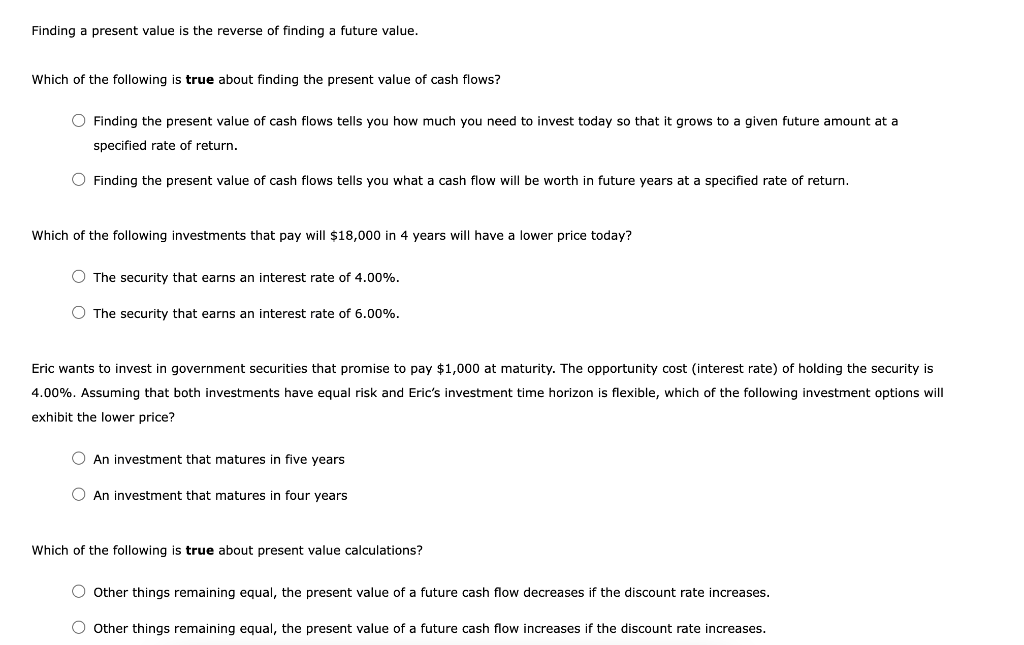
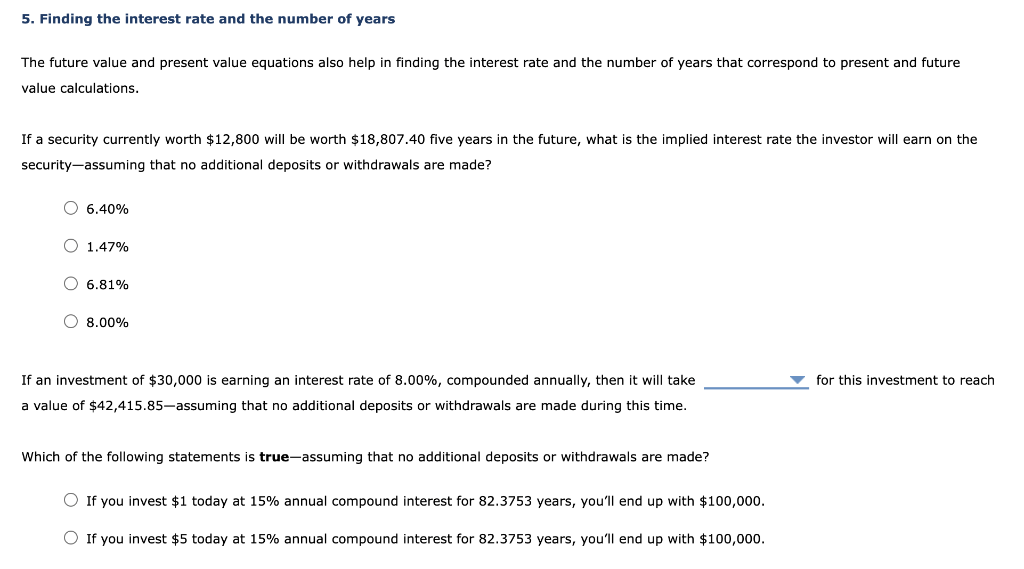
Finding a present value is the reverse of finding a future value. Which of the following is true about finding the present value of cash flows? Finding the present value of cash flows tells you how much you need to invest today so that it grows to a given future amount at a specified rate of return. Finding the present value of cash flows tells you what a cash flow will be worth in future years at a specified rate of return. Which of the following investments that pay will $18,000 in 4 years will have a lower price today? The security that earns an interest rate of 4.00%. The security that earns an interest rate of 6.00%. Eric wants to invest in government securities that promise to pay $1,000 at maturity. The opportunity cost (interest rate) of holding the security is 4.00%. Assuming that both investments have equal risk and Eric's investment time horizon is flexible, which of the following investment options will exhibit the lower price? An investment that matures in five years An investment that matures in four years Which of the following is true about present value calculations? Other things remaining equal, the present value of a future cash flow decreases if the discount rate increases. 5. Finding the interest rate and the number of years value calculations. If a security currently worth $12,800 will be worth $18,807.40 five years in the future, what is the implied interest rate the investor security-assuming that no additional deposits or withdrawals are made? 6.40% 1.47% 6.81% 8.00% If an investment of $30,000 is earning an interest rate of 8.00%, compounded annually, then it will take for this investment to reach a value of $42,415.85 assuming that no additional deposits or withdrawals are made during this time. Which of the following statements is true-assuming that no additional deposits or withdrawals are made? If you invest $1 today at 15% annual compound interest for 82.3753 years, you'll end up with $100,000. If you invest $5 today at 15% annual compound interest for 82.3753 years, you'll end up with $100,000
Step by Step Solution
There are 3 Steps involved in it

Get step-by-step solutions from verified subject matter experts
 Study Help