







Question: Finding optimal graph structures is an important optimization problem that has applications in several areas including machine learning itself, such as Bayesian Network Learning. The
Finding optimal graph structures is an important optimization problem that has applications in several
areas including machine learning itself, such as Bayesian Network Learning. The problem of Bayes
Net Learning can be simplified as the vertex ordering problem. Given a set of vertices the goal is to
determine a vertex ordering with the minimum cost. Consider the network below, which can be
represented by the ordering B C A:
Consider the following optimization problem. We are given vertices V Vn and possible parent
sets for each vertex. Each parent set has an associated cost. Let O be an ordering a permutation of the
vertices. We say that a parent set of a vertex Vi is consistent with an ordering O if all of the parents
come before the vertex in the ordering. Thus, C B A would be an inconsistent ordering for the above
network. Let mccViO be the minimum cost of the parent sets of vertex Vi that are consistent with
ordering O The task is to find an ordering of vertices O that minimizes the total cost of the network:
mccV O mccVn O:
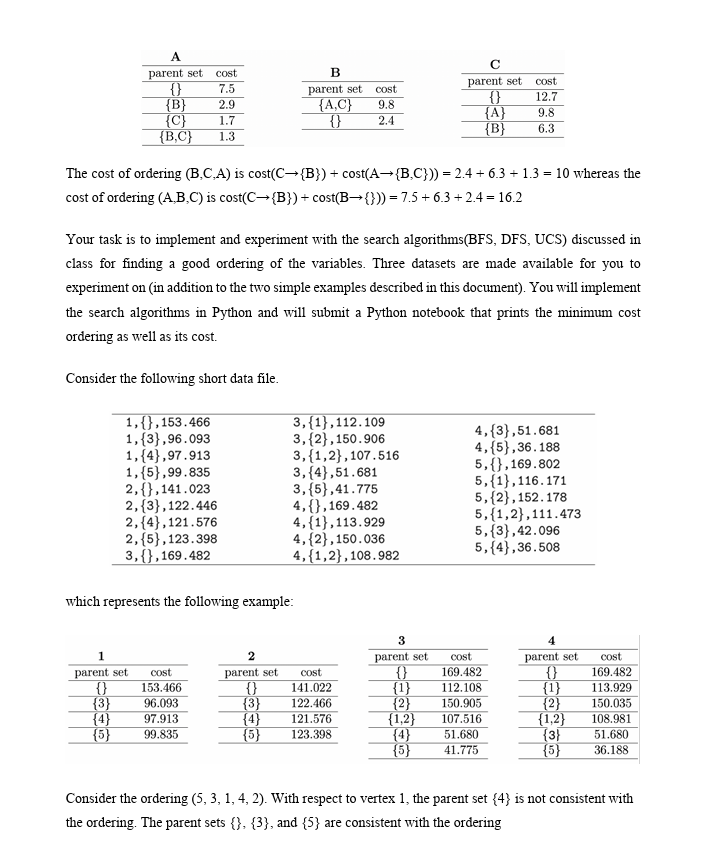
As an example, consider that you are not given the network above. Instead you are given the vertices
AB and C and their possible parent sets along with their cost as follows and given the task of finding
the minimium cost network.
The cost of ordering BCA is costCB costABC whereas the
cost of ordering ABC is costCB costB
Your task is to implement and experiment with the search algorithmsBFS DFS UCS discussed in
class for finding a good ordering of the variables. Three datasets are made available for you to
experiment on in addition to the two simple examples described in this document You will implement
the search algorithms in Python and will submit a Python notebook that prints the minimum cost
ordering as well as its cost.
Consider the following short data file.
which represents the following example:
Consider the ordering With respect to vertex the parent set is not consistent with
the ordering. The parent sets and are consistent with the ordering
The ordering has a total cost of
whereas the ordering has a total cost of
this is dataset for eg do on this
The cost of ordering is whereas the
cost of ordering is
Your task is to implement and experiment with the search algorithmsBFS DFS UCS discussed in
class for finding a good ordering of the variables. Three datasets are made available for you to
experiment on in addition to the two simple examples described in this document You will implement
the search algorithms in Python and will submit a Python notebook that prints the minimum cost
ordering as well as its cost.
Consider the following short data file.
which represents the following example:
Consider the ordering With respect to vertex the parent set is not consistent with
the ordering. The parent sets and are consistent with the ordering
Step by Step Solution
There are 3 Steps involved in it
1 Expert Approved Answer
Step: 1 Unlock

Question Has Been Solved by an Expert!
Get step-by-step solutions from verified subject matter experts
Step: 2 Unlock
Step: 3 Unlock
 Study Help