







Question: Finite math- multi step but one entire problem. Data is below. Please help with the entire problem. fOThis problem requires you to use numbers and/or
Finite math- multi step but one entire problem. Data is below. Please help with the entire problem.
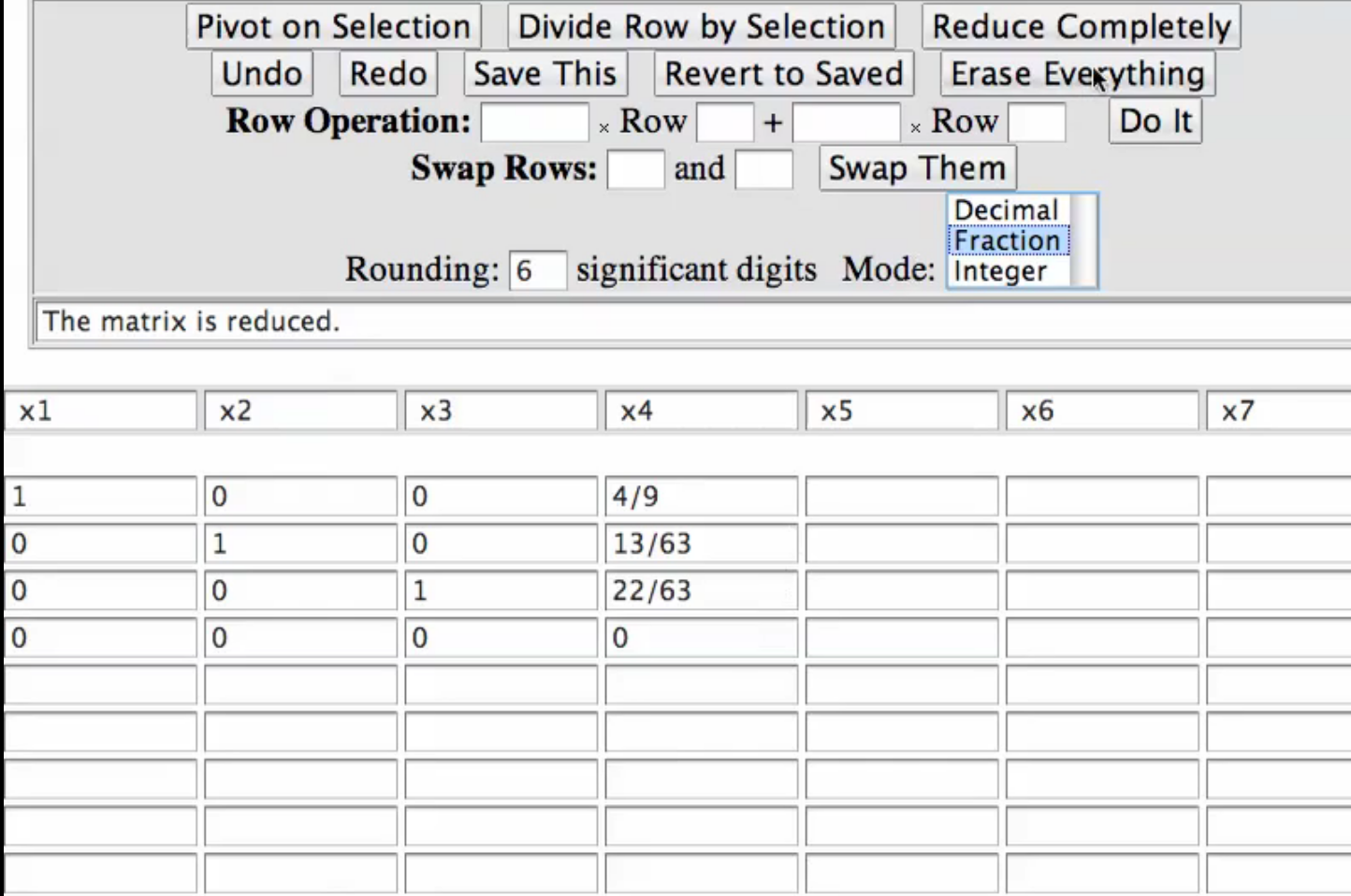
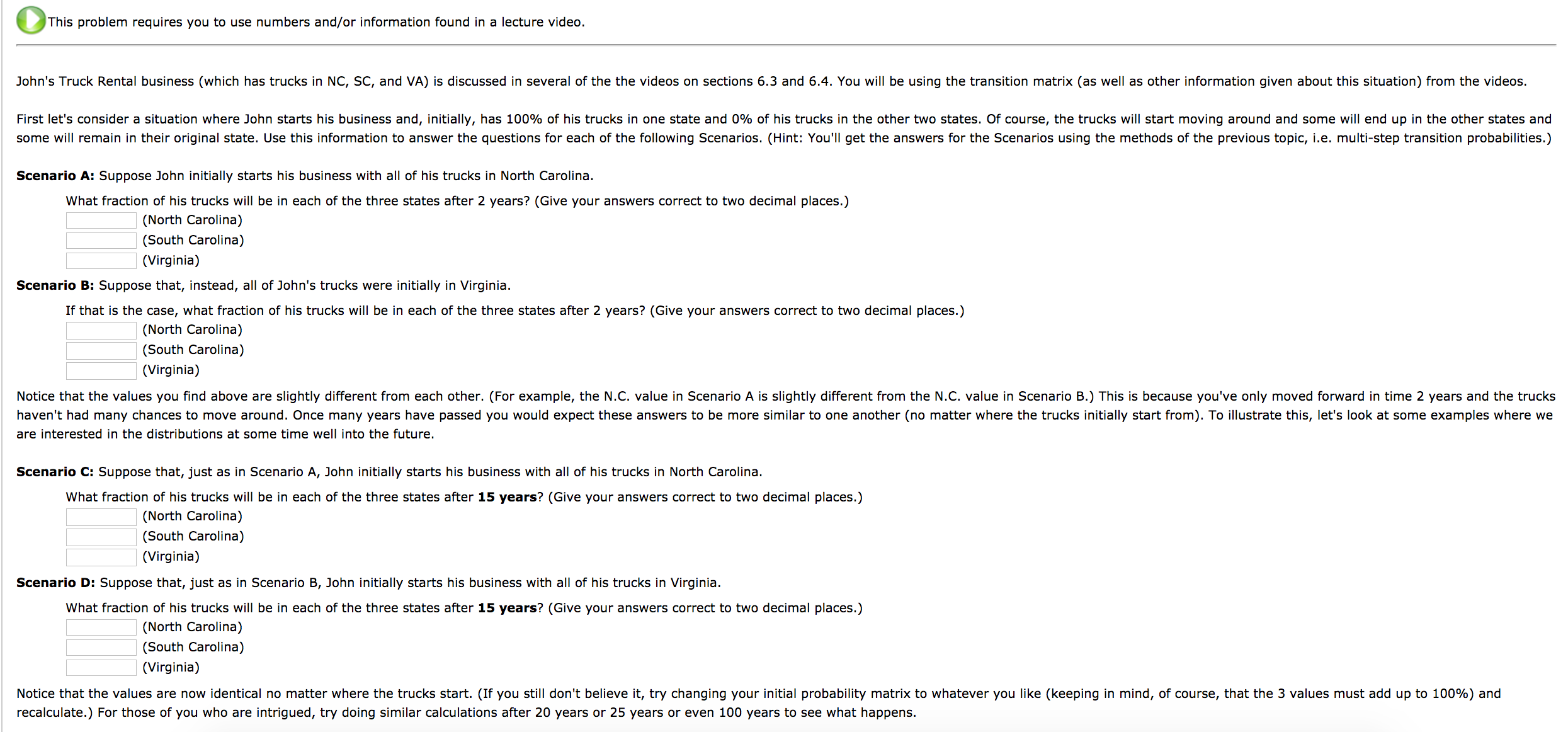

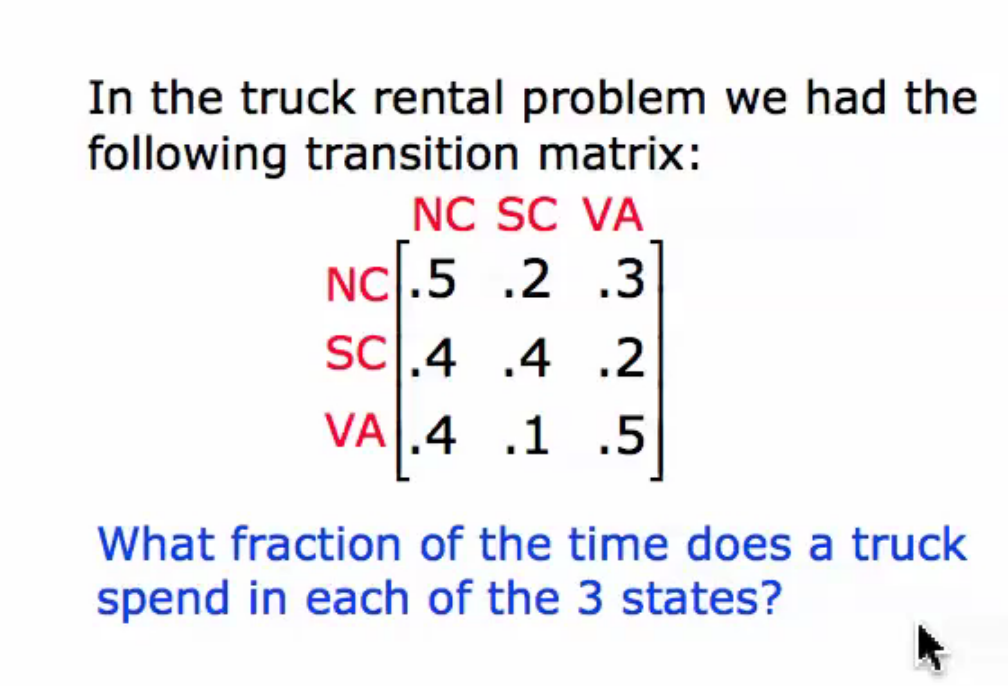
\fOThis problem requires you to use numbers and/or information found in a lecture video. John's Truck Rental business (which has trucks in NC, SC, and VA) is discussed in several of the the videos on sections 6.3 and 6.4. You will be using the transition matrix (as well as other information given about this situation) from the videos. First let's consider a situation where John starts his business and, initially, has 100% of his trucks In one state and 0% of his trucks in the other two states. Of course, the trucks will start moving around and some will end up in the other states and some will remain in their original state. Use this information to answer the questions for each of the following Scenarios. (Hint: You'll get the answers for the Scenarios using the methods of the previous topic, i.e. multi-step transition probabilities.) Scenario A: Suppose John initially starts his business with all of his trucks in North Carolina. What fraction of his trucks will be in each of the three states alter 2 years? (Give your answers correct to two decimal places.) (North Carolina) (South Carolina) , (Virginia) Scenario B: Suppose that, instead, all of John's trucks were initially in Virginia. If that is the case, what fraction of his trucks will be in each of the three states after 2 years? (Give your answers correct to two decimal places.) (North Carolina) (South Carolina) (Virginia) Notice that the values you nd above are slightly different from each other. (For example, the N.C. value in Scenario A is slightly different from the N.C. value in Scenario B.) This is because you've only moved forward in time 2 years and the trucks haven't had many chances to move around. Once many years have passed you would expect these answers to be more similarto one another (no matter where the trucks ini ially start from). To illustrate this, let's look at some examples where we are interested in the distributions at some time well into the future. Scenario C: Suppose that, just as in Scenario A, John initially starts his business with all of his trucks in North Carolina. What fraction of his trucks will be in each of the three states after 15 years? (Give your answers correct to two decimal places.) '77 (North Carolina) (South Carolina) (Virginia) Scenario D: Suppose that, just as in Scenario B, John initially starts his business with all of his trucks in Virginia. What fraction of his trucks will be in each of the three states alter 15 years? (Give your answers correct to two decimal places.) (North Carolina) (South Carolina) (Virginia) Notice that the values are now identical no matter where the trucks start. (If you still don't believe it, try changing your initial probability matrix to whatever you like (keeping in mind, of course, that the 3 values must add up to 100%) and recalculate.) For those of you who are intrigued, try doing similar calculations after 20 years or 25 years or even 100 years to see what happens. Finally, let's look at the steady-state distribution for John's truck rental business. The steady-state distribution for this situation is discussed at length in the videos on sections 6.3 and 6.4. At this time, recalculate the steady-state distribution from scratch 0R simply locate the steady-state distribution values (which can be found in one of the videos). What is the steady-state distribution? (Give your answers correct to four decimal places.) (North Carolina) 1 (South Carolina) 777] (Virginia) To understand the signicance of (and the reason for doing) this homework problem, compare your nal answers to your answers for the various scenarios. Submit Answer In the truck rental problem we had the following transition matrix: NC SC VA NC .5 .2 .3 5C .4 .4 .2 VA .4 .1 .5 What fraction of the time does a truck spend in each of the 3 states? *
Step by Step Solution
There are 3 Steps involved in it

Get step-by-step solutions from verified subject matter experts
 Study Help