







Question: First, derive the linear equations for Joint 3 ( i . e . , explain where they come from ) . Then solve the linear
First, derive the linear equations for Joint ie explain where they come from Then solve
the linear system of equations using Matlab. To do this, use the builtin Matlab function for
LU factorization as follows: LUP luA To solve the two resulting triangular systems,
you may use the operator Use the diary command to record the output from running your
script. Turnin your Matlab script and output for this problem.
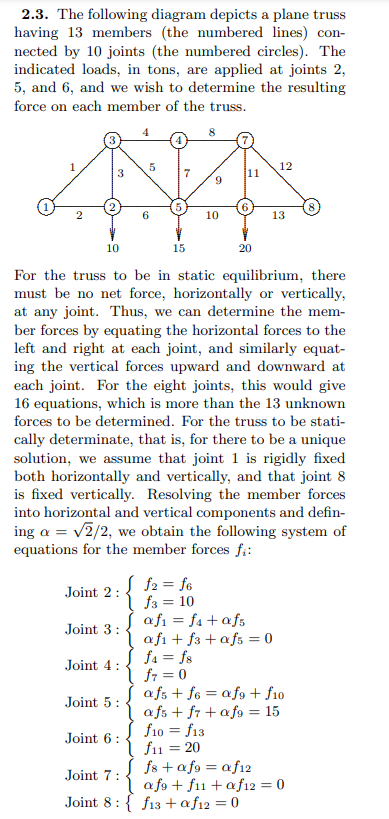
The following diagram depicts a plane truss
having members the numbered lines con
nected by joints the numbered circles The
indicated loads, in tons, are applied at joints
and and we wish to determine the resulting
force on each member of the truss.
For the truss to be in static equilibrium, there
must be no net force, horizontally or vertically,
at any joint. Thus, we can determine the mem
ber forces by equating the horizontal forces to the
left and right at each joint, and similarly equat
ing the vertical forces upward and downward at
each joint. For the eight joints, this would give
equations, which is more than the unknown
forces to be determined. For the truss to be stati
cally determinate, that is for there to be a unique
solution, we assume that joint is rigidly fixed
both horizontally and vertically, and that joint
is fixed vertically. Resolving the member forces
into horizontal and vertical components and defin
ing we obtain the following system of
equations for the member forces :
Joint :
Joint :
Joint :
Joint :
Joint :
Joint :
Joint :
Use a library routine to solve this system of linear
equations for the vector f of member forces. Note
that the matrix of this system is quite sparse, so you may wish to experiment with a banded system solver or more general sparse solver, although
this particular problem instance is too small for
these to offer significant advantage over a general
solver
Step by Step Solution
There are 3 Steps involved in it
1 Expert Approved Answer
Step: 1 Unlock

Question Has Been Solved by an Expert!
Get step-by-step solutions from verified subject matter experts
Step: 2 Unlock
Step: 3 Unlock
 Study Help