







Question: First, read the case titled, The Empowerment Plan (A): Providing Employment to Homeless Populations in Detroit. You will NOT be answering the questions listed at
First, read the case titled, "The Empowerment Plan (A): Providing Employment to Homeless Populations in Detroit." You will NOT be answering the questions listed at the end of case A. Reading this case is meant to give you the context of The Empowerment Plan (TEP).
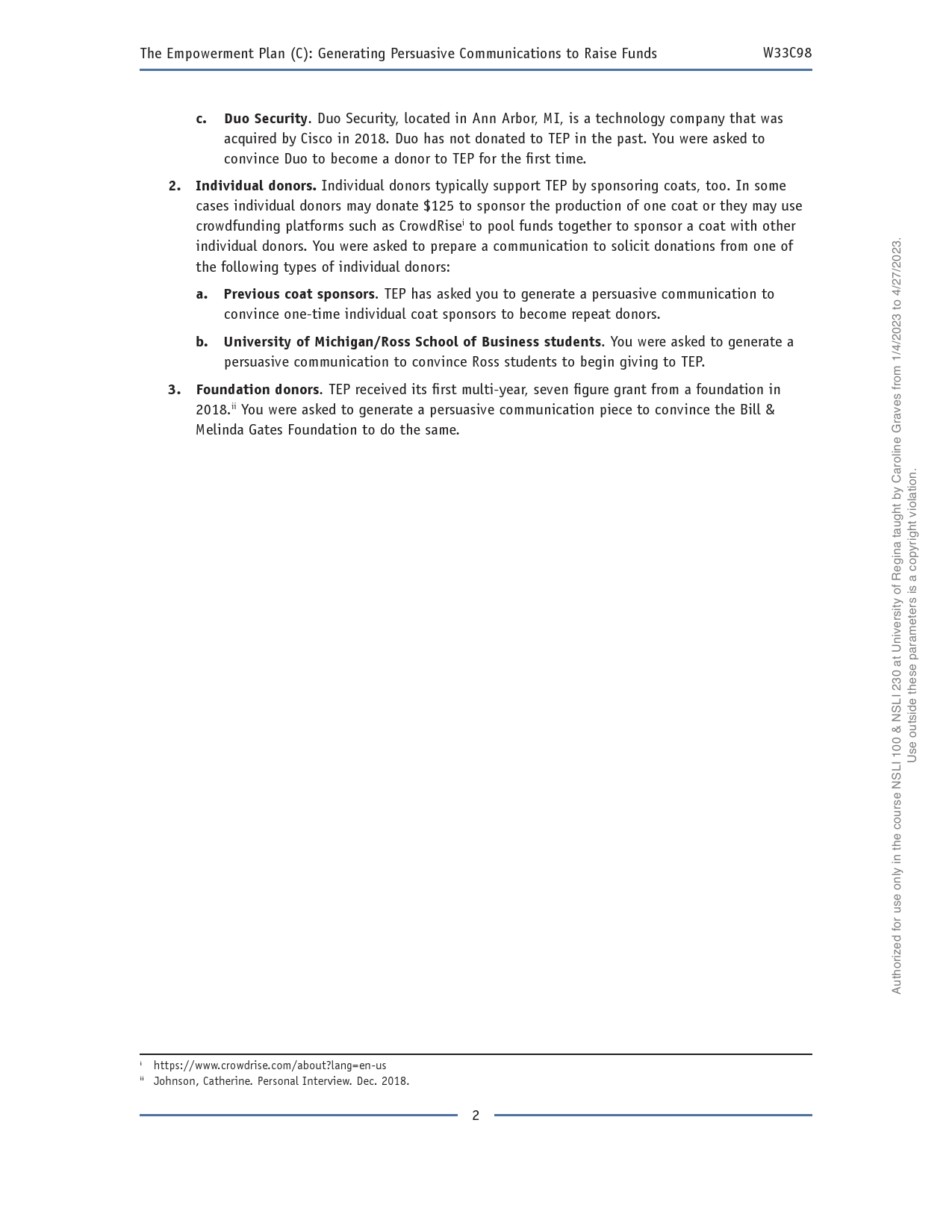
- After you have reviewed "The Empowerment Plan (A)", read, "The Empowerment Plan (C): Generating Persuasive Communications to Raise Funds in a Nonprofit Startup Organization."
- As outlined in this case, your role is to determine the best form of communication (e.g., presentation, e-mail, flyer, etc.) to reach your audience group and to craft your messaging by taking into account the relationship The Empowerment Plan (TEP) has built with the donors in the past, as well as how TEP would like to shape these relationships going forward.
- You may complete this assignment individually or in groups of your own choosing (maximum of four students).
- Your submission is to be a maximum of eight (8) pages.
- Use 12-point Times New Roman font, 1.5 line spacing, 1-inch margins, and include page numbers.
- Be sure to use the textbook and other academic literature to support your statements.
- APA is the required referencing style.
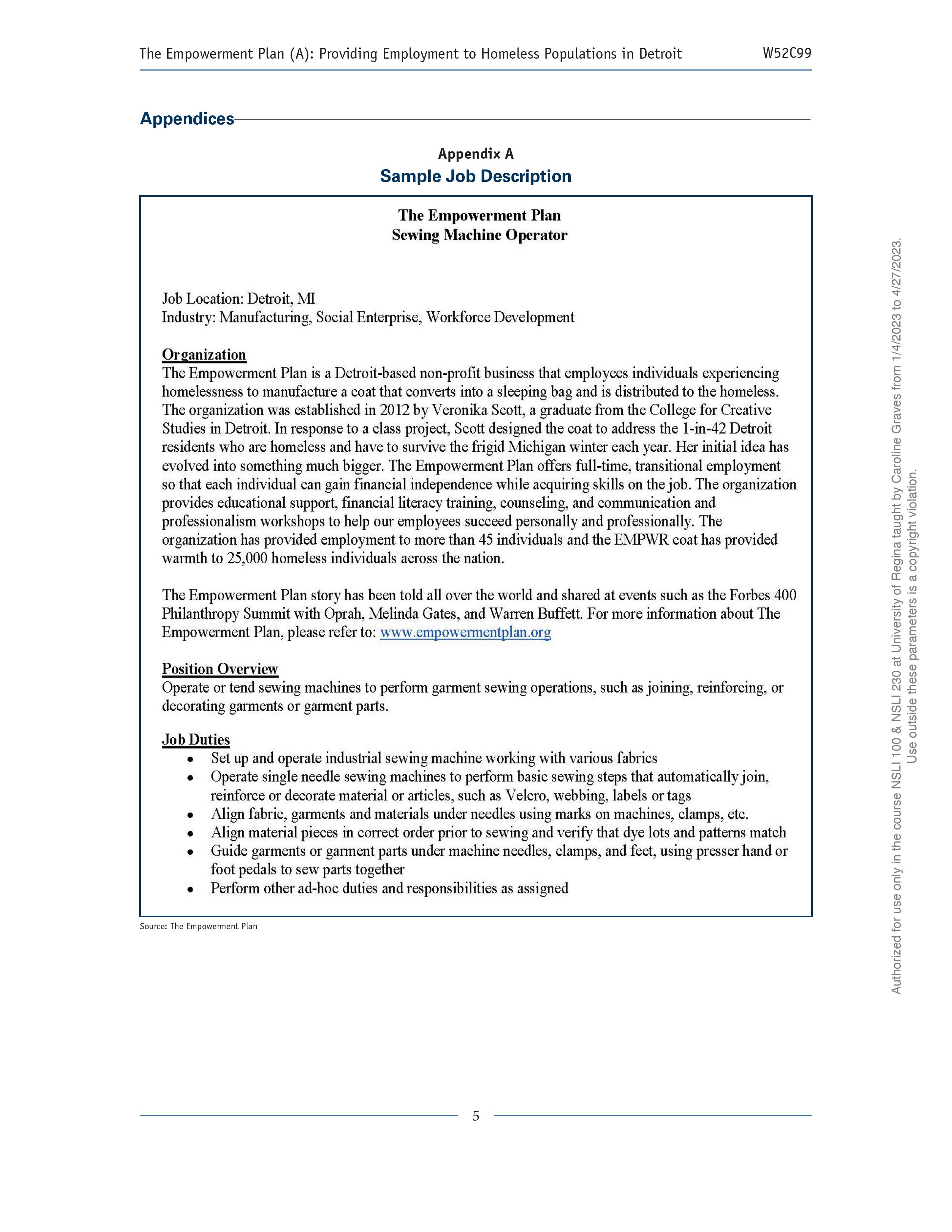
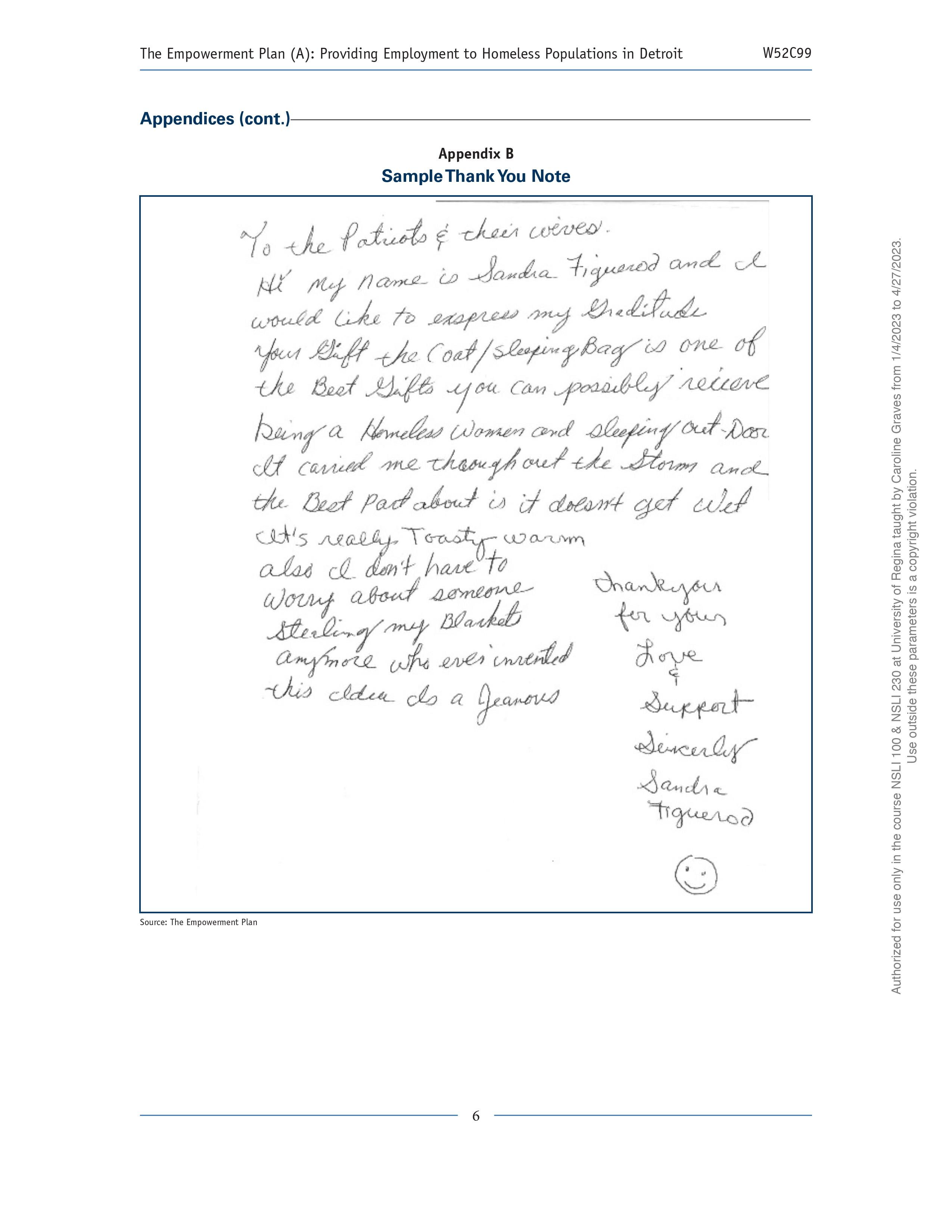
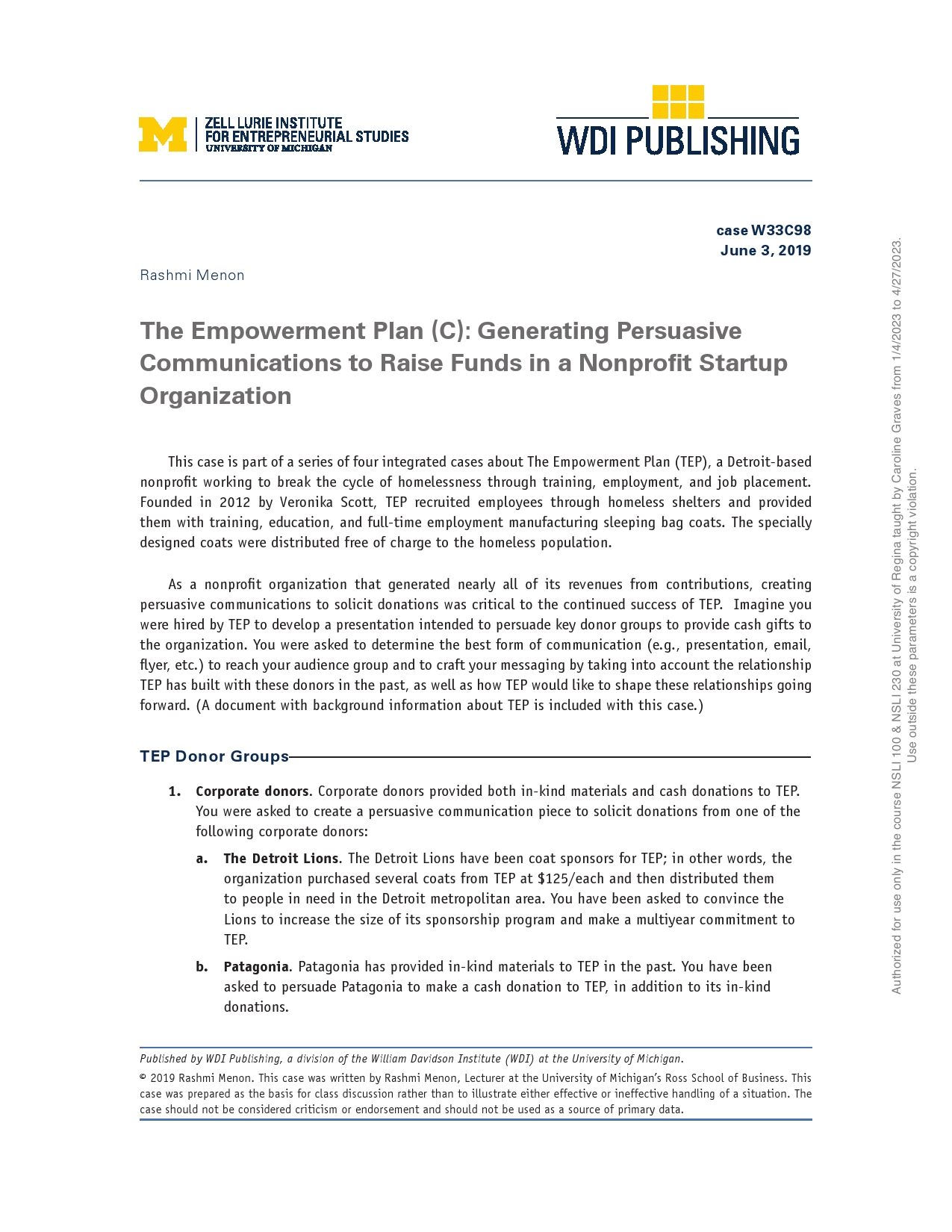
M ZELL LURIE INSTITUTE UNIVERSITY OF MICHIGAN FOR ENTREPRENEURIAL STUDIES WDI PUBLISHING Rashmi Menon case W52C99 June 3, 2019 The Empowerment Plan (A): Providing Employment to Homeless Populations in Detroit Authorized for use only in the course NSLI 100 & NSLI 230 at University of Regina taught by Caroline Graves from 1/4/2023 to 4/27/2023. Use outside these parameters is a copyright violation. This case is part of a series of four integrated cases about The Empowerment Plan (TEP), a Detroit-based nonprofit working to break the cycle of homelessness through training, employment, and job placement. Founded in 2012 by Veronika Scott, TEP recruited employees through homeless shelters and provided them with training, education, and full-time employment manufacturing sleeping bag coats. The specially designed coats were distributed free of charge to the homeless population. Scott developed the idea for TEP during a design class assignment at the College for Creative Studies in Detroit. The class challenged students to design a product to solve a social problem or need affecting the people of Detroit. Having personally grown up in an environment of housing instability due to family challenges with drug addiction, Scott chose to examine the needs of the homeless in Detroit. Adopting the principles of design thinking, Scott interviewed homeless people in Detroit to understand their needs and pain points and decided to focus on the problem of keeping them warm during the cold Detroit winters. She built a prototype of a winter coat that could also be used as a sleeping bag. She took her prototype to homeless shelters and received feedback that the first version of the coat looked too much like a "body bag." After making some adjustments to make the coat lighter and more portable, including the ability to fold the coat and wear it across the shoulders, Scott began distributing them. While Scott was distributing the coats, a homeless woman approached her and said, "We don't need coats. We need jobs." According to the National Coalition for the Homeless: ..climbing out of homelessness is virtually impossible for those without a job. For those with limited skills or experience, opportunities for jobs that pay a living wage are very limited. Additionally, many members of the homeless population have to combat barriers such as limited transportation and reduced access to educational and training programs. In such a competitive environment, the difficulties of job seeking as a homeless person can be almost insurmountable barriers to employment. Published by WDI Publishing, a division of the William Davidson Institute (WDI) at the University of Michigan. 2019 Rashmi Menon. This case was written by Rashmi Menon, Lecturer at the University of Michigan's Ross School of Business. This case was prepared as the basis for class discussion rather than to illustrate either effective or ineffective handling of a situation. The case should not be considered criticism or endorsement and should not be used as a source of primary data.
Step by Step Solution
There are 3 Steps involved in it
Title Crafting Persuasive Communications for The Empowerment Plan Introduction The Empowerment Plan TEP is a nonprofit organization dedicated to providing employment opportunities to homeless populati... View full answer

Get step-by-step solutions from verified subject matter experts
 Study Help