







Question: First you enter mistake probability(between0-1 egzample: 0.1, must work with precision up to 1/1000), Then enter m and r Then you choose between3 scenarios: Scenario
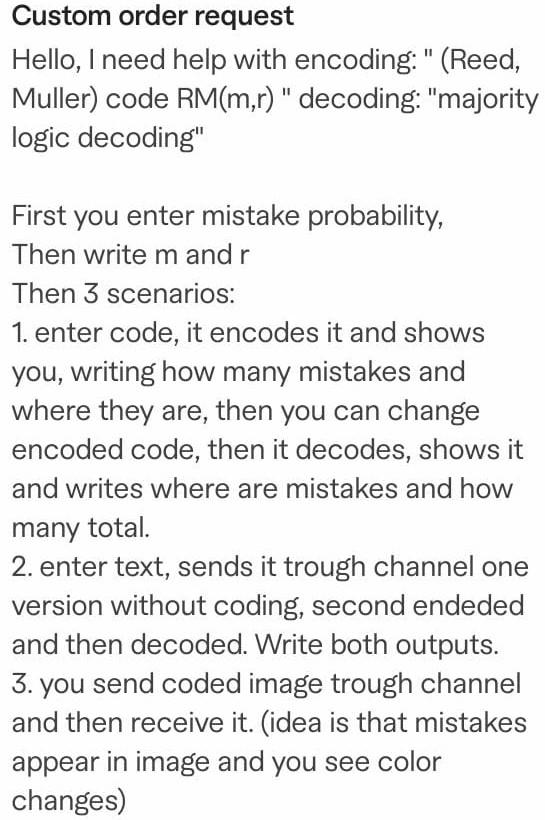
First you enter mistake probability(between0-1 egzample: 0.1, must work with precision up to 1/1000), Then enter m and r Then you choose between3 scenarios: Scenario 1 program writes what length code you can write you enter code program checks if length is correct, it encodes it, writes it then, send trough channel and shows you result after sending it, writing how many mistakes and in which positions they are. then program asks you if you want to change encoded message, you can change encoded code, check if length is correct, then it decodes trying to fix mistakes, shows it and writes where are mistakes and how many total. 2. enter text, sends it trough channel one version without coding, second endeded and then decoded. Write both outputs. 3. you send coded image trough channel and then receive it. (idea is that mistakes appear in image and you see color changes)
desired language Java or C kindly write detailed code
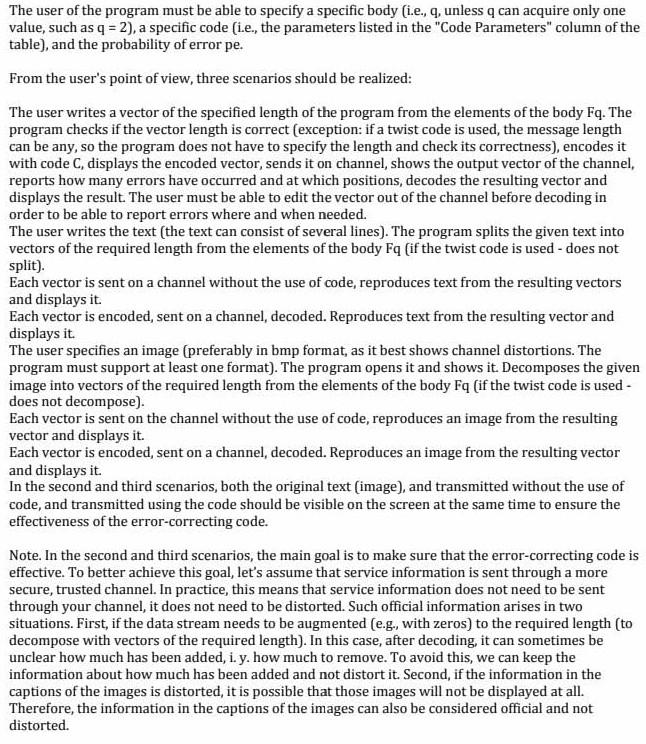
Custom order request Hello, I need help with encoding: " (Reed, Muller) code RM(m,n)" decoding: "majority logic decoding" First you enter mistake probability, Then write m andr Then 3 scenarios: 1. enter code, it encodes it and shows you, writing how many mistakes and where they are, then you can change encoded code, then it decodes, shows it and writes where are mistakes and how many total. 2. enter text, sends it trough channel one version without coding, second endeded and then decoded. Write both outputs. 3. you send coded image trough channel and then receive it. (idea is that mistakes appear in image and you see color changes) The user of the program must be able to specify a specific body (i.e., q, unless q can acquire only one value, such as q = 2), a specific code (i.e., the parameters listed in the "Code Parameters" column of the table), and the probability of error pe. From the user's point of view, three scenarios should be realized: The user writes a vector of the specified length of the program from the elements of the body Fq. The program checks if the vector length is correct (exception: if a twist code is used the message length can be any, so the program does not have to specify the length and check its correctness), encodes it with code C, displays the encoded vector, sends it on channel, shows the output vector of the channel, reports how many errors have occurred and at which positions, decodes the resulting vector and displays the result. The user must be able to edit the vector out of the channel before decoding in order to be able to report errors where and when needed. The user writes the text (the text can consist of several lines). The program splits the given text into vectors of the required length from the elements of the body Fq (if the twist code is used - does not split). Each vector is sent on a channel without the use of code, reproduces text from the resulting vectors and displays it Each vector is encoded, sent on a channel, decoded. Reproduces text from the resulting vector and displays it. The user specifies an image (preferably in bmp format, as it best shows channel distortions. The program must support at least one format). The program opens it and shows it. Decomposes the given image into vectors of the required length from the elements of the body Fq (if the twist code is used does not decompose). Each vector is sent on the channel without the use of code, reproduces an image from the resulting vector and displays it. Each vector is encoded, sent on a channel, decoded. Reproduces an image from the resulting vector and displays it. In the second and third scenarios, both the original text (image), and transmitted without the use of code, and transmitted using the code should be visible on the screen at the same time to ensure the effectiveness of the error-correcting code. Note. In the second and third scenarios, the main goal is to make sure that the error-correcting code is effective. To better achieve this goal, let's assume that service information is sent through a more secure, trusted channel. In practice, this means that service information does not need to be sent through your channel, it does not need to be distorted. Such official information arises in two situations. First, if the data stream needs to be augmented (e.g., with zeros) to the required length (to decompose with vectors of the required length). In this case, after decoding, it can sometimes be unclear how much has been added, i.y. how much to remove. To avoid this, we can keep the information about how much has been added and not distort it. Second, if the information in the captions of the images is distorted, it is possible that those images will not be displayed at all. Therefore, the information in the captions of the images can also be considered official and not distorted. Custom order request Hello, I need help with encoding: " (Reed, Muller) code RM(m,n)" decoding: "majority logic decoding" First you enter mistake probability, Then write m andr Then 3 scenarios: 1. enter code, it encodes it and shows you, writing how many mistakes and where they are, then you can change encoded code, then it decodes, shows it and writes where are mistakes and how many total. 2. enter text, sends it trough channel one version without coding, second endeded and then decoded. Write both outputs. 3. you send coded image trough channel and then receive it. (idea is that mistakes appear in image and you see color changes) The user of the program must be able to specify a specific body (i.e., q, unless q can acquire only one value, such as q = 2), a specific code (i.e., the parameters listed in the "Code Parameters" column of the table), and the probability of error pe. From the user's point of view, three scenarios should be realized: The user writes a vector of the specified length of the program from the elements of the body Fq. The program checks if the vector length is correct (exception: if a twist code is used the message length can be any, so the program does not have to specify the length and check its correctness), encodes it with code C, displays the encoded vector, sends it on channel, shows the output vector of the channel, reports how many errors have occurred and at which positions, decodes the resulting vector and displays the result. The user must be able to edit the vector out of the channel before decoding in order to be able to report errors where and when needed. The user writes the text (the text can consist of several lines). The program splits the given text into vectors of the required length from the elements of the body Fq (if the twist code is used - does not split). Each vector is sent on a channel without the use of code, reproduces text from the resulting vectors and displays it Each vector is encoded, sent on a channel, decoded. Reproduces text from the resulting vector and displays it. The user specifies an image (preferably in bmp format, as it best shows channel distortions. The program must support at least one format). The program opens it and shows it. Decomposes the given image into vectors of the required length from the elements of the body Fq (if the twist code is used does not decompose). Each vector is sent on the channel without the use of code, reproduces an image from the resulting vector and displays it. Each vector is encoded, sent on a channel, decoded. Reproduces an image from the resulting vector and displays it. In the second and third scenarios, both the original text (image), and transmitted without the use of code, and transmitted using the code should be visible on the screen at the same time to ensure the effectiveness of the error-correcting code. Note. In the second and third scenarios, the main goal is to make sure that the error-correcting code is effective. To better achieve this goal, let's assume that service information is sent through a more secure, trusted channel. In practice, this means that service information does not need to be sent through your channel, it does not need to be distorted. Such official information arises in two situations. First, if the data stream needs to be augmented (e.g., with zeros) to the required length (to decompose with vectors of the required length). In this case, after decoding, it can sometimes be unclear how much has been added, i.y. how much to remove. To avoid this, we can keep the information about how much has been added and not distort it. Second, if the information in the captions of the images is distorted, it is possible that those images will not be displayed at all. Therefore, the information in the captions of the images can also be considered official and not distorted
Step by Step Solution
There are 3 Steps involved in it

Get step-by-step solutions from verified subject matter experts
 Study Help