







Question: FIXED POINT DIGITAL FILTER Using integer math, a fixed-point digital filter is implemented with the (pseudo/C) code: FilterOut = 2240*SensorVal[0] - 2240*SensorVal[2] + 25519*FilterOutput[1] -
FIXED POINT DIGITAL FILTER
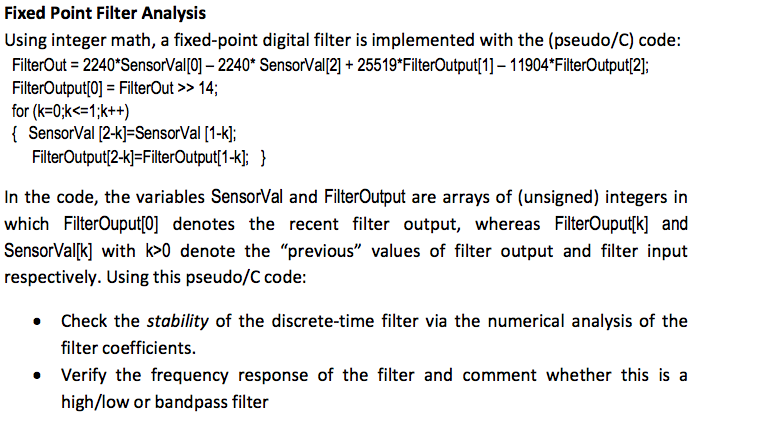
Using integer math, a fixed-point digital filter is implemented with the (pseudo/C) code: FilterOut = 2240*SensorVal[0] - 2240*SensorVal[2] + 25519*FilterOutput[1] - 11904*FilterOutput[2]; FilterOutput[0] = FilterOut >> 14; for (k=0; k=1; k++) {SensorVal[2-k]= SensorVal[1-k]; FilterOutput[2-k]= FilterOutput[1-k];} In the code, the variables SensorVal and FilterOutput are arrays of (unsigned) integers in which FilterOuputo[0] denotes the recent filter output, whereas FilterOuput[k] and SensorVal[k] with k>0 denote the "previous" values of filter output and filter input respectively. Using this pseudo/C code: Check the stability of the discrete-time filter via the numerical analysis of the filter coefficients. Verify the frequency response of the filter and comment whether this is a high/low or bandpass filter
Step by Step Solution
There are 3 Steps involved in it

Get step-by-step solutions from verified subject matter experts
 Study Help