



Question: Flanagan considers notes payable when calculating the weights of each financing source. Under what circumstances, if any, is this a defensible practice? TWO MEMORANDA When
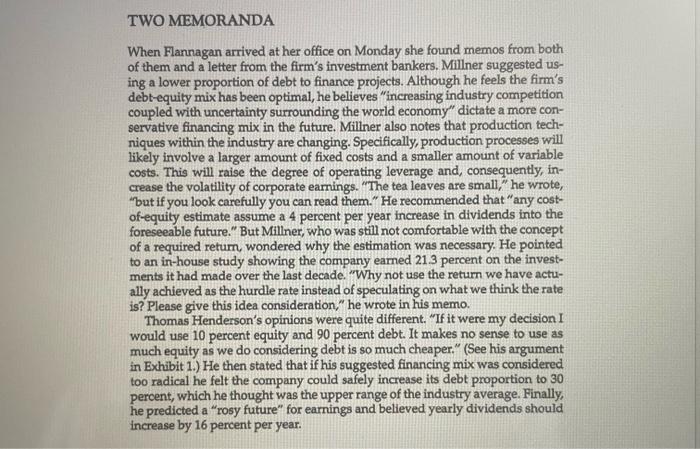
TWO MEMORANDA When Flannagan arrived at her office on Monday she found memos from both of them and a letter from the firm's investment bankers. Millner suggested us- ing a lower proportion of debt to finance projects. Although he feels the firm's debt-equity mix has been optimal, he believes "increasing industry competition coupled with uncertainty surrounding the world economy" dictate a more con- servative financing mix in the future. Millner also notes that production tech- niques within the industry are changing. Specifically, production processes will likely involve a larger amount of fixed costs and a smaller amount of variable costs. This will raise the degree of operating leverage and, consequently, in- crease the volatility of corporate earnings. "The tea leaves are small," he wrote, "but if you look carefully you can read them." He recommended that "any cost- of-equity estimate assume a 4 percent per year increase in dividends into the foreseeable future." But Millner, who was still not comfortable with the concept of a required return, wondered why the estimation was necessary. He pointed to an in-house study showing the company earned 21.3 percent on the invest- ments it had made over the last decade. "Why not use the return we have actu- ally achieved as the hurdle rate instead of speculating on what we think the rate is? Please give this idea consideration," he wrote in his memo. Thomas Henderson's opinions were quite different. "If it were my decision I would use 10 percent equity and 90 percent debt. It makes no sense to use as much equity as we do considering debt is so much cheaper." (See his argument in Exhibit 1.) He then stated that if his suggested financing mix was considered too radical he felt the company could safely increase its debt proportion to 30 percent, which he thought was the upper range of the industry average. Finally, he predicted a "rosy future" for earnings and believed yearly dividends should increase by 16 percent per year. TWO MEMORANDA When Flannagan arrived at her office on Monday she found memos from both of them and a letter from the firm's investment bankers. Millner suggested us- ing a lower proportion of debt to finance projects. Although he feels the firm's debt-equity mix has been optimal, he believes "increasing industry competition coupled with uncertainty surrounding the world economy" dictate a more con- servative financing mix in the future. Millner also notes that production tech- niques within the industry are changing. Specifically, production processes will likely involve a larger amount of fixed costs and a smaller amount of variable costs. This will raise the degree of operating leverage and, consequently, in- crease the volatility of corporate earnings. "The tea leaves are small," he wrote, "but if you look carefully you can read them." He recommended that "any cost- of-equity estimate assume a 4 percent per year increase in dividends into the foreseeable future." But Millner, who was still not comfortable with the concept of a required return, wondered why the estimation was necessary. He pointed to an in-house study showing the company earned 21.3 percent on the invest- ments it had made over the last decade. "Why not use the return we have actu- ally achieved as the hurdle rate instead of speculating on what we think the rate is? Please give this idea consideration," he wrote in his memo. Thomas Henderson's opinions were quite different. "If it were my decision I would use 10 percent equity and 90 percent debt. It makes no sense to use as much equity as we do considering debt is so much cheaper." (See his argument in Exhibit 1.) He then stated that if his suggested financing mix was considered too radical he felt the company could safely increase its debt proportion to 30 percent, which he thought was the upper range of the industry average. Finally, he predicted a "rosy future" for earnings and believed yearly dividends should increase by 16 percent per year
Step by Step Solution
There are 3 Steps involved in it

Get step-by-step solutions from verified subject matter experts