



Question: Flanagan considers notes payable when calculating the weights of each financing source. Under what circumstances, if any, is this a defensible practice? Explain. Evaluate Thomas
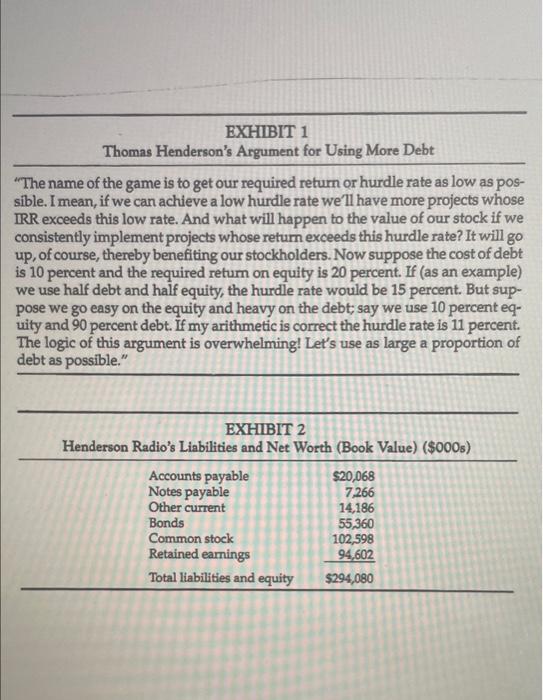
EXHIBIT 1 Thomas Henderson's Argument for Using More Debt "The name of the game is to get our required return or hurdle rate as low as pos- sible. I mean, if we can achieve a low hurdle rate we'll have more projects whose IRR exceeds this low rate. And what will happen to the value of our stock if we consistently implement projects whose return exceeds this hurdle rate? It will go up, of course, thereby benefiting our stockholders. Now suppose the cost of debt is 10 percent and the required return on equity is 20 percent. If (as an example) we use half debt and half equity, the hurdle rate would be 15 percent. But sup- pose we go easy on the equity and heavy on the debt; say we use 10 percent eq- uity and 90 percent debt. If my arithmetic is correct the hurdle rate is 11 percent. The logic of this argument is overwhelming! Let's use as large a proportion of debt as possible." EXHIBIT 2 Henderson Radio's Liabilities and Net Worth (Book Value) ($000s) $20,068 Accounts payable Notes payable Other current 7,266 14,186 Bonds 55,360 Common stock 102,598 Retained earnings 94,602 Total liabilities and equity $294,080 EXHIBIT 1 Thomas Henderson's Argument for Using More Debt "The name of the game is to get our required return or hurdle rate as low as pos- sible. I mean, if we can achieve a low hurdle rate we'll have more projects whose IRR exceeds this low rate. And what will happen to the value of our stock if we consistently implement projects whose return exceeds this hurdle rate? It will go up, of course, thereby benefiting our stockholders. Now suppose the cost of debt is 10 percent and the required return on equity is 20 percent. If (as an example) we use half debt and half equity, the hurdle rate would be 15 percent. But sup- pose we go easy on the equity and heavy on the debt; say we use 10 percent eq- uity and 90 percent debt. If my arithmetic is correct the hurdle rate is 11 percent. The logic of this argument is overwhelming! Let's use as large a proportion of debt as possible." EXHIBIT 2 Henderson Radio's Liabilities and Net Worth (Book Value) ($000s) $20,068 Accounts payable Notes payable Other current 7,266 14,186 Bonds 55,360 Common stock 102,598 Retained earnings 94,602 Total liabilities and equity $294,080
Step by Step Solution
There are 3 Steps involved in it

Get step-by-step solutions from verified subject matter experts