







Question: Floating Point Binary Numbers To represent negative numbers, we bias floating point numbers by simply adding a value to the exponent. We typically choose this
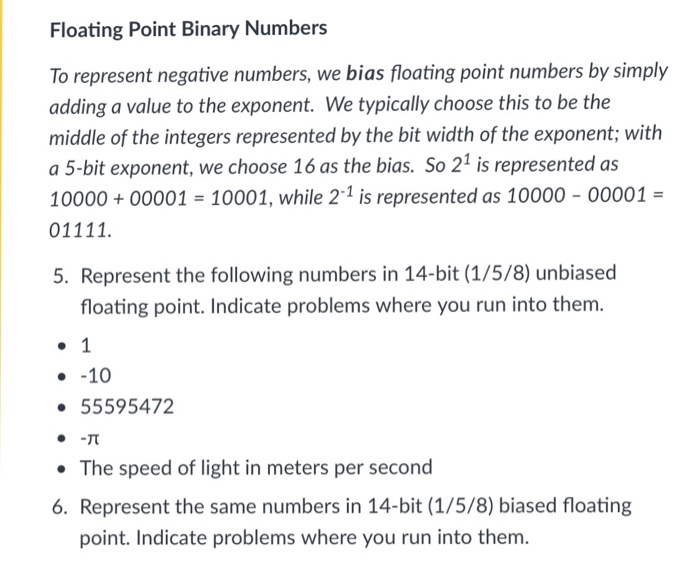
Floating Point Binary Numbers To represent negative numbers, we bias floating point numbers by simply adding a value to the exponent. We typically choose this to be the middle of the integers represented by the bit width of the exponent; with a 5-bit exponent, we choose 16 as the bias. So 21 is represented as 10000 + 00001 = 10001, while 2-1 is represented as 10000-00001 5. Represent the following numbers in 14-bit (1/5/8) unbiased floating point. Indicate problems where you run into them. -10 55595472 - The speed of light in meters per second 6. Represent the same numbers in 14-bit (1/5/8) biased floating point. Indicate problems where you run into them
Step by Step Solution
There are 3 Steps involved in it

Get step-by-step solutions from verified subject matter experts
 Study Help