







Question: Flow of Program Execution (10pts) 1. In the class, we explored how a program is executed by using a register file. Fill the blanks to
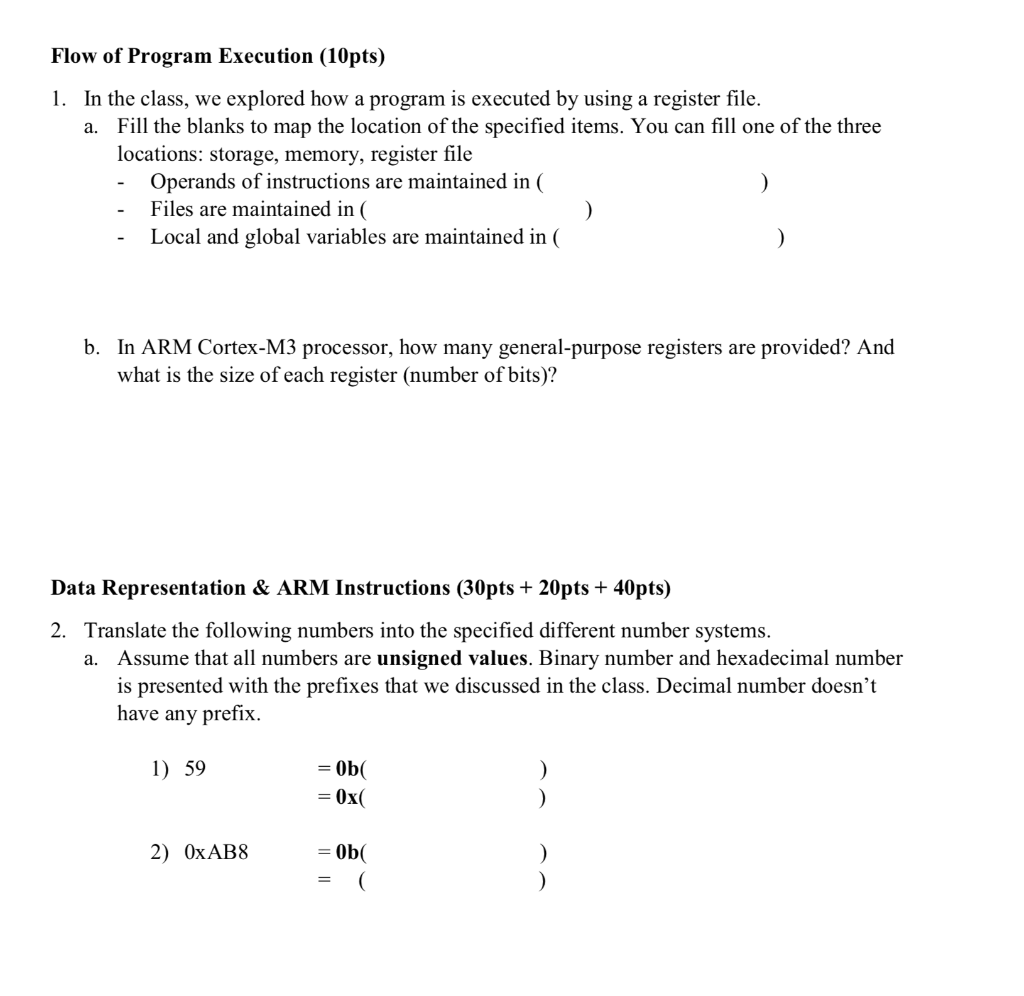
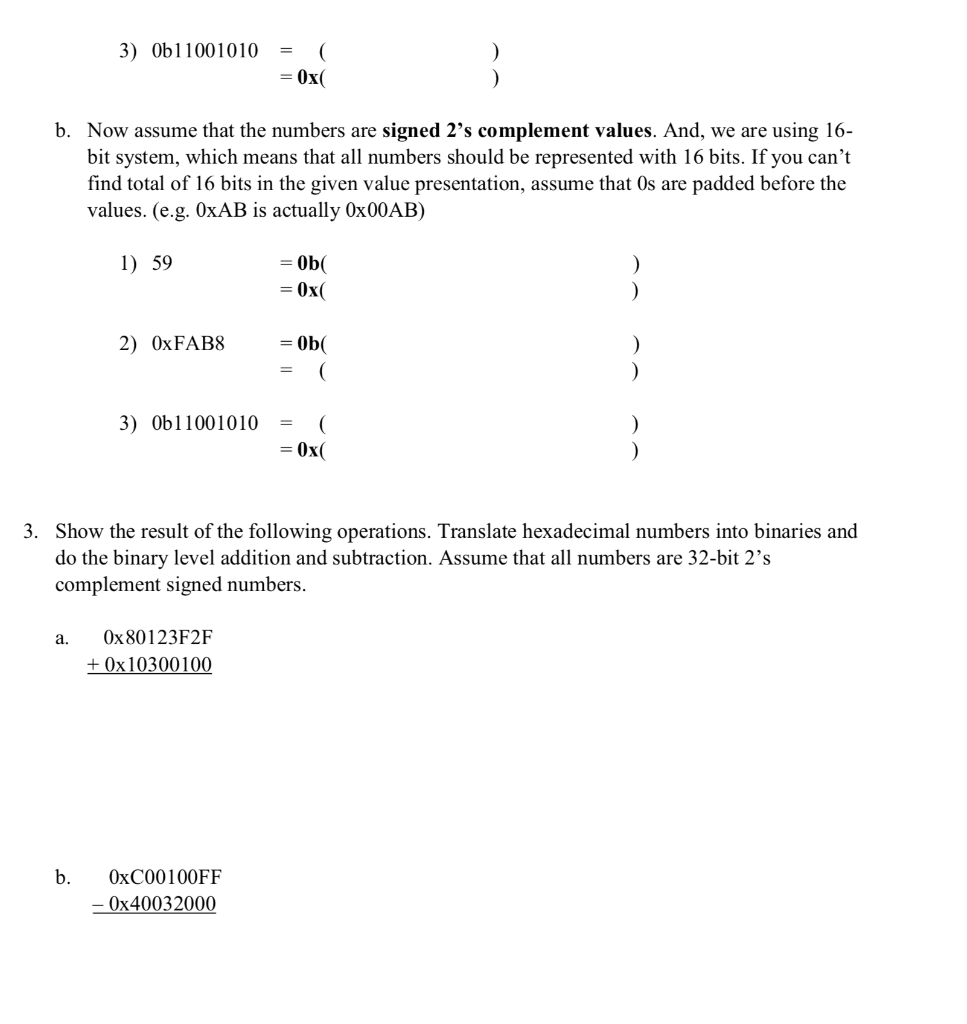
Flow of Program Execution (10pts) 1. In the class, we explored how a program is executed by using a register file. Fill the blanks to map the location of the specified items. You can fill one of the three locations: storage, memory, register file a. Operands of instructions are maintained in ( Files are maintained in ( Local and global variables are maintained in ( b. In ARM Cortex-M3 processor, how many general-purpose registers are provided? And what is the size of each register (number of bits)? Data Representation & ARM Instructions (30pts + 20pts + 40pts) 2. Translate the following numbers into the specified different number systems a. Assume that all numbers are unsigned values. Binary number and hexadecimal number is presented with the prefixes that we discussed in the class. Decimal number doesn't have any prefix 1) 59 =0x 2) 0xAB8 3) 0b11001010 - b. Now assume that the numbers are signed 2's complement values. And, we are using 16- bit system, which means that all numbers should be represented with 16 bits. If you can't find total of 16 bits in the given value presentation, assume that Os are padded before the values. (e.g. OxAB is actually 0x00AB) 1) 59 2) 0xFAB8 - Ob( 3) 0b11001010 3. Show the result of the following operations. Translate hexadecimal numbers into binaries and do the binary level addition and subtraction. Assume that all numbers are 32-bit 2's complement signed numbers a. 0x80123F2F +0x10300100 b. 0xC00100FF 0x40032000
Step by Step Solution
There are 3 Steps involved in it

Get step-by-step solutions from verified subject matter experts
 Study Help