


Question: Flowchart for Products P, Q, R [Inverted triangles represent purchased parts / raw materials consumed per unit; process steps at different workstations are denoted by
Flowchart for Products P, Q, R [Inverted
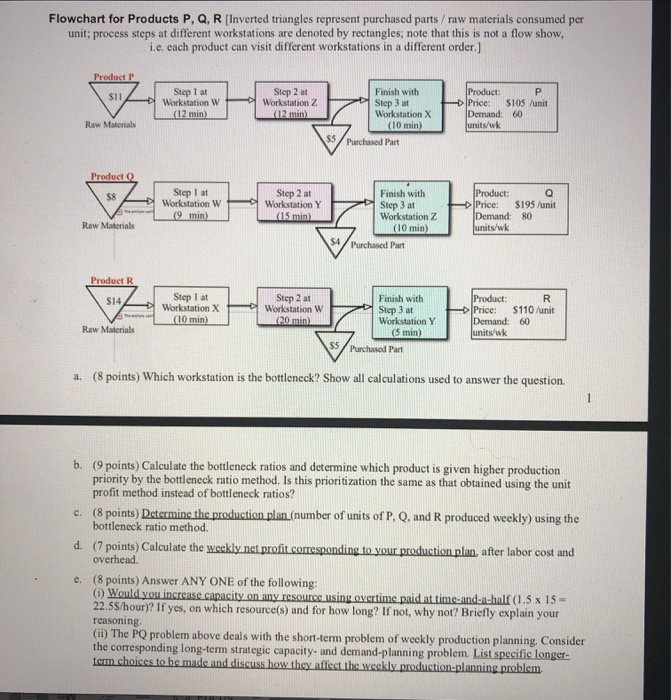
Flowchart for Products P, Q, R [Inverted triangles represent purchased parts / raw materials consumed per unit; process steps at different workstations are denoted by rectangles; note that this is not a flow show, i.e. cach product can visit different workstations in a different order.] Product P SII Step 1 at -Workstation W (12 min) Step 2 at Finish with Workstation 2 Step 3 at (12 min) Workstation X (10 min) $5/Purchased Part Product: P Price: SIOS /unit Demand: 60 unitswk Raw Materials Product $8 Step I at Workstation W (9 min) Step 2 at Workstation Y (15 min) Finish with Step 3 at Workstation 2 (10 min) Purchased Part Product: Q -Price: $195 /unit Demand: 80 units/wk Raw Materials $4 Product R $14 Step 1 at Workstation X (10 min) Step 2 at Workstation W (20 min) Finish with Step 3 at Workstation Y (5 min) Purchased Part Product: R Price: $110/unit Demand: 60 units/wk Raw Materials $5 a. (8 points) Which workstation is the bottleneck? Show all calculations used to answer the question. b. (9 points) Calculate the bottleneck ratios and determine which product is given higher production priority by the bottleneck ratio method. Is this prioritization the same as that obtained using the unit profit method instead of bottleneck ratios? c. (8 points) Determine the production plan (number of units of P, Q, and R produced weekly) using the bottleneck ratio method. d. (7 points) Calculate the weekly net profit corresponding to your production plan, after labor cost and overhead e. (8 points) Answer ANY ONE of the following: (1) Would you increase capacity on any resource using overtime paid at time-and-a-half (1.5 x 15 - 22.5$/hour)? If yes, on which resource(s) and for how long? If not, why not? Briefly explain your reasoning (ii) The PQ problem above deals with the short-term problem of weekly production planning. Consider the corresponding long-term strategic capacity and demand-planning problem. List specific longer- term choices to be made and discuss how they affect the weekly production planning

Step by Step Solution

There are 3 Steps involved in it

1 Expert Approved Answer
Step: 1 Unlock blur-text-image

Question Has Been Solved by an Expert!

Get step-by-step solutions from verified subject matter experts

Step: 2 Unlock
Step: 3 Unlock

Students Have Also Explored These Related General Management Questions!