







Question: flowing through it. The pressure difference across the pipe is 5 psi a. What is the shear stress at the wall of the pipe in
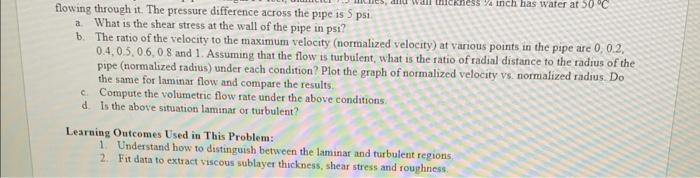
flowing through it. The pressure difference across the pipe is 5 psi a. What is the shear stress at the wall of the pipe in psi? b. The ratio of the velocity to the maximum velocity (normalized velocity) at various points in the pipe are 0,0.2, 0.4,0.5,0.6,08 and 1. Assuming that the flow is turbulent, what is the ratio of radial disfance to the radrus of the pipe (normalized radius) under each condition? Plot the graph of normalized velocity vs. normalized radius. Do the same for laminar flow and compare the results. c. Compute the volumetric flow rate under the above conditions. d Is the above situation laminar or turbulent? Learuing Outcomes Used in This Problem: 1. Understand how to distinguish between the laminar and turbulent regions 2. Fit data to extract viscous sublayer thickness, shear stress and roughness. flowing through it. The pressure difference across the pipe is 5 psi a. What is the shear stress at the wall of the pipe in psi? b. The ratio of the velocity to the maximum velocity (normalized velocity) at various points in the pipe are 0,0.2, 0.4,0.5,0.6,08 and 1. Assuming that the flow is turbulent, what is the ratio of radial disfance to the radrus of the pipe (normalized radius) under each condition? Plot the graph of normalized velocity vs. normalized radius. Do the same for laminar flow and compare the results. c. Compute the volumetric flow rate under the above conditions. d Is the above situation laminar or turbulent? Learuing Outcomes Used in This Problem: 1. Understand how to distinguish between the laminar and turbulent regions 2. Fit data to extract viscous sublayer thickness, shear stress and roughness
Step by Step Solution
There are 3 Steps involved in it

Get step-by-step solutions from verified subject matter experts
 Study Help