







Question: fO D. The statement is true becau e. If lim f() does not exist, then either lim f(X) = co or lim f(x) = -
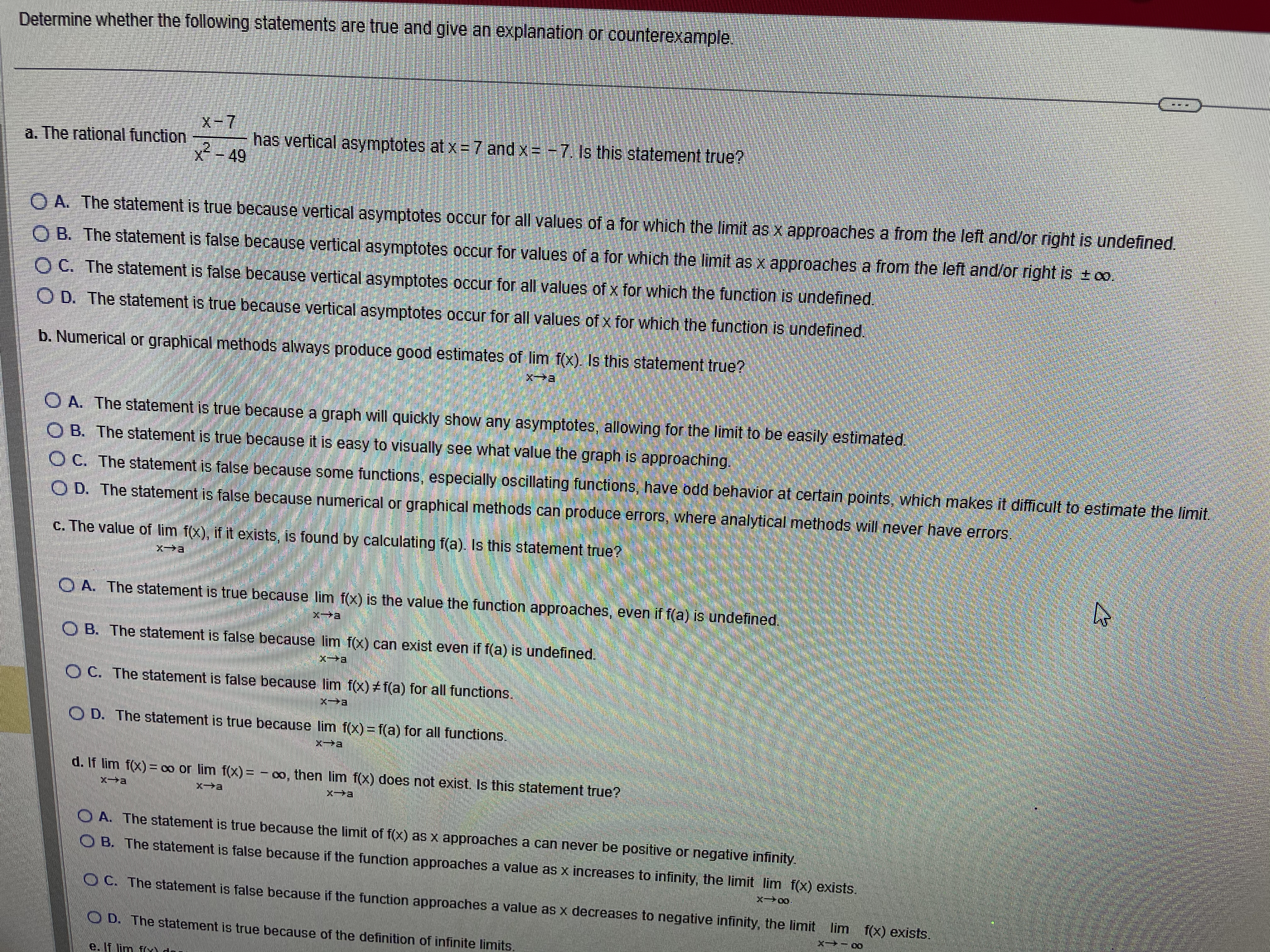
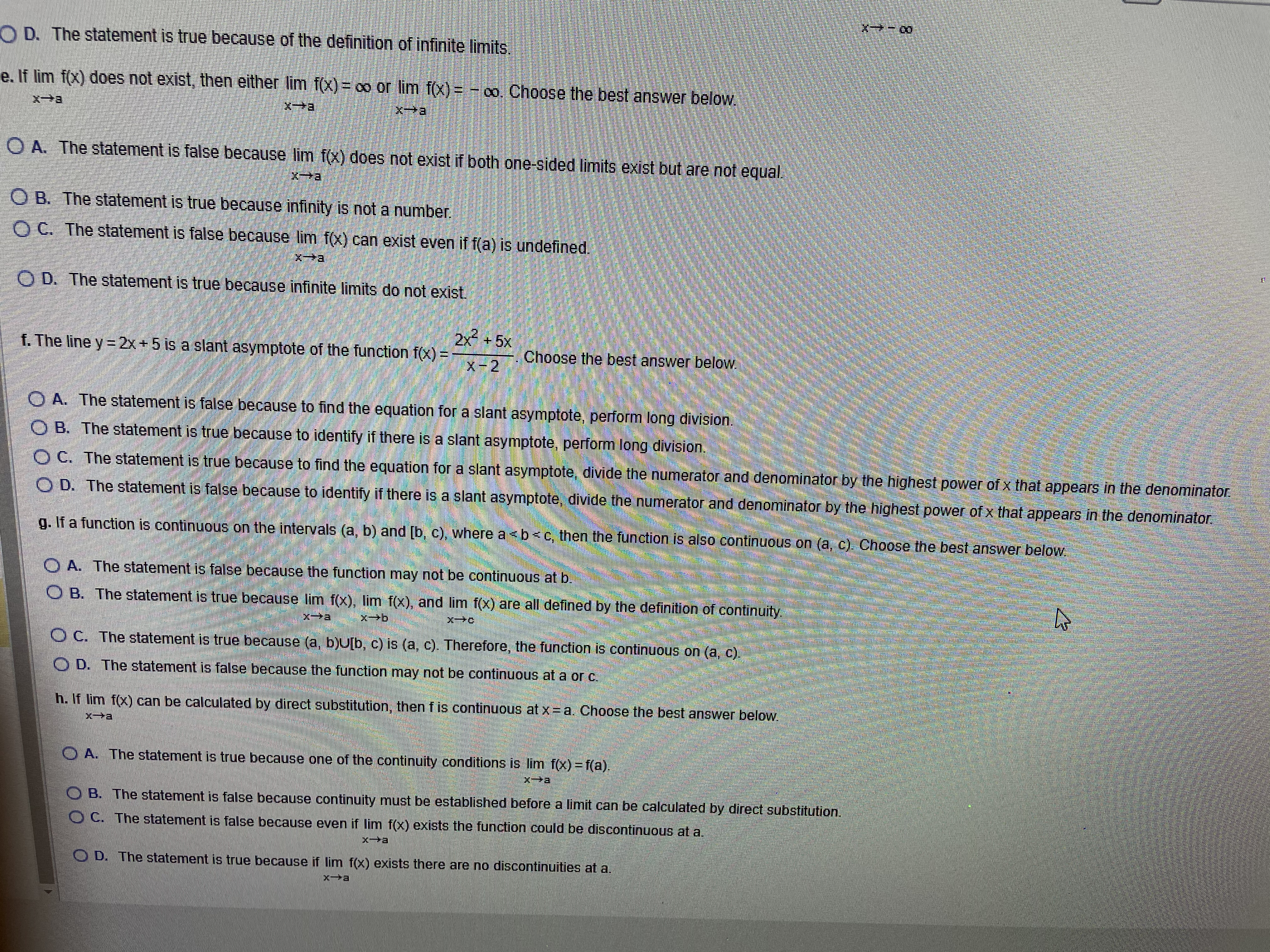
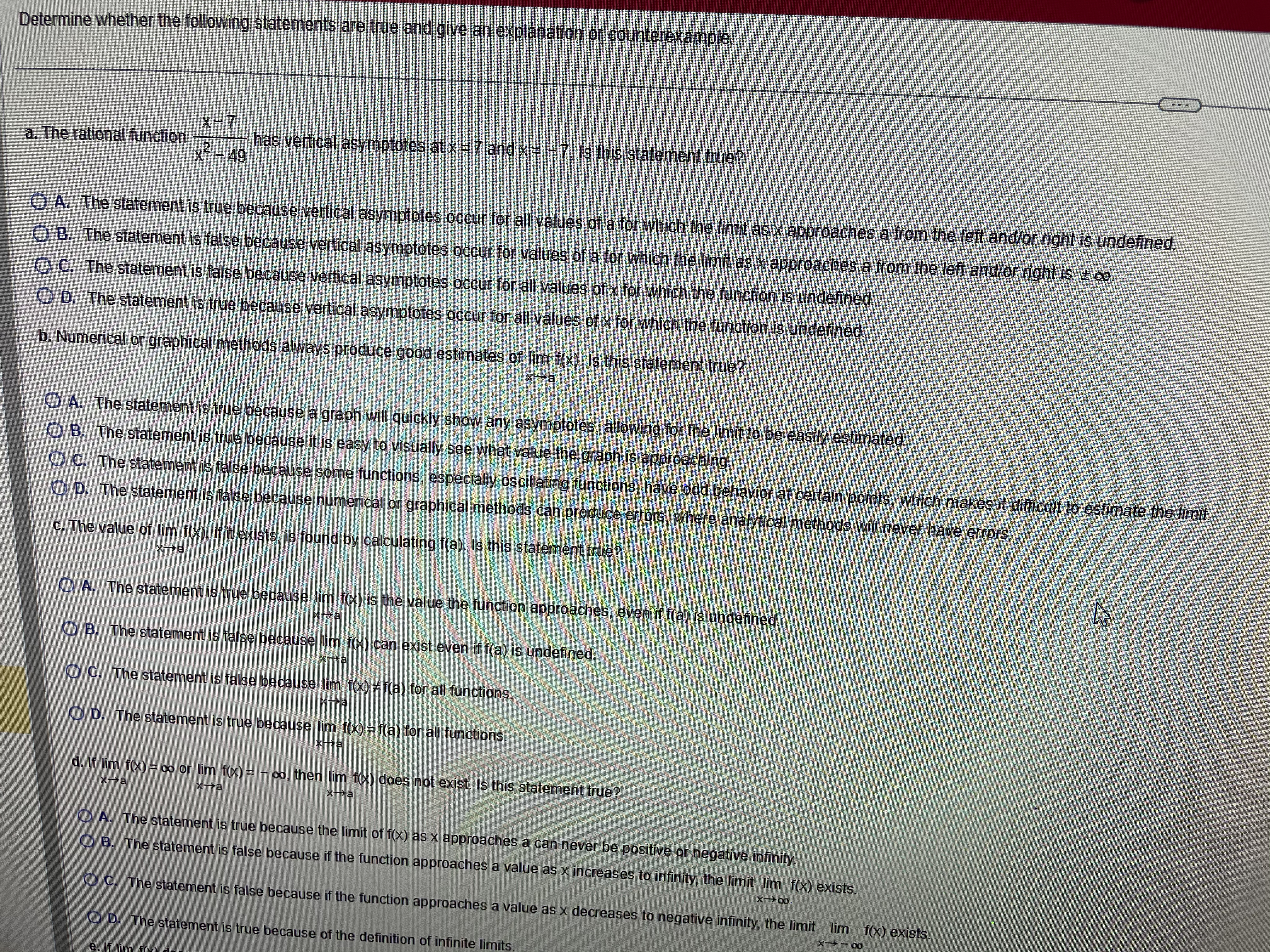
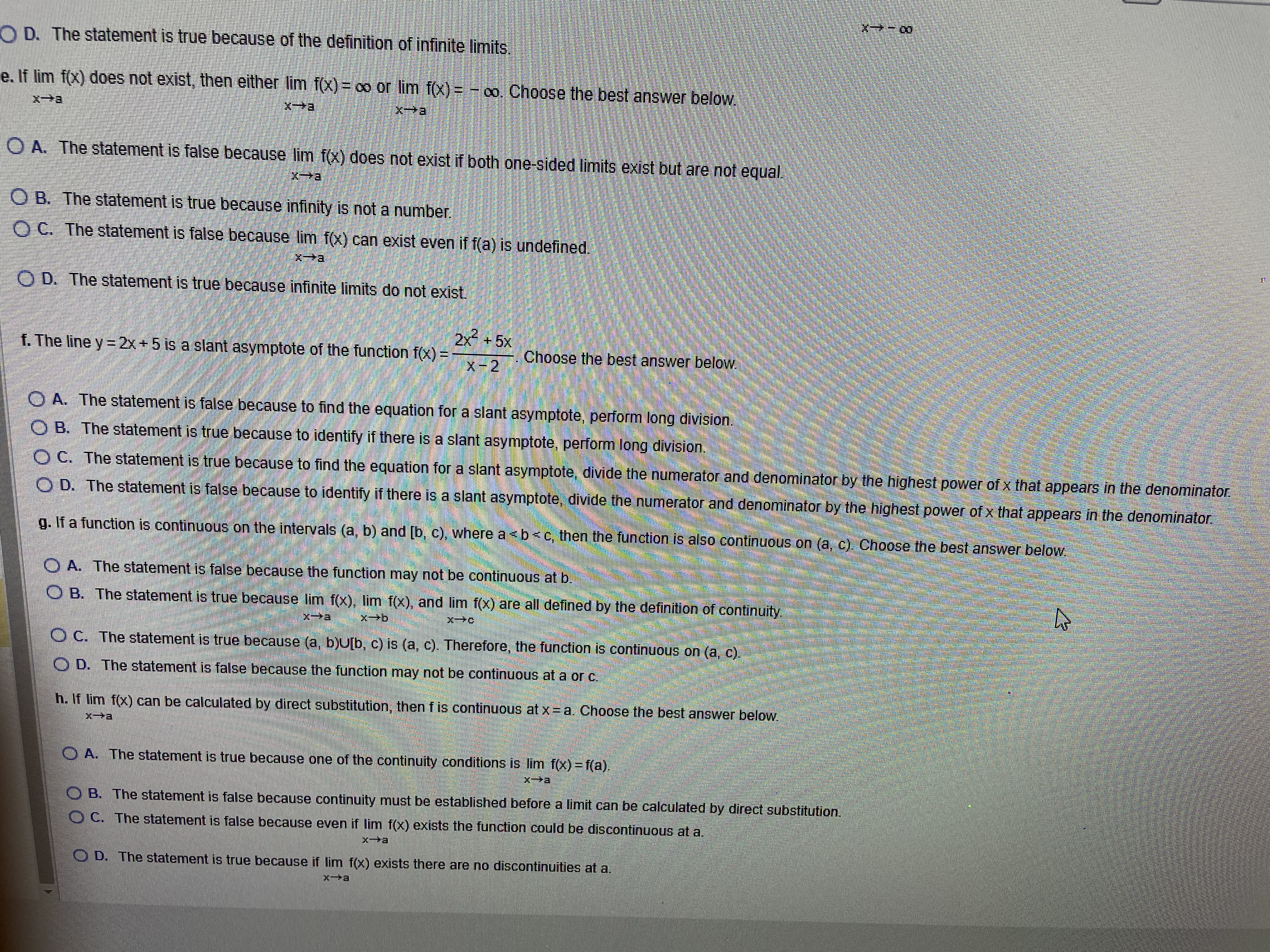
\fO D. The statement is true becau e. If lim f() does not exist, then either lim f(X) = co or lim f(x) = - co. Choose the best answer below O A. The statement is false because lim f(x) does not exist if both one-sided limits exist but are not equal. O B. The statement is true because infinity is not a number. O C. The statement is false because lim f(x) can exist even if f(a) is undefined. x-+3 O D. The statement is true because infinite limits do not exist. f. The line y = 2x + 5 is a slant asymptote of the function f(x) = 2x* + 5x x - 2 Choose the best answer below O A. The statement is false because to find the equation for a slant asymptote, perform long division. O B. The statement is true because to identify if there is a slant asymptote, perform long division. O C. The statement is true because to find the equation for a slant asymptote, divide the numerator and denominator by the highest power of x that appears in the denominator. D. The statement is false because to identify if there is a slant asymptote, divide the numerator and denominator by the highest power of x that appears in the denominator. g. If a function is continuous on the intervals (a, b) and [b, c), where a
Step by Step Solution
There are 3 Steps involved in it

Get step-by-step solutions from verified subject matter experts
 Study Help