







Question: Focused for decades on things as diverse as tools for oil and gas drillers, highpowered lasers and state-of-the-art speaker systems, the De Beers scientists at
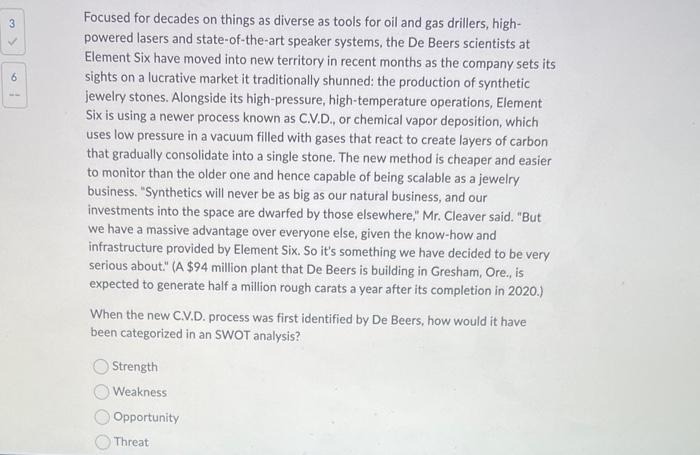
Focused for decades on things as diverse as tools for oil and gas drillers, highpowered lasers and state-of-the-art speaker systems, the De Beers scientists at Element Six have moved into new territory in recent months as the company sets its sights on a lucrative market it traditionally shunned: the production of synthetic jewelry stones. Alongside its high-pressure, high-temperature operations, Element Six is using a newer process known as C.V.D., or chemical vapor deposition, which uses low pressure in a vacuum filled with gases that react to create layers of carbon that gradually consolidate into a single stone. The new method is cheaper and easier to monitor than the older one and hence capable of being scalable as a jewelry business. "Synthetics will never be as big as our natural business, and our investments into the space are dwarfed by those elsewhere," Mr. Cleaver said. "But we have a massive advantage over everyone else, given the know-how and infrastructure provided by Element Six. So it's something we have decided to be very serious about." (A $94 million plant that De Beers is building in Gresham, Ore., is expected to generate half a million rough carats a year after its completion in 2020.) When the new C.V.D. process was first identified by De Beers, how would it have been categorized in an SWOT analysis? Strength Weakness Opportunity Threat
Step by Step Solution
There are 3 Steps involved in it

Get step-by-step solutions from verified subject matter experts
 Study Help