







Question: Following the example started in class for 2D planar conduction heat transfer within a rectangular domain. Calculate the total rate of heat flow (in Watts)
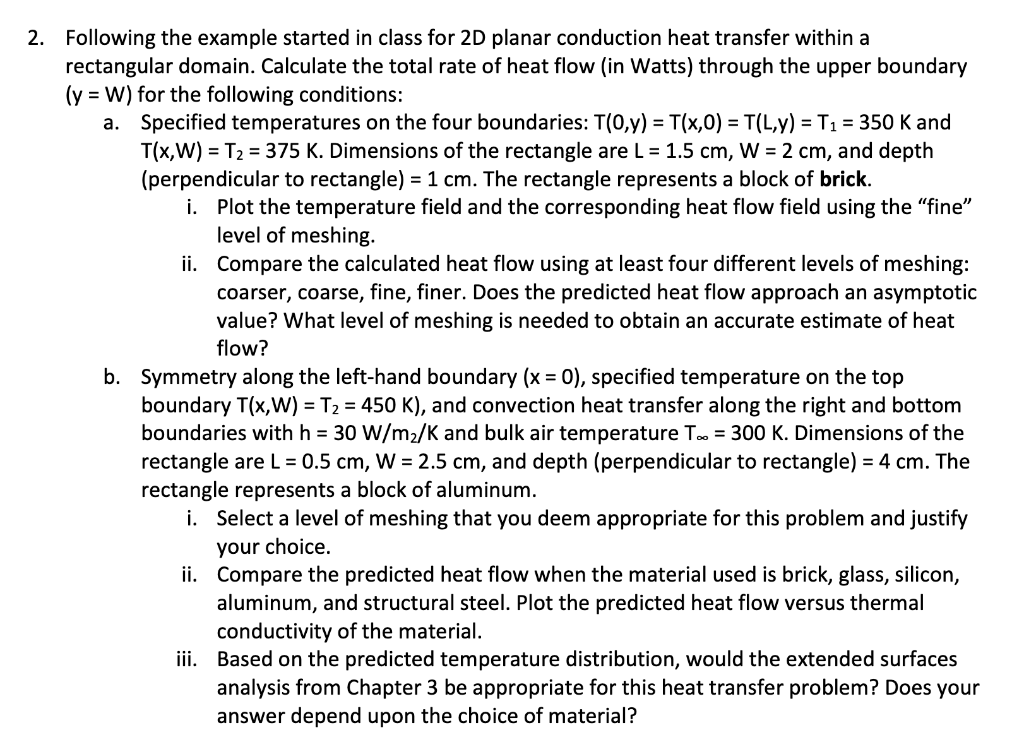
Following the example started in class for 2D planar conduction heat transfer within a rectangular domain. Calculate the total rate of heat flow (in Watts) through the upper boundary (y=W) for the following conditions: a. Specified temperatures on the four boundaries: T(0,y)=T(x,0)=T(L,y)=T1=350K and T(x,W)=T2=375K. Dimensions of the rectangle are L=1.5cm,W=2cm, and depth (perpendicular to rectangle) =1cm. The rectangle represents a block of brick. i. Plot the temperature field and the corresponding heat flow field using the "fine" level of meshing. ii. Compare the calculated heat flow using at least four different levels of meshing: coarser, coarse, fine, finer. Does the predicted heat flow approach an asymptotic value? What level of meshing is needed to obtain an accurate estimate of heat flow? b. Symmetry along the left-hand boundary (x=0), specified temperature on the top boundary T(x,W)=T2=450K), and convection heat transfer along the right and bottom boundaries with h=30W/m2/K and bulk air temperature T=300K. Dimensions of the rectangle are L=0.5cm,W=2.5cm, and depth (perpendicular to rectangle) =4cm. The rectangle represents a block of aluminum. i. Select a level of meshing that you deem appropriate for this problem and justify your choice. ii. Compare the predicted heat flow when the material used is brick, glass, silicon, aluminum, and structural steel. Plot the predicted heat flow versus thermal conductivity of the material. iii. Based on the predicted temperature distribution, would the extended surfaces analysis from Chapter 3 be appropriate for this heat transfer problem? Does your answer depend upon the choice of material? Following the example started in class for 2D planar conduction heat transfer within a rectangular domain. Calculate the total rate of heat flow (in Watts) through the upper boundary (y=W) for the following conditions: a. Specified temperatures on the four boundaries: T(0,y)=T(x,0)=T(L,y)=T1=350K and T(x,W)=T2=375K. Dimensions of the rectangle are L=1.5cm,W=2cm, and depth (perpendicular to rectangle) =1cm. The rectangle represents a block of brick. i. Plot the temperature field and the corresponding heat flow field using the "fine" level of meshing. ii. Compare the calculated heat flow using at least four different levels of meshing: coarser, coarse, fine, finer. Does the predicted heat flow approach an asymptotic value? What level of meshing is needed to obtain an accurate estimate of heat flow? b. Symmetry along the left-hand boundary (x=0), specified temperature on the top boundary T(x,W)=T2=450K), and convection heat transfer along the right and bottom boundaries with h=30W/m2/K and bulk air temperature T=300K. Dimensions of the rectangle are L=0.5cm,W=2.5cm, and depth (perpendicular to rectangle) =4cm. The rectangle represents a block of aluminum. i. Select a level of meshing that you deem appropriate for this problem and justify your choice. ii. Compare the predicted heat flow when the material used is brick, glass, silicon, aluminum, and structural steel. Plot the predicted heat flow versus thermal conductivity of the material. iii. Based on the predicted temperature distribution, would the extended surfaces analysis from Chapter 3 be appropriate for this heat transfer problem? Does your answer depend upon the choice of material
Step by Step Solution
There are 3 Steps involved in it

Get step-by-step solutions from verified subject matter experts
 Study Help