



Question: For a generic reaction. aA+bBCC+dD Consider your answer to Part B in Question 6 . the rate expression would be written as: rate=k(A)in[B)n1 A will
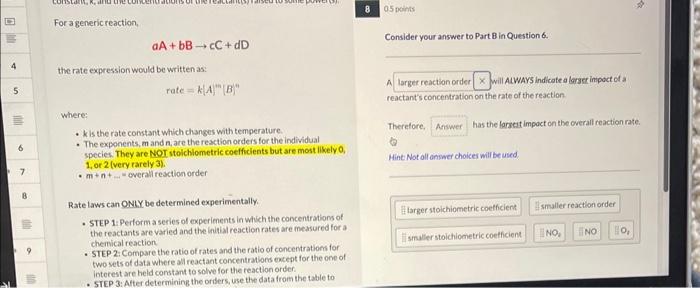
For a generic reaction. aA+bBCC+dD Consider your answer to Part B in Question 6 . the rate expression would be written as: rate=k(A)in[B)n1 A will ALWAYs indicatea larser inpoct of a reactant's concentration on the rate of the reaction. where: - k is the rate constant which changes with temperature. - The exponents, m and n, are the reaction orders for the individual species. They are NOI stoichlometric coefficients but are most likely 0 . 1, or 2 (very tarely 3 ). - m+n+= overall reaction order Rate laws can ONtY be determined experimentally. - STEP 1: Perform a series of experienents in wisch the concentrations of the reactants are varied and the initial reaction rates are ineasured for a chemical reaction. - STEP2: Compare the ratio of rates and the ratio of concentrations for two sets of data where all reactant concentrations except for the one of intecest are held constant to solve for the reaction order. - SrEP.3:After determining the orders use the data from the table to
Step by Step Solution
There are 3 Steps involved in it

Get step-by-step solutions from verified subject matter experts