







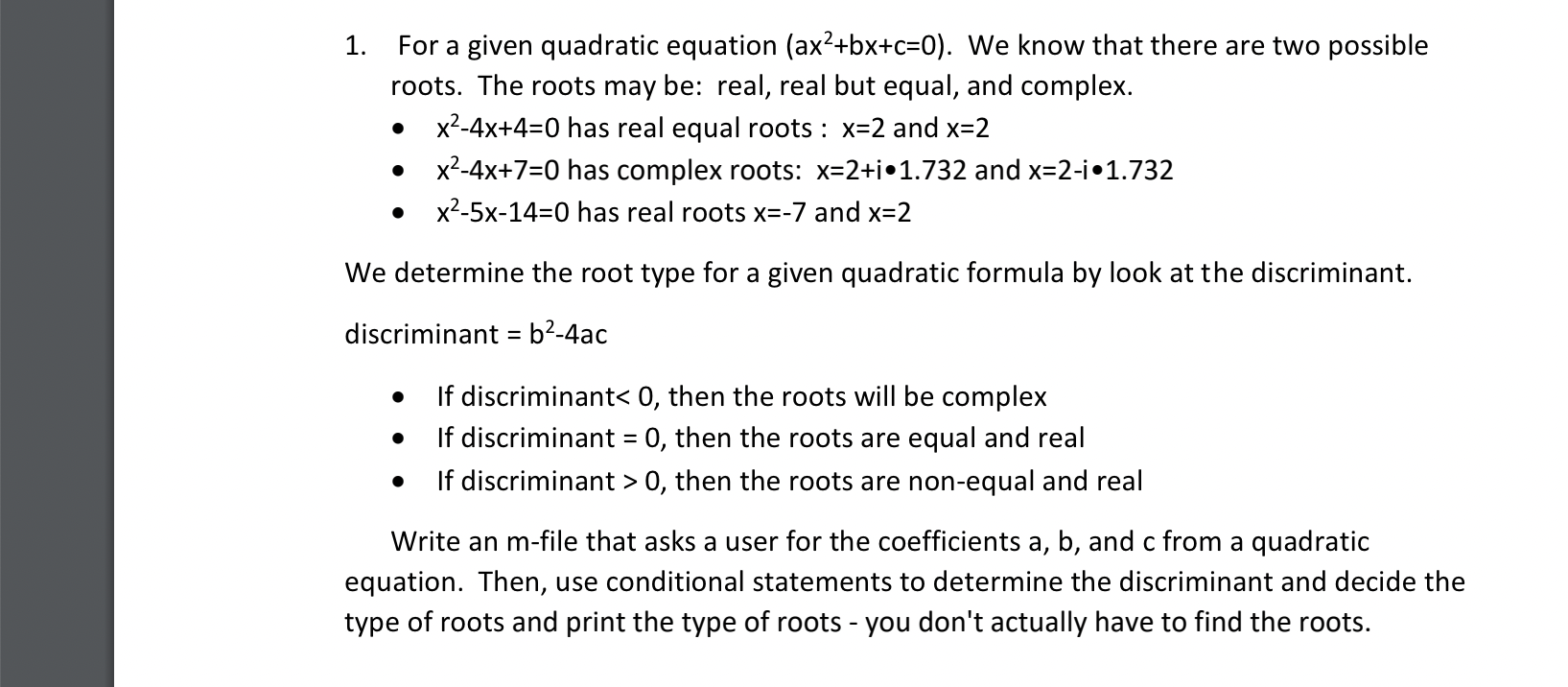
Question: For a given quadratic equation ( a x 2 + b x + c = 0 ) . We know that there are two possible
For a given quadratic equation We know that there are two possible
roots. The roots may be: real, real but equal, and complex.
has real equal roots : and
has complex roots: and
has real roots and
We determine the root type for a given quadratic formula by look at the discriminant.
discriminant
If discriminant then the roots will be complex
If discriminant then the roots are equal and real
If discriminant then the roots are nonequal and real
Write an file that asks a user for the coefficients and c from a quadratic
equation. Then, use conditional statements to determine the discriminant and decide the
type of roots and print the type of roots you don't actually have to find the roots.
Step by Step Solution
There are 3 Steps involved in it
1 Expert Approved Answer
Step: 1 Unlock

Question Has Been Solved by an Expert!
Get step-by-step solutions from verified subject matter experts
Step: 2 Unlock
Step: 3 Unlock
 Study Help