







Question: For a typical particle size distribution ( refer previous homework ) , compute the outdoor air PM 1 0 and PM 2 . 5 concentrations
For a typical particle size distribution refer previous homework compute the
outdoor air PM and PM concentrations in mu g m Assume that the particle density is
uniform with size at g cm
from previous home work answer that I got are
PMmu gm
PMmu gm
b Consider a simple model of particles in indoor air. The indoor environment is
represented as a single wellmixed reactor. The only source of particles in this model
is outdoor air. Air flows through the building at a rate lambda v QV h bringing
particles in from outside and also removing particles that are inside. Particles are also
lost from indoor air by deposition onto room surfaces, with a rate constant beta h
Given the parameters lambda v and beta derive an expression for the steady state ratio of
indoor to outdoor particle concentration, CiC
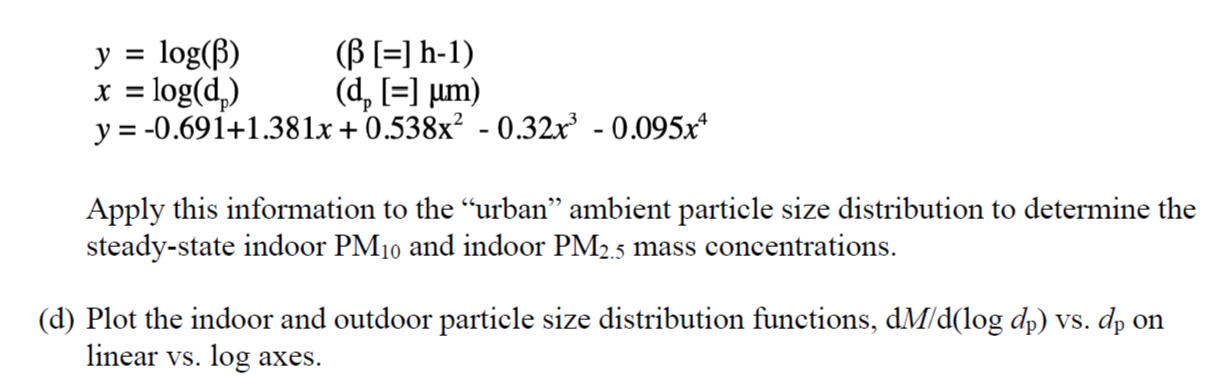
c For residential buildings, assume lambda v of h The deposition loss rate is a strong
function of particle size, and is reasonably represented by the following expressions:
Step by Step Solution
There are 3 Steps involved in it
1 Expert Approved Answer
Step: 1 Unlock

Question Has Been Solved by an Expert!
Get step-by-step solutions from verified subject matter experts
Step: 2 Unlock
Step: 3 Unlock
 Study Help