







Question: Part 2: The Size Distribution Function Because the number of different diameters of particles in a polluted atmosphere can be so large, scientists assume that
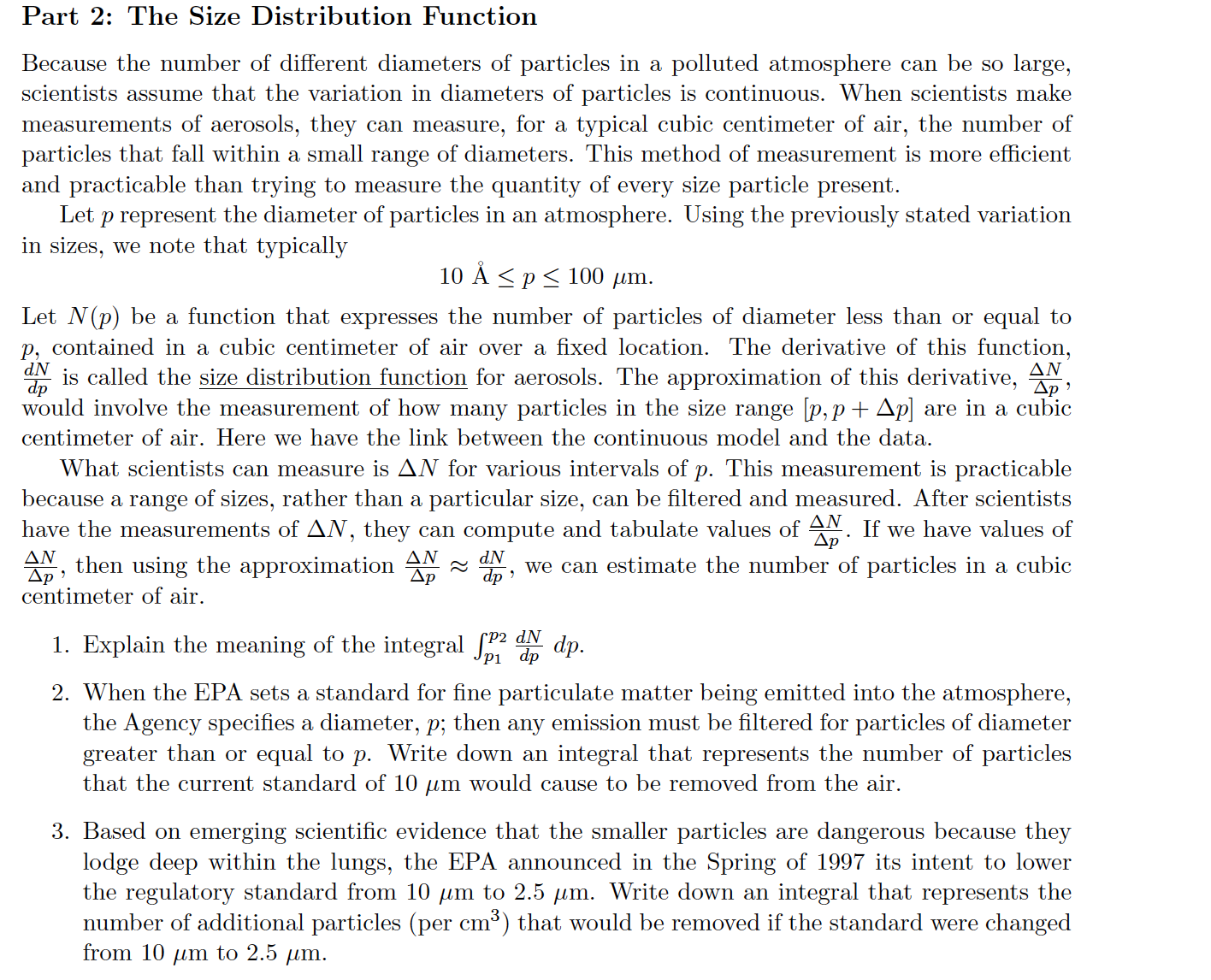
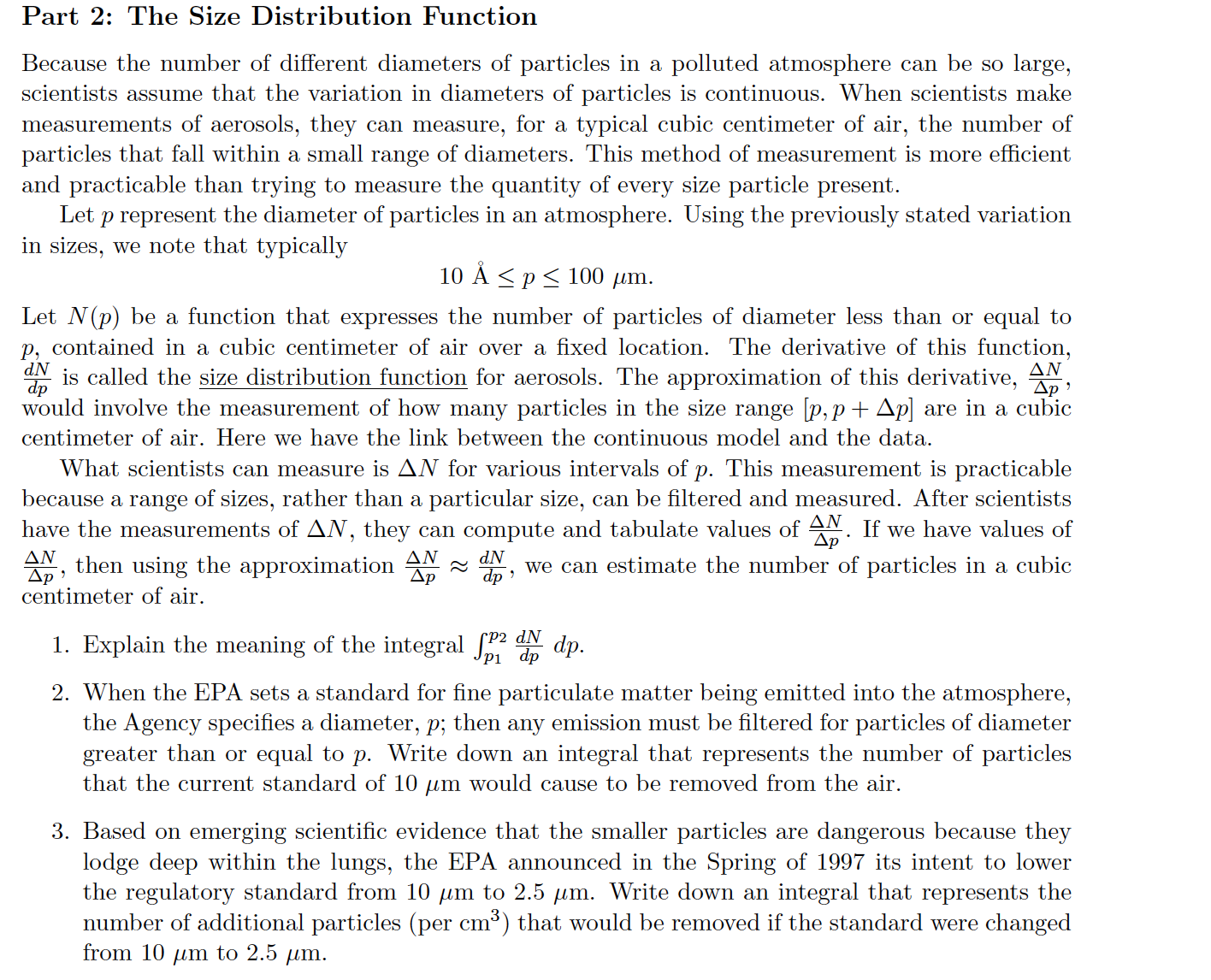
Part 2: The Size Distribution Function Because the number of different diameters of particles in a polluted atmosphere can be so large, scientists assume that the variation in diameters of particles is continuous. When scientists make measurements of aerosols, they can measure, for a typical cubic centimeter of air, the number of particles that fall within a small range of diameters. This method of measurement is more efcient and practicable than trying to measure the quantity of every size particle present. Let p represent the diameter of particles in an atmosphere. Using the previously stated variation in sizes, we note that typically 10Ap100um. Let N (p) be a function that expresses the number of particles of diameter less than or equal to p, contained in a cubic centimeter of air over a xed location. The derivative of this function, % is called the size distribution function for aerosols. The approximation of this derivative, %, would involve the measurement of how many particles in the size range [10,10 + Ap] are in a cubic centimeter of air. Here we have the link between the continuous model and the data. What scientists can measure is AN for various intervals of p. This measurement is practicable because a range of sizes, rather than a particular size, can be ltered and measured. After scientists have the measurements of AN, they can compute and tabulate values of %. If we have values of M then using the approximation M % we can estimate the number of particles in a cubic AP ' A? tip ' centimeter of air. 1. Explain the meaning of the integral f5: % tip. 2. When the EPA sets a standard for ne particulate matter being emitted into the atmosphere, the Agency species a diameter, p; then any emission must be ltered for particles of diameter greater than or equal to p. Write down an integral that represents the number of particles that the current standard of 10 um would cause to be removed from the air. 3. Based on emerging scientic evidence that the smaller particles are dangerous because they lodge deep within the lungs, the EPA announced in the Spring of 1997 its intent to lower the regulatory standard from 10 pm to 2.5 pm. Write down an integral that represents the number of additional particles (per cm3) that would be removed if the standard were changed from 10 um to 2.5 pm
Step by Step Solution
There are 3 Steps involved in it

Get step-by-step solutions from verified subject matter experts
 Study Help