



Question: For a, what is the output? For b, what would changing to the static binding do to the output? Consider the following Python program: class
For a, what is the output?
For b, what would changing to the static binding do to the output?
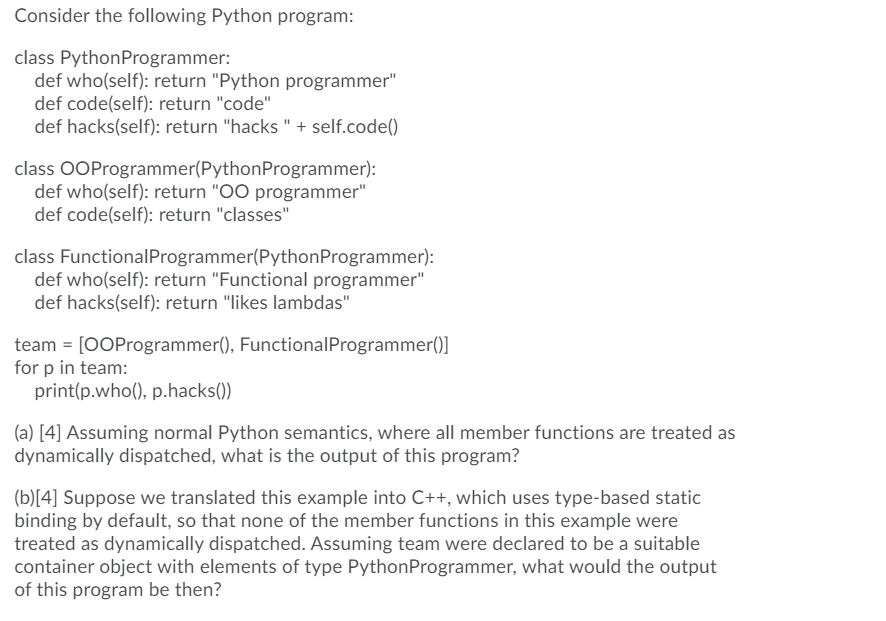
Consider the following Python program: class Python Programmer: def who(self): return "Python programmer" def code(self): return "code" def hacks(self): return "hacks " + self.code() class OOProgrammer(Python Programmer): def who(self): return "OO programmer" def code(self): return "classes" class Functional Programmer(Python Programmer): def who(self): return "Functional programmer" def hacks(self): return "likes lambdas" team = [OOProgrammer(), Functional Programmer()] for p in team: print(p.who(), p.hacks()) (a) [4] Assuming normal Python semantics, where all member functions are treated as dynamically dispatched, what is the output of this program? (b)[4] Suppose we translated this example into C++, which uses type-based static binding by default, so that none of the member functions in this example were treated as dynamically dispatched. Assuming team were declared to be a suitable container object with elements of type Python Programmer, what would the output of this program be then
Step by Step Solution
There are 3 Steps involved in it

Get step-by-step solutions from verified subject matter experts