







Question: For all the questions below, we fix an n-dimensional Hilbert space H. For any 1-qubit gate U, we let U denote U applied to
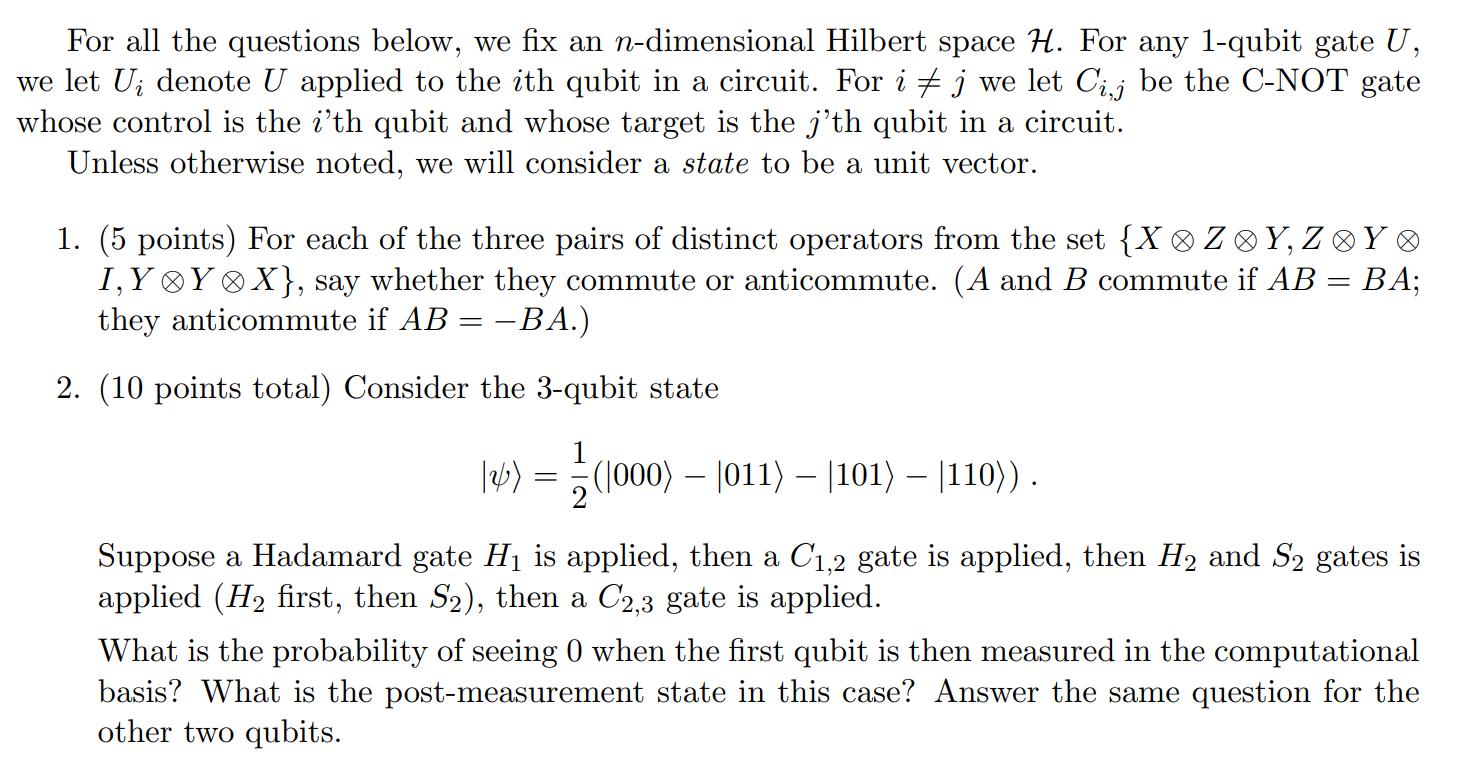
For all the questions below, we fix an n-dimensional Hilbert space H. For any 1-qubit gate U, we let U denote U applied to the ith qubit in a circuit. For i j we let Ci,j be the C-NOT gate whose control is the i'th qubit and whose target is the j'th qubit in a circuit. Unless otherwise noted, we will consider a state to be a unit vector. 1. (5 points) For each of the three pairs of distinct operators from the set {XOZOY, ZOY I,YOYOX}, say whether they commute or anticommute. (A and B commute if AB = BA; they anticommute if AB = BA.) 2. (10 points total) Consider the 3-qubit state 1 |) = (1000) 1011) |101) [110)) . Suppose a Hadamard gate H is applied, then a C1,2 gate is applied, then H and S2 gates is applied (H first, then S), then a C2,3 gate is applied. What is the probability of seeing 0 when the first qubit is then measured in the computational basis? What is the post-measurement state in this case? Answer the same question for the other two qubits.
Step by Step Solution
3.50 Rating (163 Votes )
There are 3 Steps involved in it

Get step-by-step solutions from verified subject matter experts
 Study Help