







Question: For Assignment 1. Please answer the following Case Study: Just provide the answers of the following questions asked in the case study CHAPTER 14. DEVELOPING
For Assignment 1. Please answer the following Case Study: Just provide the answers of the following questions asked in the case study 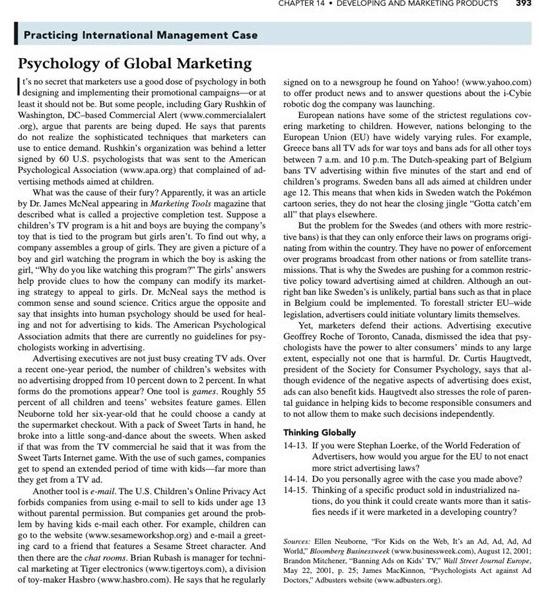
CHAPTER 14. DEVELOPING AND MARKETING PRODUCTS 393 Practicing International Management Case Psychology of Global Marketing t's no secret that marketers use a good dose of psychology in both designing and implementing their promotional campaigns or at least it should not be. But some people, including Gary Rushkin of Washington, DC-based Commercial Alert (www.commercialalert org), argue that parents are being duped. He says that parents do not realize the sophisticated techniques that marketers can use to entice demand. Rushkin's organization was behind a letter signed by 60 U.S. psychologists that was sent to the American Psychological Association (www.apa.org) that complained of ad- vertising methods aimed at children. What was the cause of their fury? Apparently, it was an article by Dr. James McNeal appearing in Marketing Tools magazine that described what is called a projective completion test. Suppose a children's TV program is a hit and boys are buying the company's toy that is tied to the program but girls aren't. To find out why, a company assembles a group of girls. They are given a picture of a boy and girl watching the program in which the boy is asking the girl, "Why do you like watching this program?" The girls' answers help provide clues to how the company can modify its market- ing strategy to appeal to girls. Dr. McNeal says the method is common sense and sound science. Critics argue the opposite and say that insights into human psychology should be used for heal- ing and not for advertising to kids. The American Psychological Association admits that there are currently no guidelines for psy chologists working in advertising Advertising executives are not just busy creating TV ads. Over a recent one-year period, the number of children's websites with no advertising dropped from 10 percent down to 2 percent. In what forms do the promotions appear? One tool is games. Roughly 55 percent of all children and teens' websites feature games. Ellen Neuborne told her six-year-old that he could choose a candy at the supermarket checkout. With a pack of Sweet Tarts in hand, he broke into a little song-and-dance about the sweets. When asked if that was from the TV commercial he said that it was from the Sweet Tarts Internet game. With the use of such games, companies get to spend an extended period of time with kids-far more than they get from a TV ad Another tool is e-mail. The U.S. Children's Online Privacy Act forbids companies from using e-mail to sell to kids under age 13 without parental permission. But companies get around the prob- lem by having kids e-mail each other. For example, children can go to the website (www.sesameworkshop.org) and e-mail a greet- ing card to a friend that features a Sesame Street character. And then there are the chat rooms. Brian Rubash is manager for techni- cal marketing at Tiger electronics (www.tigertoys.com), a division of toy-maker Hasbro (www.hasbro.com). He says that he regularly signed on to a newsgroup he found on Yahoo! (www.yahoo.com) to offer product news and to answer questions about the i-Cybie robotic dog the company was launching European nations have some of the strictest regulations cov ering marketing to children. However, nations belonging to the European Union (EU) have widely varying rules. For example, Greece bans all TV ads for war toys and bans ads for all other toys between 7 a.m. and 10 p.m. The Dutch-speaking part of Belgium bans TV advertising within five minutes of the start and end of children's programs, Sweden bans all ads aimed at children under age 12. This means that when kids in Sweden watch the Pokmon cartoon series, they do not hear the closing jingle "Gotta catch'em all" that plays elsewhere. But the problem for the Swedes (and others with more restric- tive bans) is that they can only enforce their laws on programs ongi nating from within the country. They have no power of enforcement over programs broadcast from other nations or from satellite trans- missions. That is why the Swedes are pushing for a common restric- tive policy toward advertising aimed at children. Although an out- right ban like Sweden's is unlikely, partial bans such as that in place in Belgium could be implemented. To forestall stricter EU-wide legislation, advertisers could initiate voluntary limits themselves. Yet, marketers defend their actions. Advertising executive Geoffrey Roche of Toronto, Canada, dismissed the idea that psy chologists have the power to alter consumers' minds to any large extent, especially not one that is harmful. Dr. Curtis Haugtvedt, president of the Society for Consumer Psychology, says that al- though evidence of the negative aspects of advertising does exist, ads can also benefit kids. Haugtvedt also stresses the role of paren- tal guidance in helping kids to become responsible consumers and to not allow them to make such decisions independently. Thinking Globally 14-13. If you were Stephan Loerke, of the World Federation of Advertisers, how would you argue for the EU to not enact more strict advertising laws? 14-14. Do you personally agree with the case you made above? 14-15. Thinking of a specific product sold in industrialized na tions, do you think it could create wants more than it satis- fies needs if it were marketed in a developing country? Source: Ellen Neuboene. For Kids on the Web. It's an Ad Ad Ad Ad World." Bloomberg Businessweek (www.businessweek.com). August 12, 2001 Brandon Mitchener. "Banning Ads on Kids' TV." Wall Street Journal Europe, May 22. 2001. p. 25. James MacKinnon, "Psychologists Act against Ad Doctors." Adbusters website (www.adbusters.org) Step by Step Solution
There are 3 Steps involved in it
1 Expert Approved Answer
Step: 1 Unlock

Question Has Been Solved by an Expert!
Get step-by-step solutions from verified subject matter experts
Step: 2 Unlock
Step: 3 Unlock
 Study Help