







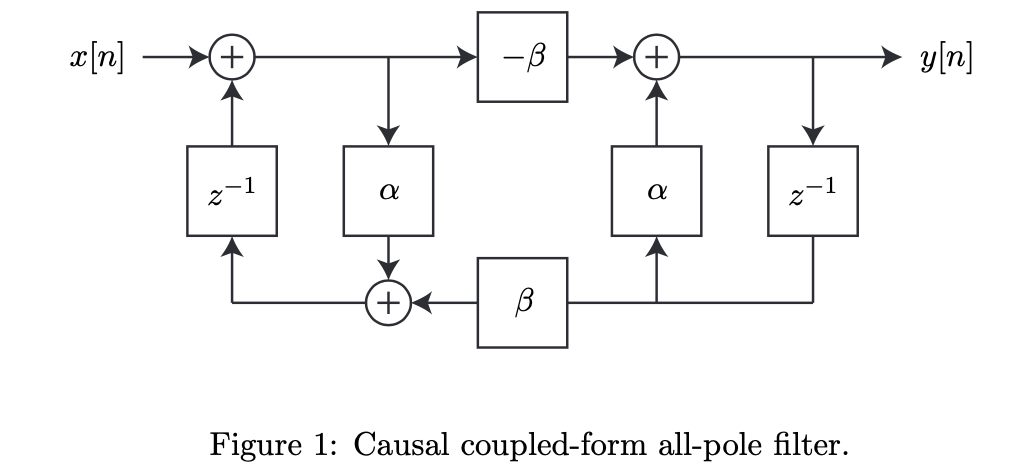
Question: For both questions below, consider the causal coupled-form all-pole filter shown in Fig. 1 with transfer function (a). Suppose we wish to realize the transfer
For both questions below, consider the causal coupled-form all-pole filter shown in Fig. 1 with transfer function

(a). Suppose we wish to realize the transfer function 
for some positive constant c. Solve for and such that this transfer function is realized in the coupled-form shown in Fig. 1.
MY ANSWER:  = 0.475 and =0.8227. Please feel free to use these numbers or calculate to double check, then solve part B.
(b). Use your (unquantized) values for and from problem (a) and assume all non-unity products in this realization are immediately rounded before any additions are done. Insert round-off noise sources at appropriate locations in the coupled-form flow-graph of Fig. 1 to model the effect of the rounding error. Assuming each multiplier generates independent rounding error noise with variance 2B, compute the total noise power at the output. Your answer should be in the form 2y = 2B for some positive value of .
Please answer both parts, thank you!
[n] + -B + yn a a z + B Figure 1: Causal coupled-form all-pole filter. H(-) = j 1- 0.952-1 + 0.90252-2 (1 0.95e-z-1)(1 0.95e-72-1) [n] + -B + yn a a z + B Figure 1: Causal coupled-form all-pole filter. H(-) = j 1- 0.952-1 + 0.90252-2 (1 0.95e-z-1)(1 0.95e-72-1)
Step by Step Solution
There are 3 Steps involved in it

Get step-by-step solutions from verified subject matter experts
 Study Help